Joaquin Aldana

  • New slang words this week: October 26 to November 1, 2026

    New slang words this week: October 26 to November 1, 2026

    This week, Dictionary.com named “maxxing” its 2026 Word of the Year, “unc” made its shortlist, and TikTok spent Halloween week saying “booooo” and pulling on black skull caps. Below are the eight terms I saw most this week, with what each one means, where it came from, an example of how people use it, and whether it’s worth learning.

    WeekOct 26 to Nov 1, 2026
    Headline wordmaxxing
    Biggest memethe Boo trend
    Last checkedOctober 29, 2026

    How I picked this week’s words

    I only included a term if a credible source showed it being used, searched or written about during the last few weeks. Then I graded each source the way I’d grade a tip from a stranger.

    • Official: Dictionary.com’s Word of the Year announcement, which came out on Monday, October 26. This is a dictionary publisher’s own data and lexicographers.
    • Trend research: YPulse, a youth research firm that publishes a regular viral-trends newsletter. Reliable for what’s spreading, less so for exact origins.
    • Community documentation: Know Your Meme, which logs meme histories with dated example posts. Good for timelines. Its origin claims are only as strong as the posts it can find.
    • Creators and anonymous accounts: teacher-creators on TikTok and trend-spotting accounts on X. These are useful early signals, but I don’t treat them as proof alone.

    I left out slurs, sexual terms and anything that started as a put-down of a group of people. There’s a short section near the end explaining what I skipped and why.

    What you need before you start

    You don’t need to be on TikTok to follow this guide. A few things do help, though:

    • A rough idea of the two generations involved. Gen Alpha, to be clear, is the generation that was born between 2010 and 2024. Gen Z is the group just older than that, roughly today’s late teens to late twenties.
    • Patience with absurdity. A lot of 2025 and 2026 slang is meant to be a bit meaningless. Last year’s winner proved that: Dictionary.com called 6-7 “classic brainrot slang” that is “purposefully nonsensical and all about being in on the absurdity.”
    • A reliable reference. When a word shows up in the news, check the dictionary’s own explanation before you trust a comment section.
    • Five minutes of real listening. Notice the tone a word is said in before you look it up. Slang means whatever its tone says.

    1. Maxxing

    Maxxing Word of the Year
    Wordmaxxing
    Part of speechNoun, verb, suffix
    SaysMAK-sing (/ˈmæksɪŋ/)
    Earliest traced2015 (looksmaxxing)

    Meaning: Doing something as fully as you can, or tuning one part of your life as far as it’ll go.

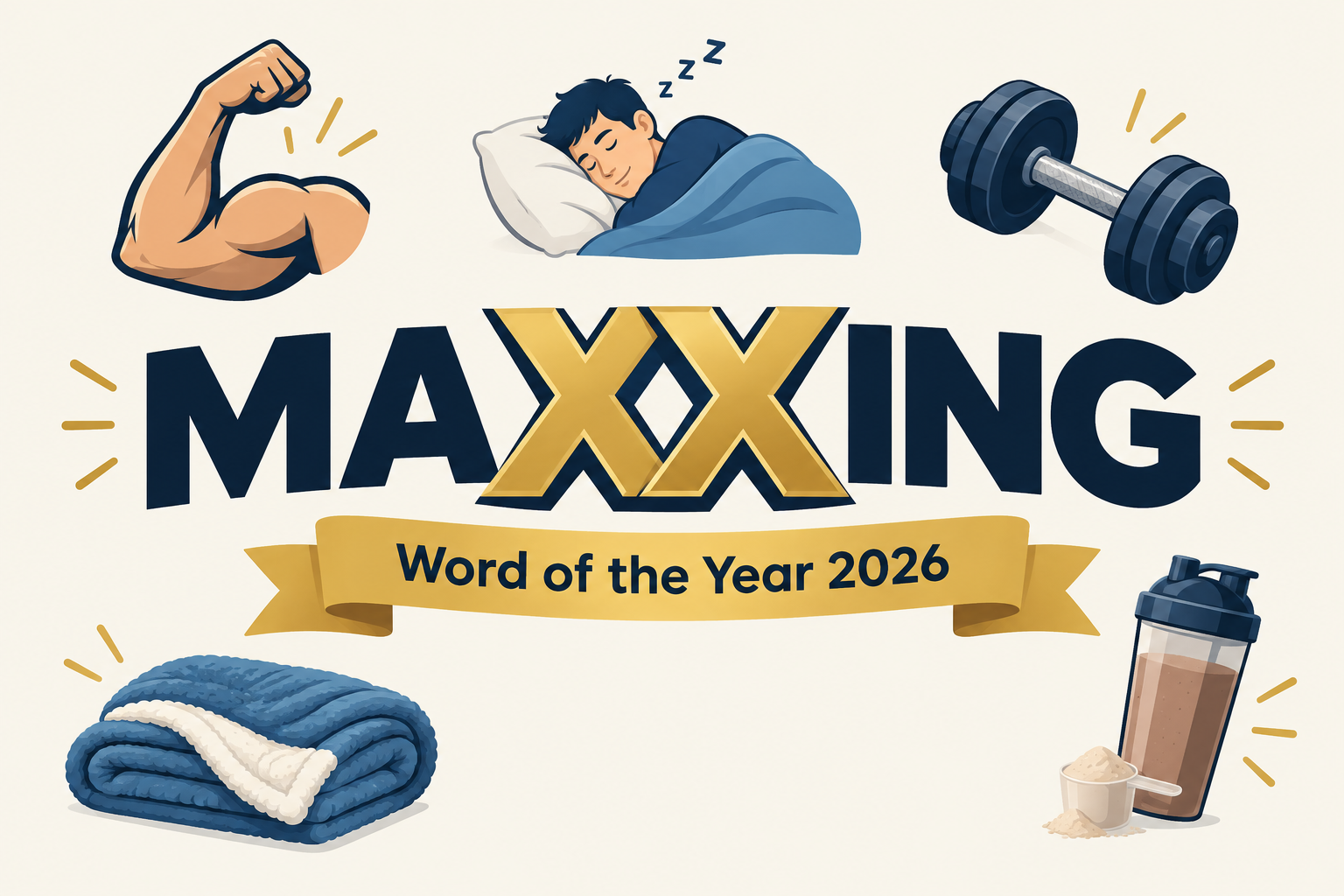
    This was the big one this week. Dictionary.com has named “maxxing” its 2026 Word of the Year. Short for “maximizing,” maxxing is a slang term that can stand alone or attach to almost any other word to describe doing something as fully and intensely as possible, according to Dictionary.com. Its formal definition calls it “the practice of pursuing an activity to the fullest or optimizing a certain aspect of your life,”

    The numbers behind the pick are real. Digital media used the term nearly 19 times more in August 2026 than in the average month of 2025, according to Dictionary.com’s report. The variation “looksmaxxing” alone rose more than 1,000% in media coverage since the start of the year, while “tokenmaxxing” grew alongside the AI boom.

    How people use it

    Most of the time it’s a suffix glued onto a noun:

    • “I’m sleepmaxxing this week. Phone goes in the kitchen at ten.”
    • “Saturday is cozymaxxing only. Blanket, soup, zero plans.”
    • “Our manager keeps pushing us to tokenmaxx, so now every email gets run through an AI tool.”

    It’s increasingly showing up on its own, too. Dictionary.com notes that in standalone use, “‘Maxxing’ functions as a verb, with something as its object, rather than as part of a longer word.” I’d write that as “I’m maxxing my last week of summer break.”

    Where it came from

    The term’s origins can be drawn back to the expression “maxing out a credit card” (exceeding assigned credit limit) and video game culture. Gamers already “maxed” stats and characters long before the double-x spelling appeared.

    The double-x version has a darker history. In the 2010s, it spread throughout manosphere and incel subcultures via the term “looksmaxxing”, which means to maximise phycial attractiveness through fitness routines and physical grooming. Dictionary.com’s archived internet data traces examples of “looksmaxxing” to 2015, with terms such as “moneymaxxing” and “statusmaxxing” appearing by 2021. Dictionary.com gives credit to Reddit and other online forums for helping maxxing, and specifically looksmaxxing, grow into the popular social media lingo it is today.

    It got lighter as it spread. By late 2025, The New York Times observed that quasi-serious slang terms (“booksmaxxing,” “proteinmaxxing”) as well as intentionally ridiculous ones (“cozymaxxing,” “salmonmaxxing”) were being tossed around.

    Often confused with

    Maxing (one x) is the older, everyday verb: “I maxed out my card.” Maxxing (two x’s) is the slang suffix. If you mean the internet sense, use both x’s.

    Usage tip

    Sleepmaxxing, cozymaxxing and proteinmaxxing are safe and playful. Looksmaxxing still carries its forum baggage. If a teen is deep into looksmaxxing content, ask what they’re watching rather than laughing it off.

    Related words: mog (to outshine someone), looksmaxxing, tokenmaxxing, cozymaxxing.

    2. Unc

    Wordunc
    Part of speechNoun
    SaysUNK (/ʌŋk/)
    StatusDictionary.com 2026 shortlist

    Meaning: A teasing name for an older person, or anyone who seems out of touch with what’s current.

    Unc was the runner-up you might not know. Maxxing edged out several terms you may be more familiar with (affordability, data center, and odyssey) and another you may not recognize in “unc.” Short for “uncle,” it’s the younger generations who use the term to describe someone they view as “corny or just doesn’t get it.” Dictionary.com compares it to the “OK Boomer” phrase of yore.

    How people use it

    • “You still put two spaces after a period? Okay, unc.”
    • “I said ‘that’s sick’ out loud and my niece just whispered ‘unc status.’”
    • “Unc is explaining Vine to us again.”

    You don’t have to be old to get called unc. A 22-year-old who doesn’t know this month’s meme can earn it from a 13-year-old. It also gets used on yourself, as in “Unc needs a nap.”

    Where it came from

    “Unc” as a short, affectionate way to address an older man has a long history in Black American speech. The mocking “you’re old and don’t get it” sense is the newer, internet-driven layer. I couldn’t find a dated first use for that newer sense, so I won’t guess one.

    Usage tip

    Tone decides everything here. Among friends, unc is light ribbing. Said with a sigh to an actual relative, it can sting a little more than the speaker intends.

    Related words: OK boomer, cringe, “back in my day” (used ironically).

    3. Boo (the Boo trend)

    Wordboo / booooo
    Part of speechInterjection
    SaysBOOOO (dragged out)
    Took offLate September 2026

    Meaning: A stretched-out, deliberately goofy “booooo” said with crossed eyes, used as a joke, a prank and, this week, a Halloween greeting.

    If your kids keep saying “booooo” at you with a strange face, this is why. Know Your Meme, a community-run meme encyclopedia with dated documentation, describes the Boo Trend as a TikTok trend in which users say “boo” while crossing their eyes in mocking reference to the original video, typically making a funny face and moving toward the camera. The trend emerged online sometime around mid-to-late September 2026, spreading from TikTok to other social media platforms like Instagram.

    It grew into a prank format. The trend is commonly used as a prank by tricking people, especially boyfriends or family members, into performing the embarrassing trend alongside them and then only recording and posting their participation. The view counts got big fast. One post from October 6th, 2026 received over 2.6 million views and 641,300 likes in roughly one week.

    Teacher-creator Mr. Lindsay, whose weekly Gen Alpha slang videos are a well-followed community signal, covered “Booooooo” in a TikTok as recently as this week. A small trend-spotting account on X, @early404, went further on October 24, claiming the face had become the unofficial Halloween 2026 greeting, with the TikTok trend racking up millions of views since early October. The post itself drew only 424 views. That fits what I’m seeing, but treat the “official greeting” label as one account’s opinion.

    How people use it

    • “My little brother said we’d both do the boo thing, then posted only my half.”
    • “Teacher walked in and the whole back row went ‘booooo.’”
    • “Trick-or-treaters this year don’t say ‘trick or treat.’ They just boo you.”

    Often confused with

    “Boo” as a pet name (my boo, you do you, boo) is a completely separate, much older word. The Boo trend is a sound and a face, not a term of affection.

    4. Skull cap (the Skull Cap trend)

    Wordskull cap
    Part of speechNoun
    SaysSKULL kap
    Took offMid-October 2026

    Meaning: A plain black beanie that, in this TikTok joke, instantly turns an awkward person into a brooding, overconfident one.

    This is a meme format more than a new word, but “skull cap” has picked up a new meaning online. Know Your Meme defines it as a TikTok trend in which users depict a comedic transformation from an exaggerated awkward appearance to a confident persona after putting on a black skull cap. Clips use a before-and-after setup, timed to the beat drop in Bryson Tiller’s verse from DJ Khaled’s song “Wild Thoughts” featuring Rihanna.

    The Skull Cap meme trend gained popularity on TikTok in mid-October 2026. There is no one identifiable originator of the trend, and appears to have developed organically in accordance with similar memes featuring dramatic glow ups. An early documented clip from October 16 received 7.4 million views and 286,400 likes in 11 days. Another from October 18 received 12.8 million views and 2.3 million likes in 9 days.

    The caption that people now repeat as a phrase is “How dudes act 0.01 seconds after putting on a skull cap.” The joke lies in the over-the-top nature of the transformation, which treats the hat as if it can instantly change someone’s entire demeanor and attractiveness. While some creators play the format straight, others use it ironically to mock the trend itself.

    How people use it

    • “He put the beanie on and his whole personality changed. Classic skull cap moment.”
    • “Do the skull cap one with the dog.”
    • “Mom bought me a skull cap for winter and now I can’t wear it without my sister humming the song.”

    Usage tip

    In the trend, “skull cap” just means a close-fitting black knit beanie. No skulls, filters or face effects are involved. If a parent searches “skull cap filter,” they’re probably looking for the hard cut on the beat drop.

    5. 🍟✌️ (the fries emoji)

    Word🍟 (often with ✌️)
    Part of speechEmoji reply
    MeansWrap it up
    ReportedOctober 2026

    Meaning: A reply that tells someone they’re being corny, embarrassing or going on too long.

    Emoji count as slang when they carry a meaning the dictionary doesn’t give them. Yahoo reported this one in mid-October: The French fries emoji (🍟), sometimes accompanied by a peace sign (✌️), has become a way for Gen Alpha to tell someone they’re being corny, embarrassing, or simply talking too much. Think of it as the emoji equivalent of telling someone to wrap it up.

    The same report says the joke isn’t entirely new. It’s the latest evolution of a meme that’s been circulating online for years. I couldn’t confirm the exact chain from older meme to emoji, so I’m leaving the deeper origin as unconfirmed.

    How people use it

    • Friend sends a three-paragraph rant about a video game patch. Reply: “🍟✌️”
    • “Bro sent me 🍟✌️ after my birthday speech. Rude.”
    • In comments under an overlong storytime video: “🍟🍟🍟”

    Often confused with

    A plain 🍟 under a food video usually just means fries. The insult reading needs context: a reply to something long or cringey, often paired with the peace sign.

    6. Fridge cigarette

    Wordfridge cigarette
    Part of speechNoun
    SaysFRIJ sig-uh-RET
    Went viral2025 TikTok

    Meaning: A cold can of soda, especially Diet Coke, treated as a small daily ritual you can’t quite give up.

    This one isn’t new, but it was back in the news this week. Yahoo reported that Coca-Cola’s CEO dislikes the nickname. Merriam-Webster defines “fridge cigarette” as “a cold, refreshing, and addictive soft drink,” noting that it’s especially used to refer to Diet Coke.

    The phrase first gained traction with Gen Z through a viral TikTok video in 2025, which has nearly 4 million views. Using the image of a cigarette break, it describes the ritual: the crack of the can, a short pause in the workday, the “I need this” feeling.

    How people use it

    • “Two-minute break. Going out back for a fridge cigarette.”
    • “Nothing hits like a fridge cigarette after a long shift.”
    • “She has a fridge cigarette at 3 p.m. like clockwork.”

    Usage tip

    It’s office and college slang more than kid slang, and it’s affectionate. It doesn’t mean anyone is smoking. It’s a joke about how habit-forming the soda ritual feels.

    7. Polyester

    Wordpolyester
    Part of speechAdjective (slang)
    SaysPOL-ee-es-ter
    Took offAugust 2026

    Meaning: Cheap, mass-produced, fake or unoriginal, usually aimed at a lifestyle or a piece of content.

    YPulse flagged this in August and recapped it in its newsletter this week. The latest slang making the rounds on socials is “polyester,” which Gen Z is using to describe something that feels cheap, mass-produced, or just plain inauthentic. In one example the firm cites, a creator posted about using an AI agent to build their “dream adult lifestyle,” and the top comment simply read: “polyester lifestyle” (49.5K likes).

    The metaphor is easy to follow. Polyester is the synthetic fabric that imitates natural fibers, so calling something “polyester” means it’s an imitation. YPulse places it alongside similar insults: The term joins a growing list of internet insults for things that feel generic, from larping and performative to NPC.

    How people use it

    • “That whole 5 a.m. morning routine video felt so polyester.”
    • “Polyester apology. Clearly written by a PR team.”
    • “Her feed went polyester the moment she started taking sponsorships.”

    Often confused with

    Polyester as a fabric is neutral. As slang it’s always a mild insult. “Polyester vibes” is a dig, never a compliment.

    8. Quiet on the creek

    Wordquiet on the creek
    Part of speechPhrase
    SaysKWY-ut on the KREEK
    Took offJuly 2026

    Meaning: Keep it low-key, say nothing, don’t draw attention.

    This phrase has staying power. It’s been in kids’ vocabulary since summer and was still showing up in school-hallway slang this autumn. The viral phrase comes from a clip of rapper Saucy Santana during a TikTok Live, where he recalled fishing as a kid and told someone off-camera, “You gotta be real quiet on the creek.” Gen Z, of course, took the line and gave it entirely new meaning. Now, it describes any situation that requires someone to be extra lowkey.

    The usual full form is “you gotta be real quiet on the creek.” Credit goes to Saucy Santana and to the TikTok users who remixed his line into a catchphrase.

    How people use it

    • “Got the job but I’m staying quiet on the creek till Monday.”
    • “Sneaking snacks into the movie? Real quiet on the creek.”
    • “We’re planning her surprise party, so everybody be quiet on the creek.”

    Usage tip

    It works best for small secrets and sneaky moments. Using it for something serious makes it sound oddly flippant.

    Still in rotation: the holdovers you’ll keep hearing

    None of these are new this week, but they keep coming up, and the guides that rank for this topic all cover them. Here’s the short version of each.

    Chud

    Searches for this one spiked across 2026. It comes from the 1984 movie “C.H.U.D.,” which stands for cannibalistic humanoid underground dwellers, explains content creator Mr. Lindsay. Now, kids use it as another way to say “loser.” Example: “Only a chud skips the group project meeting.” Adults online sometimes use it with a more political edge, so the tone can change depending on the platform.

    Aura farming

    Aura is your perceived coolness, and farming it means collecting it on purpose. Aura farming, meanwhile, is the act of trying to intentionally cultivate a “cool” persona by performing specific actions. It was on Dictionary.com’s shortlist for 2025 word of the year. The term borrows “farming” from gaming, where you repeat an action to grind resources. Example: “He wore sunglasses indoors for the class photo. Pure aura farming.” The flip side is “minus aura,” for losing cool points in public.

    Crash out

    To crash out is to lose emotional control in spectacular, often public fashion. It comes from Black American slang and rap, and the noun form “crashout” describes the person doing it. Example: “Lost one ranked match and had a full crash out on stream.”

    Based

    “Based” means being unapologetically yourself, especially when you say an opinion out loud. One guide defines it as being confidently authentic, especially when sharing an honest opinion without worrying whether everyone agrees. Its modern positive sense is widely credited to rapper Lil B, who reclaimed what had been an insult. Example: “You admitted you like pineapple on pizza in front of everyone? Based.”

    Pop off

    As praise, pop off means to do brilliantly. When someone pops off, they do really well. They might perform well, post something that gets lots of attention, or simply have a great moment that deserves praise. Older speakers also use “pop off” to mean mouthing off angrily, so check the tone. Example: “She popped off in the second half: 22 points.”

    6-7

    Last year’s Word of the Year refuses to fade. It came from rap and basketball culture. Some trace the term to Skrilla’s 2024 drill song “Doot Doot (6 7).” It has no fixed meaning, and that’s the joke. If a kid shouts “six-seven” and does the palms-up weighing gesture, the right response is usually to sigh.

    Words I left out on purpose

    Some of 2026’s most-searched terms don’t belong in a family-friendly roundup. “Gooning” tops several lists, but most of its meanings are sexual, so I’m not defining it here. “Foid” is a misogynistic insult that came from incel forums. “Huzz” has derogatory roots, even though younger kids now use it for a crush.

    If you hear any of these from a child, the meaning they intend is often milder than the word’s origin. The origin is still worth a calm conversation. Parenting writers have flagged the pattern too: some newer Gen Alpha slang also originated in the toxic online manosphere. That includes “mog” and the looksmaxxing branch of maxxing.

    How to decode a new slang word in 5 steps

    Next week there’ll be new words. This is the routine I use to figure out a term I’ve never seen before.

    1. Write down the exact spelling and the context. “Maxxing” and “maxing” are different words. “Boo” as a sound and “boo” as a nickname are too. The surrounding sentence usually narrows down the meaning before you search.
    2. Check whether it’s a word or a meme format. Skull cap and Boo are formats with a sound and a visual. Polyester and unc are actual vocabulary. Formats fade faster.
    3. Find the source community. Ask whether it came from gaming, AAVE, a rapper’s clip, fandom, or a forum. That tells you the tone and whether there’s baggage. If you like tracing the etymology of a word, this is the fun part.
    4. Grade what you find. A dictionary announcement beats a meme encyclopedia, and a meme encyclopedia with dated posts beats a random explainer site. An anonymous account’s claim is a lead, not a fact.
    5. Listen once more before using it. Hear the word in two or three real conversations or comment threads. If the tone matches your reading, you’ve got it.

    Common mistakes I see adults make

    • Using the word to sound young. Using slang awkwardly is how you earn “unc.” Understanding a word is plenty. You don’t have to adopt it.
    • Taking absurd words literally. 6-7 and Boo aren’t codes. Searching for a hidden meaning in brainrot words usually ends up somewhere strange and wrong.
    • Treating every list as current. Many “2026 slang” pages recycle 2023 words like bussin and gyat. Look for dates and fresh examples.
    • Ignoring the origin. A word can sound playful and still come from somewhere ugly. Looksmaxxing is the clearest example this year.
    • Panicking over the emoji. 🍟✌️ is rude but harmless. Save the worry for words with real red flags.
    • Forgetting regional and platform differences. “Chud” means one thing in a middle-school hallway and something sharper on political X.

    What you should come away with

    After this roundup, you should be able to hear any of these eight terms and know three things:

    • what the speaker means
    • roughly where the term came from
    • whether it’s a passing meme or a word with staying power

    My bet: maxxing and unc will last well into 2027, helped along by the Word of the Year coverage. Polyester and quiet on the creek have already outlived a normal meme cycle. The Boo trend and the skull cap trend are tied to this season and will probably fade by mid-November.

    FAQ

    What is the newest slang word this week?

    The biggest news is “maxxing.” Dictionary.com on Monday revealed its annual top word, giving it to the beloved Gen Z term, “maxxing.” The newest meme-driven terms are the Boo trend and the skull cap trend, both of which took off in the past six weeks.

    What were the other Dictionary.com 2026 finalists?

    “Maxxing” beat four other contenders for Dictionary.com’s word of the year: “affordability”, “data centre”, “odyssey”, and “unc”. Odyssey’s place on the list was linked to Christopher Nolan’s film adaptation of Homer’s epic.

    Is maxxing a bad word?

    No. Most uses, like sleepmaxxing or cozymaxxing, are harmless. The word does have roots in incel and manosphere forums through looksmaxxing, so be careful with that branch.

    Why are kids saying “booooo” with crossed eyes?

    It’s a TikTok trend that started in September 2026. People copy a viral face-and-sound clip, often to prank family members, and this year it doubled as a Halloween greeting.

    What does 🍟✌️ mean in a text?

    It means “wrap it up.” Gen Alpha uses it to tell someone they’re being corny or talking too much.

    Should adults use these words?

    Use them if they come naturally and the tone fits. Otherwise, understanding them is enough. The fastest way to get called unc is to force a word that isn’t yours yet.

  • Supercalifragilisticexpialidocious Meaning, Origin and Spelling

    Supercalifragilisticexpialidocious Meaning, Origin and Spelling

    Supercalifragilisticexpialidocious is a playful English adjective meaning “extraordinarily good” or “wonderful.” It became famous through the 1964 Disney film Mary Poppins, where it is the title of a song by Richard M. and Robert B. Sherman. It is a real, dictionary-listed word, though it began as a piece of nonsense.

    Wordsupercalifragilisticexpialidocious
    Part of speechAdjective
    SaysSOO-per-KAL-ih-FRAJ-ih-LIS-tik-EK-spee-AL-ih-DOH-shus
    Popularised1964, Mary Poppins

    What supercalifragilisticexpialidocious means

    The short definition is “fantastic.” People use it to say something is marvellous, delightful or better than ordinary words can cover.

    The film gives it a second, sillier job. In Mary Poppins, it is presented as the thing to say when you don’t know what to say. That framing explains a lot about how people still use it. It sounds clever and it means very little, and that is the whole joke.

    The Oxford English Dictionary lists it as an adjective. It marks the word as a nonsense formation that people use to express approval, especially in a jokey or childlike way.

    How people use it

    Here are some examples we wrote to show the common patterns:

    • “The cake was supercalifragilisticexpialidocious. I had three slices.”
    • “How was the trip? Honestly? Supercalifragilisticexpialidocious.”
    • “My niece learned to spell supercalifragilisticexpialidocious before she could spell Wednesday.”
    • “The reviews called the show ‘supercalifragilisticexpialidocious,’ which tells you nothing and everything.”

    As the last two examples show, the word often turns up as a word about words. People mention it to show off their spelling or to test a child’s memory. They also use it as shorthand for “very long word.”

    Register and tone

    This is informal, playful English. You will hear it at children’s parties, in theatre reviews and in ironic adult chat. You will not see it in a business report unless someone is making a point.

    Usage tip

    Use it for comic effect or warm enthusiasm. In serious writing it reads as a joke, so pick “superb,” “excellent” or “wonderful” when you need to sound measured.

    How to pronounce it

    The word has 14 syllables. Most people find it easiest to say in small runs, with the strongest stress near the end on “DOH.”

    Region Simple respelling IPA
    American English soo-per-kal-ih-fraj-ih-lis-tik-ek-spee-al-ih-DOH-shus /ˌsuːpərˌkælɪˌfrædʒɪˌlɪstɪkˌɛkspiˌælɪˈdoʊʃəs/
    British English soo-puh-kal-ih-fraj-ih-lis-tik-ek-spee-al-ih-DOH-shus /ˌsuːpəˌkælɪˌfradʒɪˌlɪstɪkˌɛkspɪˌalɪˈdəʊʃəs/

    The main difference is the “r” in “super.” Americans usually pronounce it. Most British speakers drop it. The ending “-docious” rhymes with “precocious” and “atrocious,” which the song uses to great effect.

    How to spell it

    The word is spelled the same way in British and American English. That is a relief compared with words like the British spelling of liter, where the two sides of the Atlantic disagree.

    Break it into chunks and it stops being scary:

    Chunk Letters Running total
    super 5 5
    cali 4 9
    fragil 6 15
    istic 5 20
    expi 4 24
    ali 3 27
    docious 7 34

    Say each chunk out loud as you write it. Most spelling errors happen in the middle, around “expiali.”

    Common misspellings

    These are the slips we see most often:

    • supercalifragilisticexpealidocious (the “i” after “exp” goes missing)
    • supercalifragilisticexpialidoshus (spelled the way it sounds)
    • supercalafragilisticexpialidocious (an “a” sneaks in after “cal”)
    • supercalifragilisticexpialidocious written as “fragilistic” plus a stray extra “l”

    A quick check: the word has seven letter i’s. If you count fewer, something has dropped out.

    Where the word comes from

    The honest answer to “who invented it?” is complicated. The Sherman brothers wrote the song and made the word famous. They did not claim to have made it up from nothing.

    The Sherman brothers and Mary Poppins

    Richard M. Sherman and Robert B. Sherman were Disney staff songwriters. They wrote the songs for Mary Poppins, released in 1964, with Julie Andrews as Mary and Dick Van Dyke as Bert.

    The word does not appear in P. L. Travers’s original Mary Poppins books. The Shermans created the song for the film. In later interviews, they said the word grew out of the double-talk they had heard as boys in the 1930s. Kids at summer camp would toss around long, ridiculous words to sound smart. The brothers shaped that memory into a single word that could carry a song.

    Earlier versions before 1964

    Similar words existed decades before the film. The OED’s editors traced an earlier form to a 1931 column by Helen Herman in the Daily Orange, Syracuse University’s student newspaper. It was spelled “Super-cali-flawjalistic-expialadoshus.” The spelling was different but the sound and shape were clearly related.

    In 1949, songwriters Barney Young and Gloria Parker wrote a song with the title “Supercalafajalistickespeealadojus.” After the film became a hit, Parker and Young sued Disney’s music publishing subsidiary, Wonderland Music, in 1965 for copyright infringement. The suit failed. A key reason was that versions of the word had been around before the 1949 song, so no one could claim to own it.

    That history matters for anyone curious about the etymology of the word. It looks like a single invention but behaves more like folklore. It is a schoolyard sound that circulated for years until a hit film fixed one spelling in place.

    The “atoning for educability” breakdown

    You may have seen this breakdown online:

    • super: above
    • cali: beauty
    • fragilistic: delicate
    • expiali: to atone
    • docious: educable

    Put together, it supposedly means “atoning for educability through delicate beauty.” This is a joke analysis built after the fact. It is a fun party piece, and the Shermans themselves enjoyed playing along with it. It is not how the word was formed. The parts were chosen for sound and rhythm, not meaning.

    What we can say is that “super” works as the familiar intensifying prefix. The ending “-docious” echoes words like “precocious,” and the song leans on that rhyme. Beyond that, the honest label for the middle of the word is nonsense.

    The song in Mary Poppins

    The song arrives in the film’s animated chalk-drawing sequence. Mary has just won a horse race, and a crowd of reporters asks her to describe how she feels. She answers with the word, and the song takes off from there.

    The lyrics play with the idea that saying it loudly makes you sound clever, however odd it sounds. Bert joins in with a cheerful nonsense refrain, and the film even jokes about saying the word backwards. The whole number celebrates sound over sense.

    Julie Andrews and Dick Van Dyke perform it, and it became one of the best-known songs in the Disney catalogue. In 2004, the American Film Institute ranked it at number 36 on its list of the 100 greatest songs in American films. The song also has its own number in the stage musical of Mary Poppins, where the cast spells the word out with gestures.

    Supercalifragilistic and other short forms

    Many people search for “supercalifragilistic,” and it is worth a quick note. It is an informal clipping, the first 20 letters of the full word. People use it when the whole thing feels like too much effort, or for comic timing.

    • “That was supercalifragilistic!”
    • “Your outfit is very supercalifragilistic today.”

    It carries the same meaning, “fantastic,” with the same playful tone. Treat it as slang. It is not the standard form, so spell out the full word when accuracy matters, such as in a spelling bee or a quiz answer.

    You will also hear “supercal” as a nickname for the song itself, mostly among theatre and Disney fans.

    Often confused with

    Supercilious also starts with “super” but means haughty and scornful. The two are unrelated, so a supercilious person is the opposite of a supercalifragilisticexpialidocious one.

    Is it the longest word in English?

    No. It is probably the most famous long word, but several longer words exist. Its 34 letters put it near the top of the list without reaching first place.

    Word Letters Notes
    pneumonoultramicroscopicsilicovolcanoconiosis 45 Lung disease from fine dust; coined in 1935 as a deliberately long word
    hippopotomonstrosesquippedaliophobia 36 Jokey term for fear of long words; not in most major dictionaries
    supercalifragilisticexpialidocious 34 Popularised by Mary Poppins (1964)
    pseudopseudohypoparathyroidism 30 A genuine medical condition
    floccinaucinihilipilification 29 The act of judging something worthless
    antidisestablishmentarianism 28 Opposition to removing a state church
    honorificabilitudinitatibus 27 Used by Shakespeare in Love’s Labour’s Lost

    Chemical names can run far longer than anything in this table, but most word lovers exclude them because they are formulas written out in letters.

    For the record, the top word on that list was itself invented to be long. So “longest word” contests are partly a game with their own rules, and supercalifragilisticexpialidocious plays that game better than most.

    Translations of supercalifragilisticexpialidocious

    The word is usually kept close to the English sound in other languages. Dubbed versions of the film adapt the ending so it fits local grammar and still rhymes.

    Language Version used in the film’s dub Note
    French supercalifragilisticexpidélilicieux Ends with a nod to “délicieux” (delicious)
    German superkalifragilistischexpialigetisch German adjective endings, “k” for “c”
    Italian supercalifragilistichespiralidoso Ends like an Italian adjective in “-oso”
    Spanish supercalifragilisticoespialidoso Adds the “-oso” ending common in Spanish
    Portuguese (Brazil) supercalifragilisticexpialidoce Ends with “doce” (sweet)

    Outside the film, many speakers simply borrow the English word as it is. There is no formal or informal form to worry about, since it is a single playful adjective in every language.

    Word facts at a glance

    For quiz writers and word-game fans, here are the hard numbers. If you mostly play games built on 5 letter words, this one is about seven times too long for a Wordle row.

    Fact Value
    Letters 34
    Syllables 14
    Vowels 16 (i ×7, a ×3, e ×2, o ×2, u ×2)
    Consonants 18
    Distinct letters used 15
    Most frequent letter i (7 times)
    Starts and ends with s
    Film Mary Poppins (1964)
    Songwriters Richard M. Sherman and Robert B. Sherman
    AFI song ranking No. 36 (2004)

    A neat detail: the word begins and ends with “s,” with three in total. That makes the last letter easy to remember once you get past the middle.

    FAQ

    Is supercalifragilisticexpialidocious an actual word?

    Yes. It started as nonsense, but it is now listed in major dictionaries, including the Oxford English Dictionary, as an adjective. A word becomes “real” when people use it widely with a shared meaning, and this one has done that for six decades.

    Is supercalifragilisticexpialidocious actually the longest word?

    No. Pneumonoultramicroscopicsilicovolcanoconiosis has 45 letters, and several other words are longer than 34 letters too. Supercalifragilisticexpialidocious is the best-known long word, which is why people often assume it holds the record.

    Is supercalifragilisticexpialidocious a bad word?

    No. It is completely family-friendly. It comes from a Disney children’s film and means “wonderful.” Nothing hidden in it is rude, despite its length and odd sound.

    What is the longest word for “fantastic”?

    Supercalifragilisticexpialidocious is the longest word in common use that means “fantastic.” Among more ordinary synonyms, “extraordinary” (13 letters) and “magnificent” (11 letters) are good long options that work in serious writing.

    What does supercalifragilistic mean?

    It is a shortened, informal form of the full word and means the same thing: fantastic or wonderful. Use it in casual speech. Spell out the full 34-letter version for anything formal or competitive.

    Who sang Supercalifragilisticexpialidocious?

    Julie Andrews and Dick Van Dyke sang it in Mary Poppins (1964). The song was written by the Sherman brothers, Richard M. and Robert B. Sherman.

  • English to Japanese Translation and the Writing Systems Explained

    English to Japanese Translation and the Writing Systems Explained

    English to Japanese translation means changing words, grammar and politeness all at once. Japanese is written in three scripts, often drops the subject, and expects you to choose a level of formality. Free tools like Google Translate and DeepL handle short, clear text well, and the tips below help you get natural results.

    Word日本語 (nihongo)
    Part of speechNoun
    Saysnee-hohn-goh
    MeansJapanese language

    The three Japanese writing systems

    A single Japanese sentence can mix three scripts. Each has its own job.

    Script Example What it is used for
    Hiragana ひらがな Grammar endings, particles, native words
    Katakana カタカナ Loanwords, foreign names, emphasis
    Kanji 漢字 Nouns and verb stems, borrowed from Chinese

    Hiragana and katakana each have 46 basic characters. Both are syllabaries, so each symbol stands for a sound like ka or mi.

    Kanji carry meaning as well as sound. The official jōyō list for everyday use contains 2,136 characters. Most adult readers know far more than that.

    You will also see romaji, which is Japanese written in the Latin alphabet. Learners and road signs use it. Native speakers rarely write full sentences in it.

    How the scripts combine

    Take this sentence:

    私はコーヒーを飲みます。
    Watashi wa kōhī o nomimasu.
    “I drink coffee.”

    • 私 (watashi, “I”) is kanji.
    • は and を are hiragana particles.
    • コーヒー (kōhī, “coffee”) is katakana because it is a loanword.
    • 飲みます mixes a kanji stem with a hiragana ending.

    A good translator picks the right script for every part. Most English speakers never have to think about that.

    Why English to Japanese is hard for machines

    Word order flips

    English uses subject, verb, object. Japanese uses subject, object, verb. The verb nearly always comes last. Long English sentences with several clauses have to be rebuilt, not just reordered.

    Subjects disappear

    Japanese drops “I”, “you” and “it” whenever context makes them clear. “Are you going?” can be just 行きますか (ikimasu ka). Going the other way, tools sometimes guess the wrong subject.

    Politeness is built into the verb

    The same idea changes form with the listener:

    English Japanese Note
    Thank you ありがとう (arigatō) Casual, for friends
    Thank you ありがとうございます (arigatō gozaimasu) Polite, safe default
    I’m a student 学生です (gakusei desu) Polite, no “I” needed
    Excuse me / sorry すみません (sumimasen) Everyday polite form
    Please (requesting) お願いします (onegaishimasu) Used when asking for something
    Japan 日本 (Nihon or Nippon) The country
    Japanese 日本語 (nihongo) The language

    Beyond polite desu/masu forms sits keigo, honorific speech used with customers, bosses and strangers. Business emails depend on it. Machine output often gets keigo slightly wrong.

    Often confused with

    日本 (Nihon) means Japan, the country. 日本語 (nihongo) means Japanese, the language. Searching “English to Japan” finds the right tools, but in writing you translate into Japanese.

    7 tips for better English to Japanese results

    Three Japanese Writing Systems Chart

    1. Write short, plain source text

    The cleaner your English, the cleaner the Japanese. Split long sentences. Cut idioms like “the ins and outs” or “hit the ground running.” Literal tools tend to mangle them.

    2. Say who is doing what

    Since Japanese drops subjects, make yours explicit in English. “We will send the file Monday” works better than “Will send Monday.”

    3. Choose a tone before you translate

    Decide whether you are writing to a friend, a client or the public. Some tools let you select formal or informal output. If yours does not, add context like “polite business email” to AI translators.

    4. Back-translate to check meaning

    Paste the Japanese output back in and switch the direction to English. If the meaning drifts, rewrite your source and try again. This will not catch every nuance. It does catch big errors fast.

    5. Use camera and image translation for signs and menus

    Google Translate can read Japanese text through your phone camera. That is handy for menus, train stations and packaging. It runs without signing in. Handwritten or stylised fonts still trip it up.

    6. Check names and loanwords in katakana

    Your name gets spelled by sound. “Chris” becomes クリス (kurisu). Brand names often have an official katakana spelling, so look it up rather than trusting the tool. Some loanwords also shift meaning. パソコン (pasokon) is a Japanese contraction of パーソナルコンピューター (pāsonaru konpyūtā, “personal computer”) and means a PC, while a laptop is usually called ノートパソコン (nōto pasokon). If you enjoy how a borrowed word changes along the way, the etymology of the word is often more surprising than the dictionary meaning.

    7. Know when to hire a person

    Free translators are fine for travel, chat and getting the gist of content. Use a professional translation service for contracts, medical information, visa paperwork and anything you publish. Official documents usually need a certified translator. Machine output also cannot judge cultural fit in marketing copy.

    Which translation tools to use

    Most people start with one of these:

    • Google Translate: free, supports Japanese with text, voice and camera input. Chrome can also translate whole web pages in the browser.
    • DeepL: many users find its Japanese reads more naturally for longer text. It offers a free tier and paid plans.
    • AI chat assistants: useful when you need to explain context, ask for a specific tone or have a reply drafted for you. Always check the output, since they can sound confident and still be wrong.

    Usage tip

    Run important text through two different tools. Where both agree, you can trust the core meaning. Where they differ, that is the phrase to rewrite or ask a native speaker about.

    Mixing languages has its own rules too. Japanese speakers blend English loanwords into daily speech much like a Spanglish translator handles English mixed into Spanish.

    FAQ

    Japanese Politeness Levels Diagram

    What does “eng to jpn” mean?

    It is shorthand for English to Japanese. “JPN” is the standard three-letter code for Japan, and many apps use it in language menus. You will also see “ja” or “jp.”

    Is “English to Japan” the same as English to Japanese?

    People search it meaning the same thing, and tools understand it. Strictly, Japan is the country and Japanese is the language you translate into.

    What is “English to nihongo”?

    Nihongo (日本語) is the Japanese word for the Japanese language. “English to nihongo” is simply English to Japanese, phrased with the native term.

    Do I need to learn all three scripts to read Japanese?

    Start with hiragana and katakana. You can learn both in a few weeks. Kanji takes years, but learning them gradually lets you read real text sooner.

    Is Google Translate accurate for Japanese?

    It is reliable for short, simple sentences and signs. It struggles with long sentences, dropped subjects and keigo. For anything formal or public, have a fluent speaker review it.

    Last updated: October 29, 2026

  • What S/O Means in Text Messages and on Social Media

    What S/O Means in Text Messages and on Social Media

    In a text or post, s/o almost always means one of two things: shout-out (public thanks or recognition) or significant other (your romantic partner). “S/o to my sister for the ride” is a shout-out. “My s/o and I are staying in tonight” is about a partner. The rest of this guide covers how I tell them apart, the less common meanings, and how to reply.

    Words/o (also SO, s.o.)
    Part of speechAbbreviation (noun)
    SaysESS-OH, or the full phrase
    Main sensesshout-out; significant other
    RegisterInformal, online

    Things you should know

    • Shout-out is the usual meaning on Instagram, TikTok, X and in group chats, especially when it’s followed by “to”: “s/o to the team.”
    • Significant other is the usual meaning in relationship talk, especially after “my”: “my s/o.”
    • Without the slash, “s o” or “so” usually means the same two things. Lowercase “so” can also be the everyday word, as in “so tired.”
    • On official forms in India and Pakistan, S/O means “son of,” which has nothing to do with texting.
    • A few other expansions exist, such as “sold out” and “someone,” but they’re rare in casual messages.

    Meaning 1: S/O = shout-out

    A shout-out is a public mention that thanks, praises or greets someone. When people write “s/o to” someone, they’re pointing their audience at that person: a friend’s new business, a coworker who helped, a creator they like.

    Here are a few examples I’d expect to see:

    • “Huge s/o to Maya for fixing my résumé at midnight.”
    • “S/o to everyone who came out to the show 🙏”
    • “Not sponsored, just a s/o to the bakery on 5th. Best croissant in town.”
    • “Can I get a s/o?” (asking someone with followers to mention you)

    As a noun, shout-out can be singular or plural (“thanks for the s/o,” “a few s/os before I go”). People also use it like a verb in casual speech: “she s/o’d me in her story.” That verb use is very informal and looks odd in anything outside chat.

    On Instagram you’ll also see S4S or SFS, short for “shout-out for shout-out.” Two accounts agree to promote each other. Some people read S4S as “share for share” instead, and the idea is the same.

    Where shout-out comes from

    The phrase grew out of radio and hip-hop culture, where DJs and MCs called out names on air and on records to greet friends, crews and neighbourhoods. By the 1990s, “shout-out” was common in mainstream American English. When texting and social media rewarded short forms, s/o followed naturally.

    Meaning 2: S/O = significant other

    Two Meanings Context Chart

    A significant other is a romantic partner. The term is deliberately neutral. It doesn’t say whether the person is a boyfriend, girlfriend, husband, wife or partner, and it doesn’t say anything about gender or marital status. That neutrality is the main reason people use it.

    Examples:

    • “My s/o is making dinner, so I’m offline for an hour.”
    • “Bringing my SO to the wedding, hope that’s okay.”
    • “Gift ideas for an SO who says they don’t want anything?”
    • “How long did you date your s/o before moving in?”

    On Reddit and in advice forums, the capitalised SO is especially common in relationship posts. You’ll often see it next to other shorthand like BF (boyfriend) and GF (girlfriend).

    Where significant other comes from

    “Significant other” began as a term in mid-20th-century psychology, closely associated with the American psychiatrist Harry Stack Sullivan. There it meant any person who strongly shapes your sense of self, such as a parent or close mentor. Later in the century, everyday English narrowed it to mean a romantic partner, and that is the sense almost everyone means today. If you like tracing that kind of shift, our piece on the etymology of words explains how linguists follow a phrase from one meaning to another.

    Usage tip

    Use “SO” or “s/o” for a partner when you want to stay vague or inclusive. Don’t use it in a wedding toast or a formal invitation. Write “partner” or the person’s name instead.

    How I tell the two meanings apart

    Context does almost all the work. I look at the word right before or after it.

    Clue in the message Likely meaning Example
    “s/o to …” Shout-out “s/o to my mom for the cake”
    “my s/o,” “your s/o,” “her SO” Significant other “my s/o hates horror movies”
    “give me a s/o,” “thanks for the s/o” Shout-out “thanks for the s/o, means a lot”
    Talk of dates, gifts, moving in, in-laws Significant other “meeting my SO’s parents Sunday”
    Posted with a tag (@name) Shout-out “s/o @dani_bakes”

    If a message still feels ambiguous, asking is fine. “Shout-out or significant other? 😅” is a perfectly normal reply.

    Often confused with

    “So” the ordinary word (“so tired,” “so what?”) isn’t an abbreviation at all. If it’s part of a sentence’s grammar, it’s just the word “so.”

    Other meanings of S/O

    These turn up far less often in texts, but they’re the reason some searches for “s o” lead to confusing results.

    Son of (official documents in South Asia)

    On identity cards, legal papers, school forms and job applications in India and Pakistan, S/O means “son of.” It sits between a person’s name and their father’s name: “Arjun Mehta S/O Rakesh Mehta.” It belongs to a family of similar abbreviations:

    • D/O: daughter of
    • W/O: wife of
    • C/O: care of (also used worldwide in addresses, for mail sent through someone else)

    If you see S/O on a form, a certificate or an address label, read it as “son of.” It is not a shout-out.

    Sold out

    Some shops, ticket sites and inventory spreadsheets use S/O for “sold out.” It’s specialist shorthand, and you’ll rarely see it in a personal text.

    Someone (dictionary shorthand)

    A few dictionaries and grammar books write s.o. for “someone” in phrase entries, like “to let s.o. down,” alongside “sth” for “something.” Most English learners meet the “sb” form instead, but s.o. means the same thing.

    How to reply to an S/O

    When someone gives you a shout-out, a short thank-you is the norm. Try something like “Thanks for the s/o! 🙌,” “Appreciate you!” or “Means a lot, thank you.” If they tagged you publicly, resharing their post to your own story is a common way to return the favour.

    When someone mentions their s/o, just treat it as you would “partner.” “Tell your s/o I said hi” works. So does asking a friendly question about them.

    Alternatives to S/O

    Spelling things out can be clearer, especially at work or with readers who don’t use texting shorthand.

    For shout-out:
    – Thanks to
    – Big thanks to
    – Credit to
    – Props to (casual)
    – Kudos to

    For significant other:
    – Partner
    – Other half
    – Boyfriend, girlfriend, husband, wife
    – Spouse (formal)
    – Bae (very casual slang)

    My rule of thumb: s/o is fine with friends and on social media. In an email to a manager or a client, write “thanks to” or “partner.”

    Is S/O still current?

    Yes. Both senses are firmly established, though they live in slightly different places. Shout-out keeps showing up in captions, livestreams and group chats. SO for significant other is a staple of relationship forums and advice columns, and plenty of people say “significant other” out loud too.

    The written form drifts. Many people now drop the slash and type “so” or “SO,” or spell out “shout out” in full. The slash style belongs to the same habit as w/e for “whatever” and w/ for “with,” and it’s still widely understood.

    FAQ

    What does s/o mean on Instagram and TikTok?

    It almost always means shout-out: a public thank-you or recommendation, often with a tag. “S/o @name” means the poster wants their followers to check that person out.

    What does s/o mean in a relationship?

    It means significant other, the person you’re dating or married to. It’s a neutral term that skips labels like boyfriend or wife.

    Is “s o” (with a space) the same as s/o?

    Usually, yes. People type “s o” when they skip the slash, and context decides between shout-out and significant other. Lowercase “so” within a sentence is normally just the ordinary word.

    What does S/O mean on an Indian ID or form?

    It means “son of,” followed by the father’s name. D/O means daughter of, and W/O means wife of.

    How do you pronounce s/o?

    Most people say the full phrase, “shout-out” or “significant other.” When it’s read as letters, it’s “ESS-OH” (/ˌɛsˈoʊ/).

    Is s/o rude or too casual?

    It isn’t rude, but it is informal. It’s fine in texts and social posts. In formal writing, spell out the full phrase or choose a clearer alternative.

  • Morse Code Alphabet Chart and How to Read Morse Code

    Morse Code Alphabet Chart and How to Read Morse Code

    Morse code is a signalling system that turns every letter, number and punctuation mark into a pattern of short signals (dots) and long signals (dashes). To read it, you match each pattern to a character using a chart, then use the length of the gaps to tell where letters and words end. Below are the full International Morse chart, the timing rules, and a practical way to learn it by ear.

    WordMorse code
    Part of speechNoun
    SaysMORSS kohd (/mɔːrs koʊd/)
    Named afterSamuel F. B. Morse
    Created1830s to 1840s

    What Morse code is and where it came from

    Samuel Morse and his collaborator Alfred Vail developed the code in the late 1830s to send messages over the electric telegraph. The famous first public message, “What hath God wrought,” went from Washington to Baltimore on May 24, 1844.

    That original system is now called American Morse code. Europe adopted a cleaner version based on Friedrich Gerke’s 1848 revision, and it became International Morse code at the 1865 International Telegraph Conference in Paris. Today the International Telecommunication Union maintains the standard in Recommendation ITU-R M.1677-1.

    The design is clever. Common letters got the shortest codes, so E is a single dot and T is a single dash. The usual account is that Vail estimated letter frequency by counting the type in a printer’s case.

    Morse code chart: the alphabet

    All 26 letters in International Morse code. A dot is . and a dash is -.

    Letter Code Letter Code
    A .- N -.
    B -... O ---
    C -.-. P .--.
    D -.. Q --.-
    E . R .-.
    F ..-. S ...
    G --. T -
    H .... U ..-
    I .. V ...-
    J .--- W .--
    K -.- X -..-
    L .-.. Y -.--
    M -- Z --..

    Numbers and punctuation

    Morse Code Alphabet Chart

    Numbers are the easiest group. Each has five elements, and the pattern shifts by one position as you count.

    Number Code Number Code
    1 .---- 6 -....
    2 ..--- 7 --...
    3 ...-- 8 ---..
    4 ....- 9 ----.
    5 ..... 0 -----

    These punctuation marks appear in the ITU standard. The @ sign was added in 2004, the first new character in decades.

    Mark Code Mark Code
    Full stop (.) .-.-.- Hyphen (-) -....-
    Comma (,) --..-- Slash (/) -..-.
    Question mark (?) ..--.. Left bracket ( ( ) -.--.
    Apostrophe (‘) .----. Right bracket ( ) ) -.--.-
    Colon (:) ---... Quotation mark (“) .-..-.
    Equals / break (=) -...- Plus (+) .-.-.
    At sign (@) .--.-. Error ........

    You will see the exclamation mark written as -.-.-- on many charts. It is widely used but sits outside the ITU list.

    The timing rules that make Morse code work

    Morse is a rhythm system. Everything is measured in one unit, the length of a dot.

    Element Length
    Dot 1 unit
    Dash 3 units
    Gap inside a letter 1 unit
    Gap between letters 3 units
    Gap between words 7 units

    Without these gaps, a string like ...... could be “HI,” “IH,” “EEEEEE” or several other things. Spacing is how you solve that ambiguity.

    Speed is measured in words per minute (WPM) using the standard word PARIS, which is exactly 50 units long. To find the unit length in milliseconds, divide 1200 by the WPM. At 20 WPM, each dot lasts 60 milliseconds.

    Usage tip

    When you write Morse on paper or type it into a translator, put one space between letters and a slash (/) between words. For example, “HI YOU” becomes .... .. / -.-- --- ..-.

    How to read Morse code step by step

    Morse Code Timing Diagram
    1. Split by words. Find the slashes or the long seven-unit pauses.
    2. Split by letters. Inside each word, look for the three-unit gaps.
    3. Look up each pattern. Match it against the chart above.
    4. Check odd results. A string of nonsense usually means a missed letter gap.

    Try this example: -- --- .-. ... . / -.-. --- -.. .

    Break it apart and you get M, O, R, S, E, then C, O, D, E. The message is “MORSE CODE.”

    Examples to try

    Decode these yourself before checking the answers.

    • ... --- ...: SOS
    • .... . .-.. .-.. ---: HELLO
    • -.-. --.-: CQ (a radio call meaning “calling any station”)
    • .-- --- .-. -.. ...: WORDS

    A fun drill is to encode 5 letter words from a Wordle list. They are short enough to hold in your head and long enough to practise letter spacing.

    Learning by ear: the method that works

    Reading a chart is fine for puzzles. To copy Morse at real speed, you need to hear each letter as a single sound, a habit operators describe as learning the rhythm of a character.

    Two methods dominate amateur radio training:

    • Koch method. Start with two letters at full speed, often 20 WPM. Add a new letter once you copy 90% correctly.
    • Farnsworth timing. Send each character at full speed but stretch the gaps between them. This gives your brain time to think without teaching slow, broken rhythms.

    Use an audio generator or practice app that plays characters aloud. Ten or fifteen minutes a day beats an hour on the weekend.

    Often confused with

    American Morse code uses different patterns and internal spaces (O is . . and C is .. .). Unless a source says otherwise, assume International Morse.

    Common mistakes

    • Counting dots and dashes visually. This creates a lookup delay that caps you at very slow speeds.
    • Ignoring spacing. Most decoding errors come from merging two letters into one.
    • Learning with mnemonics. Picture tricks help for a day, then slow you down.
    • Confusing similar letters. Watch pairs like ..-. (F) and .-.. (L), or -.. (D) and -... (B).

    Prosigns and SOS

    Prosigns are procedural signals sent as one run with no letter gaps. SOS is the best known: ...---.... It was adopted at the 1906 Berlin Radiotelegraph Convention and took effect in 1908. It was chosen for its distinctive rhythm and stands for nothing.

    Prosign Code Meaning
    SOS ...---... Distress
    AR .-.-. End of message
    SK ...-.- End of contact
    K -.- Go ahead, over
    BT -...- Break or new paragraph

    Is Morse code still used?

    Yes, though in narrower roles. Ships stopped relying on Morse for distress calls when the Global Maritime Distress and Safety System took over in 1999. In the US, the FCC dropped the Morse requirement for amateur radio licences in 2007.

    Even so, Morse remains popular with radio amateurs because a weak CW (continuous wave) signal can get through when voice fails. Aviation navigation beacons still identify themselves in Morse. It also helps people with severe motor disabilities type using a single switch.

    FAQ

    What is the fastest way to learn Morse code?

    Learn by sound using the Koch or Farnsworth method, with daily short practice sessions. Most learners can copy the full alphabet slowly within a few weeks.

    What does a slash mean in written Morse code?

    A slash separates words. A single space separates letters within a word.

    Does SOS stand for “save our souls”?

    No. That phrase came later. SOS was chosen because its three dots, three dashes and three dots are easy to send and hard to mistake.

    How fast do experienced operators send Morse code?

    Many working amateur operators are comfortable around 20 to 30 WPM. Competition speeds run far higher.

    Is there a Morse code for lowercase letters?

    No. Morse code has no case, so “A” and “a” share the same pattern.

  • Tous les Jours Meaning and Correct Spelling in French

    Tous les Jours Meaning and Correct Spelling in French

    Tous les jours is French for “every day,” literally “all the days,” and it is always written with an s on every word: tous les jours, never “tous les jour.” Below we explain the grammar behind that spelling, how to pronounce the phrase, where it comes from, and how to use it in real sentences. We also cover why a Korean bakery chain borrowed it as a brand name.

    Wordtous les jours
    Part of speechAdverbial phrase
    Saystoo lay ZHOOR
    Meaningevery day, daily
    RegisterNeutral, all contexts

    Last updated: October 29, 2026

    What tous les jours means

    Tous les jours means “every day” or “daily.” It describes something that happens on each day without exception, or at least as a firm habit. A French speaker who says Je bois un café tous les jours means “I drink a coffee every day,” in exactly the way an English speaker would say it, with no special emphasis or poetic flavour.

    The literal translation is “all the days.” Tous means “all,” les is the plural form of “the,” and jours means “days.” French expresses regular frequency this way, as “all the [unit of time],” where English prefers “every [unit of time].” Once we see that pattern, a whole family of expressions becomes easy to read: toutes les semaines (every week), tous les ans (every year), toutes les heures (every hour).

    The phrase is neutral in register. It appears in casual conversation, in news reporting, in children’s books and in legal or administrative French, so learners can use it anywhere without sounding too stiff or too slangy.

    Correct spelling: why it is never “tous les jour”

    The most common search mistake around this phrase is “tous les jour,” without the final s. We understand why people write it: the s at the end of jours is silent, so nothing in the spoken phrase signals that it is there. In written French, though, it is required, and leaving it off is a clear spelling error.

    How tous, les and jours agree

    French nouns and the words that go with them must agree in gender and number. In this phrase, each part does its own job, and all three point to the plural:

    1. Les is the plural definite article. Once we use les, the noun that follows must be plural.
    2. Jours is the plural of the masculine noun jour (day), formed in the regular way by adding s.
    3. Tous is the masculine plural form of tout (all). Because jours is masculine plural, tout has to become tous.

    The adjective tout has four forms, and choosing the right one depends entirely on the noun it describes:

    Form Gender and number Example Meaning
    tout masculine singular tout le jour all day long (literary)
    toute feminine singular toute la journée all day long
    tous masculine plural tous les jours every day
    toutes feminine plural toutes les semaines every week

    Notice that the masculine plural is tous, not “touts.” This is one of the few irregular plurals in French: the final t of tout drops away and is replaced by s. Writing “touts les jours” is a mistake that even some native speakers make in fast typing.

    Common misspellings and how to fix them

    These are the errors we see most often in search queries, social posts and learner essays:

    Incorrect Correct What went wrong
    tous les jour tous les jours jour must be plural after les
    tout les jours tous les jours tout must be plural to match jours
    touts les jours tous les jours the plural of tout is irregular: tous
    tous le jours tous les jours le is singular; plural nouns need les
    tous les jours’s tous les jours French has no possessive ‘s
    toujours (for “every day”) tous les jours toujours means “always,” a different word

    Getting the ins and outs of French plural agreement right takes practice, but this particular phrase follows the rules perfectly. If we remember that every word in it is plural, the spelling takes care of itself.

    Often confused with

    Toujours (one word) means “always” or “still.” Tous les jours (three words) means “every day.” They sound similar but are not interchangeable.

    How to pronounce tous les jours

    Spelling and agreement table

    In simple respelling, tous les jours sounds like too lay ZHOOR. In IPA it is written /tu le ʒuʁ/.

    Breaking that down syllable by syllable makes it easier to say aloud:

    • tous = “too.” The s is silent here because tous is working as a determiner in front of a noun.
    • les = “lay.” The s is silent because the next word begins with a consonant, so there is no liaison.
    • jours = “zhoor.” The j is the soft sound in the middle of English “measure,” not the hard j of “jump.” The s is silent.

    The French r at the end is made at the back of the throat, close to a light gargle, and it is softer than the English r. English speakers who cannot produce it yet will still be understood with “zhoor,” but rolling the tongue the Spanish way sounds noticeably off to French ears.

    French stress falls lightly on the final syllable of a phrase, so jours gets a touch more weight than tous or les. It is a gentle rise, nothing like the strong stress we put on English words.

    When tous is pronounced “toos”

    One detail trips up intermediate learners. When tous is used as a pronoun, standing on its own and meaning “all of them,” its final s is pronounced: Ils sont tous là (they are all here) sounds like “eel sohn TOOS la.” In tous les jours, though, tous sits in front of a noun, so the s stays silent. Saying “toos lay zhoor” is a common learner mistake that native speakers notice immediately.

    Usage tip

    Think of tous les jours as one smooth unit, “toolayzhoor,” with no pause between the words. Saying it in one breath sounds far more natural than three separate words.

    Where the phrase comes from

    Both main words in tous les jours trace back to Latin, and the history explains some quirks of modern French.

    Jour comes from Late Latin diurnum, meaning “a day” or “a day’s allowance,” which was the neuter form of the adjective diurnus (daily). Over time, diurnum pushed aside the older Latin word for day, dies, in the language that became French, and it developed into Old French jorn and jor, then modern jour. The same root gives French journal (originally a daily record) and journée (the span of a day). English borrowed from this family too: “journal” and “journey,” which originally meant a day’s travel or a day’s work, both come from it.

    Tout comes from Latin totus, meaning “whole” or “entire,” through a spoken Latin form often reconstructed as tottus. The English word “total” shares the same Latin ancestor.

    The most useful bit of history concerns the word learners most often confuse with our phrase. Toujours (“always”) began as the Old French phrase toz jorz, literally “all days.” Over centuries those two words fused into a single adverb with a broader meaning, while the full phrase with the article, tous les jours, kept the specific sense of “every day.” The two expressions are, in effect, siblings that grew apart.

    How to use tous les jours in a sentence

    Tous les jours works as an adverbial phrase, telling us how often something happens. It is flexible in placement, which makes it a comfortable phrase for beginners to start using early.

    Where it goes in the sentence

    Most often, tous les jours sits at the end of the clause, after the verb and its object:

    • Elle lit le journal tous les jours. (She reads the newspaper every day.)

    It can also come at the start for emphasis, usually followed by a comma:

    • Tous les jours, il prend le métro à huit heures. (Every day, he takes the metro at eight.)

    In compound tenses such as the passé composé, it normally follows the past participle rather than slipping between the auxiliary and the participle:

    • J’ai couru tous les jours pendant un mois. (I ran every day for a month.)

    Placing it as J’ai tous les jours couru is grammatical in careful written style but sounds unusual in speech, so we recommend the end position as the default.

    Negation

    With a negative, tous les jours often takes on the meaning “not every day” or “not often”:

    • Je ne fais pas du sport tous les jours. (I don’t exercise every day.)

    The idiomatic construction Ce n’est pas tous les jours que… means “It’s not every day that…” and marks something as special or rare:

    • Ce n’est pas tous les jours qu’on fête ses quarante ans ! (It’s not every day you turn forty!)

    12 real examples with translations

    We wrote these sentences to show the phrase across everyday situations, from routine habits to idioms. Each French sentence is followed by a natural English translation rather than a word-for-word one.

    1. Je promène le chien tous les jours. I walk the dog every day.
    2. Tous les jours, ma grand-mère appelle à midi. Every day, my grandmother calls at noon.
    3. Il pleut presque tous les jours en novembre. It rains almost every day in November.
    4. On mange du pain frais tous les jours. We eat fresh bread every day.
    5. Tu travailles tous les jours, même le dimanche ? You work every day, even on Sundays?
    6. Les enfants vont à l’école tous les jours sauf le mercredi. The children go to school every day except Wednesday.
    7. J’apprends dix mots de vocabulaire tous les jours. I learn ten vocabulary words every day.
    8. Ce n’est pas tous les jours qu’on voit un arc-en-ciel double. It’s not every day you see a double rainbow.
    9. Elle porte cette veste tous les jours depuis septembre. She has worn that jacket every day since September.
    10. Le boulanger ouvre à six heures tous les jours. The baker opens at six every day.
    11. Nous nous sommes parlé tous les jours pendant les vacances. We talked to each other every day during the holidays.
    12. Il répète la même blague tous les jours que Dieu fait. He tells the same joke every single day.

    The last example uses an idiom worth knowing. Tous les jours que Dieu fait (literally “every day that God makes”) is an emphatic, slightly old-fashioned way to say “every single day,” often with a note of weariness or exasperation. It is common in spoken French and in fiction, and it carries no strongly religious tone in modern use.

    Tous les jours vs chaque jour, toujours and toute la journée

    French has several phrases that circle around the idea of “day” or “always,” and choosing the right one matters. This comparison table covers the four that learners mix up most often.

    French English When to use it
    tous les jours every day Regular, daily frequency; the everyday default
    chaque jour each day, every day Slightly more formal; stresses each individual day
    toujours always, still Constancy over time, not daily frequency
    toute la journée all day long Duration within one day, from morning to night

    Tous les jours or chaque jour?

    These two overlap heavily, and in many sentences either works. The difference is one of emphasis. Tous les jours presents the days as a group and states a habit. Chaque jour singles out each day one at a time, which suits sentences about gradual change or progress:

    • Je me lève à sept heures tous les jours. (I get up at seven every day: a plain habit.)
    • Chaque jour, il fait un peu plus froid. (Each day, it gets a little colder: a change measured day by day.)

    Chaque jour also leans slightly more formal and literary, so it turns up more in speeches, written reports and motivational slogans.

    Tous les jours or toujours?

    This is the pair that causes real misunderstandings. Toujours means “always” or “still,” with no reference to days:

    • Il est toujours en retard. (He is always late.)
    • Tu habites toujours à Lyon ? (Do you still live in Lyon?)

    Swapping in tous les jours would change the meaning. Il est en retard tous les jours says he is late every day, which is a habit report, while Il est toujours en retard is a general statement about his character.

    Tous les jours or toute la journée?

    Toute la journée describes duration within one day: “the whole day,” “all day long.” Tous les jours describes repetition across many days:

    • J’ai travaillé toute la journée. (I worked all day.)
    • Je travaille tous les jours. (I work every day.)

    Note the switch from jour to journée. French tends to use jour for days as units you can count and journée when the focus is on the content or span of a day, which is why we say toute la journée and not “tout le jour” in modern speech.

    Related phrases built on the same pattern

    Once the “all the + time unit” pattern is clear, it unlocks a set of frequency expressions. Some of them do not translate literally, which makes them worth learning as fixed phrases.

    French Literal meaning English equivalent
    tous les deux jours all the two days every other day
    tous les trois jours all the three days every three days
    tous les huit jours all the eight days every week
    tous les quinze jours all the fifteen days every two weeks, fortnightly
    tous les matins all the mornings every morning
    tous les soirs all the evenings every evening
    toutes les semaines all the weeks every week
    tous les mois all the months every month
    tous les ans all the years every year

    The entries for eight and fifteen days surprise most English speakers. French traditionally counts weeks inclusively, so a week from Monday to the following Monday is “eight days” (huit jours) and two weeks is “fifteen days” (quinze jours). Saying tous les huit jours for “weekly” is perfectly natural, and une quinzaine (about fifteen) is the everyday French word for a fortnight.

    A few neighbouring expressions use jour without the frequency pattern but come up often enough to be useful:

    • de nos jours: nowadays, these days
    • au jour le jour: day by day, living hand to mouth
    • un de ces jours: one of these days
    • du jour au lendemain: overnight, suddenly
    • le plat du jour: the dish of the day, a restaurant special

    For formal writing, French also has quotidiennement, a single adverb meaning “daily.” It is correct but heavy, the sort of word that suits a technical manual or an official notice. In conversation, tous les jours is almost always the better choice.

    De tous les jours: the adjective form

    When we add de in front, the phrase turns into an adjective meaning “everyday,” “ordinary” or “for daily use”:

    • des vêtements de tous les jours (everyday clothes)
    • la vie de tous les jours (everyday life)
    • un repas de tous les jours (an ordinary weeknight meal)

    This construction neatly mirrors a distinction that English writers often get wrong. In English, every day (two words) is an adverbial phrase, the true equivalent of tous les jours: “We bake bread every day.” Everyday (one word) is an adjective meaning “ordinary,” the equivalent of de tous les jours: “This is our everyday bread.”

    French marks the difference with the little word de; English marks it with a space. A handy test for English: if we could replace the word with “each day,” we need two words. If we could replace it with “ordinary,” we need one. A slogan like “Freshly Baked Everyday” uses the one-word form where standard English calls for “every day,” which is a stylistic choice many brands make but not grammatically standard.

    Why a Korean bakery is called Tous les Jours

    Many people searching “tous les jours” are looking for the bakery rather than the grammar, and the two topics connect more closely than they might seem. TOUS les JOURS is a South Korean bakery and café franchise operated by CJ Foodville, part of the CJ Group. It opened its first store in South Korea in 1997, built a large network at home, and has since expanded abroad, including a substantial presence in the United States, where its US social accounts and local listings now rank prominently for the phrase.

    What the name is meant to say

    The brand chose a French phrase on purpose, and the choice reflects a pattern in South Korea’s bakery market. French baking carries a strong association with quality, craft and fresh bread, and several major Korean bakery chains use French-sounding names to signal that heritage. Paris Baguette, run by SPC Group, is the best-known rival and follows the same naming logic.

    The literal meaning, “every day,” doubles as a promise: baked goods made fresh each day, for an everyday visit rather than a special occasion. The chain’s English tagline, “Freshly Baked Everyday,” spells that promise out for customers who do not read French. The brand’s typography, with TOUS and JOURS in capitals and les in lower case, is a design choice and not a spelling rule; in ordinary French text the phrase is written in lower case unless it starts a sentence.

    How English speakers pronounce the brand

    Among American customers, pronunciations range from a close French “too lay ZHOOR” to anglicised versions like “toos lez jors” or “too lay jors.” There is no official requirement to say it the French way, and staff will understand any of them. The French pronunciation is still the accurate one, and it is the version we recommend for anyone who wants to say the name correctly.

    What the bakery sells

    The menu blends French baking, Korean bakery traditions and café drinks, and the exact range varies by country and by store. In US locations, customers typically choose pastries and bread from open shelves using a tray and tongs, the self-service model common in Korean bakeries, then pay at the counter. Typical items include:

    • Breads and pastries: soft milk breads, filled buns, croissants, savoury rolls and sweet baked goods, many of them Korean bakery staples that differ from what a traditional French boulangerie offers.
    • Cakes: light sponge cakes with whipped cream and fresh fruit, a style closely associated with Korean bakeries, available as whole cakes for celebrations and as individual slices. Cake designs, including character and licensed themes, rotate over time.
    • Drinks: espresso-based coffee, iced drinks, teas and blended fruit smoothies, with flavours such as mango appearing on many menus.
    • Seasonal items: limited-time products that change with holidays and the time of year, from autumn flavours to festive cakes.

    Because menus, prices and services change, we suggest checking the bakery’s own app or website, or calling the nearest location, for current items, online order options, pickup and delivery availability, and store accessibility details. Delivery coverage in particular depends on each store and its local partners, so what works near one customer may not be offered at a café across town.

    From a language point of view, the bakery’s name is a small, cheerful example of how phrases travel. A plain French adverbial phrase became a Korean brand and then a household name in parts of the United States, often for people who have never studied French. Code-switching of this kind has close cousins in other languages, the same mix-and-match spirit that makes a Spanglish translator so popular with bilingual families.

    Quick checklist for using tous les jours correctly

    Before we finish, here is a short checklist that covers the mistakes we see most often:

    1. Spell every word as plural: tous les jours, with s on all three words.
    2. Use tous, not tout or touts: the masculine plural of tout is irregular.
    3. Keep the s sounds silent in speech: “too lay ZHOOR.”
    4. Do not swap in toujours when you mean “every day”; it means “always.”
    5. Use toute la journée for “all day long,” not tous les jours.
    6. Add de to make the adjective: la vie de tous les jours (everyday life).

    If something still sounds off when we write in French, reading the sentence aloud to a native speaker, or using a tutor as a sounding board, catches errors that spell-checkers miss, especially silent-letter mistakes like “tous les jour.”

    FAQ

    What does tous les jours mean in English?

    It means “every day” or “daily.” The literal translation is “all the days,” because French expresses regular frequency as “all the [time unit],” as in tous les ans (every year) and toutes les semaines (every week).

    Is it “tous les jours” or “tous les jour”?

    The correct spelling is tous les jours, with an s at the end of jours. The article les is plural, so the noun after it must be plural too. People often drop the s because it is silent in speech, but “tous les jour” is a spelling error.

    How do you pronounce tous les jours?

    Say “too lay ZHOOR,” IPA /tu le ʒuʁ/. All three final s letters are silent, the j sounds like the middle of “measure,” and the r is the soft French r made at the back of the throat.

    What is the difference between toujours and tous les jours?

    Toujours means “always” or “still” and has nothing to do with daily frequency. Tous les jours means “every day.” Historically, toujours grew out of the Old French phrase toz jorz (“all days”), but the two expressions now have separate meanings.

    Is tous les jours formal or informal?

    It is neutral and works in every register, from text messages to official documents. For a more formal tone, writers sometimes choose chaque jour or the adverb quotidiennement, but tous les jours is never wrong in polite company.

    How do you say “every other day” in French?

    Use tous les deux jours, literally “all the two days.” Similarly, tous les quinze jours means “every two weeks,” because French counts a fortnight as fifteen days.

    What does the bakery name Tous les Jours mean?

    The bakery’s name means “every day” in French. TOUS les JOURS is a South Korean bakery and café chain run by CJ Foodville, and the name signals freshly baked goods made daily, which its English slogan “Freshly Baked Everyday” spells out.

    Is “everyday” or “every day” the right translation?

    It depends on the job the phrase is doing. Tous les jours on its own is an adverb, so the English is “every day,” two words. De tous les jours is an adjective, so the English is “everyday,” one word, as in “everyday clothes.”

  • Five Letter Words List for Wordle and Other Word Games

    Five Letter Words List for Wordle and Other Word Games

    Five letter words are words with exactly five letters, like CRANE, LIGHT, PROUD and NYMPH. They are the backbone of Wordle, Quordle and dozens of other daily puzzles, and they score well in Scrabble too. Below you’ll find strong starting words, lists by first and last letter, common traps, and a simple method to solve any 5-letter word puzzle.

    Last checked: October 29, 2026.

    WordWordle
    Part of speechProper noun
    SaysWUR-dul (/ˈwɜːrdəl/)
    First used2021

    Why 5-letter words matter so much

    Five letters hit a sweet spot. The format is short enough to guess quickly. It is also long enough to create thousands of possible answers.

    Josh Wardle’s Wordle made the format famous in late 2021. The New York Times bought the game in early 2022. Since then, copycats and spin-offs have multiplied.

    Not every five letter word counts in every game. Wordle accepts more than 12,000 guesses, but its answer pool is only about 2,300 common words. Scrabble lists are far bigger and include obscure entries you’d never see as a Wordle answer.

    Best 5 letter words to start Wordle

    A good opener tests common letters in useful positions. E, A, R, O, T, L, I, S and N show up far more often than J, Q, X or Z. Pick a word built from them.

    Starter Why it works
    CRANE Tests R, A, N, E plus a common opening C
    SLATE S is the most frequent first letter in Wordle answers
    TRACE Five high-value letters, E in its usual final spot
    ROAST Two vowels and three very common consonants
    ADIEU Four vowels at once, but weak on consonants
    AUDIO Similar vowel sweep with a different shape

    Vowel-heavy openers like ADIEU are popular, but they leave you hunting for consonants later. Most solvers get better results from CRANE or SLATE.

    Usage tip

    Stick with one opener for a few weeks. You’ll learn its typical patterns and read the colours faster on your second guess.

    5 letter words by first letter

    Best Wordle Starter Words Chart

    Use this table when you know the first letter but your vocabulary goes blank. Every word here is common enough to be a realistic Wordle answer.

    Letter Words
    A ABOUT, ALIEN, ANGLE, APPLE, AWARE
    B BEACH, BLAME, BRAVE, BRICK, BUNCH
    C CHAIR, CLOUD, CRISP, CROWN, CURVE
    D DANCE, DEPTH, DRAFT, DREAM, DWELL
    E EAGER, EARTH, EIGHT, EMPTY, EVENT
    F FAINT, FEAST, FLAME, FROST, FUNNY
    G GHOST, GIANT, GLOVE, GRAPE, GUEST
    H HABIT, HEART, HONEY, HORSE, HUMOR
    I IDEAL, IMAGE, INDEX, INPUT, IVORY
    J JELLY, JOINT, JOKER, JUDGE, JUICE
    K KAYAK, KNACK, KNEEL, KNIFE, KNOCK
    L LASER, LEMON, LIGHT, LOYAL, LUNCH
    M MAGIC, MERCY, MONEY, MOUSE, MUSIC
    N NERVE, NIGHT, NOBLE, NOVEL, NURSE
    O OCEAN, OFFER, OLIVE, ORBIT, OUTER
    P PAINT, PIANO, PLANT, PRIDE, PROUD
    Q QUACK, QUEEN, QUIET, QUOTA, QUOTE
    R RADIO, RAVEN, RIVER, ROBOT, ROUGH
    S SCARF, SHADE, SMILE, STORM, SWEET
    T TABLE, THUMB, TOAST, TRAIN, TRUST
    U ULTRA, UNCLE, UNDER, UNITY, USUAL
    V VALID, VALUE, VAPOR, VIVID, VOICE
    W WAGON, WATCH, WHEAT, WORLD, WRIST
    X XENON, XYLEM
    Y YACHT, YEARN, YIELD, YOUNG, YOUTH
    Z ZEBRA, ZESTY, ZONAL

    5 letter words by last letter

    Endings are often where you get stuck. E and Y are the most common final letters in Wordle answers, so lean on them first.

    • Ending in E: ABOVE, CHASE, FLUTE, GRACE, PLANE, STONE
    • Ending in Y: CANDY, DIRTY, HAPPY, LUCKY, PARTY, STORY
    • Ending in T: BURST, COAST, FLOAT, HEIST, PLANT, SHIRT
    • Ending in R: CIDER, FEVER, LUNAR, POWER, TIGER, WATER
    • Ending in H: BRUSH, CLOTH, FRESH, MOUTH, PEACH, TEETH
    • Ending in K: BLACK, CHALK, DRINK, SHARK, STICK, TRUNK
    • Ending in L: CAMEL, GRAIL, METAL, SKULL, TRAIL, VOWEL
    • Ending in D: BLOND, CLOUD, GUARD, SALAD, SWORD, WORLD

    Words ending in S are everywhere in Scrabble but rare as Wordle answers. The NYT answer list mostly skips simple plurals like CATS or BOOKS.

    Tricky patterns that ruin streaks

    Tricky Word Patterns Diagram

    Some endings fit too many words. With six guesses, guessing one candidate at a time can run you out of tries.

    • _IGHT: EIGHT, FIGHT, LIGHT, MIGHT, NIGHT, RIGHT, SIGHT, TIGHT
    • _OUND: BOUND, FOUND, HOUND, MOUND, POUND, ROUND, SOUND, WOUND
    • _ATCH: BATCH, CATCH, HATCH, LATCH, MATCH, PATCH, WATCH
    • _ASTE: BASTE, HASTE, PASTE, TASTE, WASTE

    The fix is a “burner” guess. Say you’re stuck on _OUND. Try a word like FLOPS that tests F, P and S together. You won’t win on that turn, but you’ll cut the list sharply.

    Hard Mode blocks this tactic, because it forces you to reuse every hint. In Hard Mode, pick the candidate with the most common starting letter.

    Unusual 5 letter words worth knowing

    These help when the obvious letters are gone. They’re also great Scrabble plays.

    Words with no A, E, I, O or U: CRYPT, GLYPH, LYMPH, MYRRH, NYMPH, PSYCH, SYLPH, TRYST.

    Vowel-packed words: ADIEU, AUDIO, OUIJA, QUEUE.

    Double-letter words: ABBEY, BOOST, ERROR, FLUFF, GEESE, SKILL, SWEET.

    Q without U (Scrabble): QANAT and QOPHS appear in official tournament word lists. You won’t see them in Wordle.

    Spelling variants matter as well. LITER and LITRE both have five letters, and the British spelling of liter catches out plenty of players. If a game rejects one spelling, try the other.

    Often confused with

    LOOSE (five letters, means not tight) is often typed when people mean LOSE (four letters, to misplace or be defeated). Count before you enter it.

    How a word finder or solver works

    Online word finders and unscramblers all follow the same logic. You can apply it in your head without any tool.

    1. Lock the greens. A green tile means the right letter in the right spot. Keep it fixed.
    2. Move the yellows. A yellow letter is in the word but not in that spot. Rule out that position only.
    3. Drop the grays. Gray letters aren’t in the word at all. Strike them from every remaining guess.
    4. Watch for repeats. A letter can appear twice. If you’re short on options, test a double.
    5. Rank what’s left. Pick the candidate with the most common letters, which tells you the most.

    An unscrambler does the reverse job. You enter a jumble of letters, such as R, T, A, I, N. It returns every valid word it can make, here TRAIN, and in Scrabble also RIANT.

    Understanding the ins and outs of letter frequency makes you faster than most tools. A solver tells you what’s possible. Your judgment tells you what’s likely.

    Which games use 5-letter words

    The format now has its own small family of puzzles.

    • Wordle: one hidden word, six guesses, a new puzzle daily.
    • Quordle: four words at once with nine guesses.
    • Octordle: eight words at once with 13 guesses.
    • Scrabble and Words With Friends: five-letter plays often land on bonus squares for strong scores.
    • Lingo: the TV word game that used five-letter words long before Wordle existed.

    Multi-grid games reward broad openers. Your first two guesses should cover about ten different common letters.

    Tips to get better at 5 letter words

    • Learn common blends: CH, SH, TH, ST, CR, BR and GR start a huge share of answers.
    • Remember Y works as a vowel. Many stuck players forget words like GYPSY or LYNCH.
    • Read widely. Words like KNACK or YEARN come back faster if you’ve seen them in print.
    • After each puzzle, look at what tripped you up. That beats memorising lists.

    FAQ

    How many 5 letter words are there in English?

    It depends on the dictionary. Tournament Scrabble lists run to many thousands, with Collins Scrabble Words far larger than the North American list. Wordle accepts more than 12,000 guesses but draws its answers from roughly 2,300 everyday words.

    What is the best 5 letter word to start Wordle?

    CRANE, SLATE and TRACE are consistently strong because they use high-frequency letters in common positions. ADIEU is popular for vowels but weaker overall.

    Can a Wordle answer have repeated letters?

    Yes. Answers like SKILL, GEESE and FLUFF repeat letters. If your hints aren’t adding up, test a double.

    Are plurals allowed in Wordle?

    You can guess plurals, but they almost never appear as answers. The NYT list largely leaves out simple plurals ending in S.

    What 5-letter words have no vowels?

    CRYPT, GLYPH, LYMPH, NYMPH, PSYCH, SYLPH, MYRRH and TRYST all use Y in place of a standard vowel.

  • Spanglish Translator and the Most Common Spanglish Words

    Spanglish Translator and the Most Common Spanglish Words

    A Spanglish translator turns plain English or Spanish into the mixed speech that bilingual communities use every day, and back again. The best results come from telling the tool which region you mean and checking its output against real usage. Below you’ll find how to use one well, plus 15 common Spanglish words with their standard Spanish equivalents.

    Last updated: October 29, 2026

    WordSpanglish
    Part of speechNoun
    SaysSPANG-glish (/ˈspæŋɡlɪʃ/)
    First usedlate 1940s

    What a Spanglish Translator Actually Does

    Spanglish has no single fixed form. A good translator does one of two jobs. It blends a sentence, swapping some words into the other language the way a bilingual speaker would. Or it unpacks Spanglish into clean English or standard Spanish.

    The second job is usually more useful. If your abuela texts you “voy a parquear en el bloque,” you need to know she’s parking on the block. Formal Spanish would say estacionar and cuadra instead.

    How to Use a Spanglish Translator

    1. Pick a direction. Choose English to Spanglish, Spanish to Spanglish, or Spanglish to standard language.
    2. Name the region. Mexican-American Spanglish differs from Puerto Rican or Miami Cuban speech. Add it to your input if the tool allows.
    3. Keep the input short. One or two sentences translate more naturally than a full paragraph.
    4. Check key words. Compare the output with the word list below, especially words that look like English.
    5. Set the register. Spanglish is informal. Don’t use it for job applications, legal forms or medical notes.

    15 Common Spanglish Words

    Common Spanglish Words Chart

    These loan words show up constantly in US bilingual speech. Every one has a standard Spanish equivalent you can fall back on.

    Spanglish From English Standard Spanish Where you hear it
    parquear to park estacionar / aparcar US-wide, Puerto Rico
    lonche lunch almuerzo Mexican-American
    troca truck camioneta Mexican-American, Southwest
    janguear to hang out pasar el rato Puerto Rico
    textear to text mandar un mensaje US-wide
    marqueta market mercado New York
    rufo roof techo / azotea New York, Caribbean
    biles bills facturas / cuentas US-wide
    wachar to watch mirar Chicano, border areas
    puchar to push empujar US-wide
    frisar to freeze congelar Puerto Rico
    mapear to mop trapear Puerto Rico
    vacunar la carpeta vacuum the carpet aspirar la alfombra US-wide (often a joke)
    bloque block cuadra Caribbean communities
    aplicar to apply (for a job) solicitar US-wide

    Usage tip

    Spanglish words sound natural with family and friends who share your background. Switch to the standard Spanish column when you’re writing to someone from another country or in a formal setting.

    How Spanglish Words Are Built

    Most Spanglish follows a handful of patterns. Once you see them, you’ll spot new words easily.

    Type What happens Example
    Direct borrowing English word used as-is “Nos vemos el weekend.”
    Loan adaptation English root, Spanish ending parquear, textear, janguear
    Calque English phrase translated word by word “llamar para atrás” (call back)
    Semantic loan Spanish word takes an English meaning “realizar” used as “to realize”
    Code-switching Whole phrases change language “Voy al store y vuelvo, okay?”

    Often confused with

    Carpeta looks like “carpet,” but in standard Spanish it means a folder. The floor covering is alfombra.

    Where Code-Switching Happens in a Sentence

    Code-switching isn’t random. Linguist Shana Poplack showed this in a 1980 paper whose title is itself a switch: “Sometimes I’ll start a sentence in Spanish y termino en español.”

    Her research found that switches tend to land where English and Spanish word order line up. “I bought a car que es muy rápido” works, because both languages agree on the structure there. Speakers also rarely switch inside a single word, such as an English stem with a Spanish ending added on the spot. Adapted loans like parquear are different. They’re settled words, not mid-sentence switches.

    This is where machine translators stumble. They often switch at points no bilingual speaker would choose. If an output sounds off, it usually is. Learning the ins and outs of these switch points will help you judge any tool’s work.

    Regional Spanglish Varieties

    Variety Main community Typical traits
    Nuyorican Spanglish Puerto Ricans in New York janguear, rufo, marqueta
    Chicano / Tex-Mex Mexican-Americans, Southwest troca, lonche, wachar
    Miami Spanglish Cuban-Americans and other Latin Americans heavy calques, fast switching
    Llanito Gibraltar Andalusian Spanish mixed with British English

    A translator trained mostly on one variety will give you words that sound strange in another. Troca is everyday speech in Texas, but plenty of Puerto Ricans would say something else.

    A Short History of Spanglish

    Year Milestone
    1948 Puerto Rican writer Salvador Tió popularizes the term “espanglish”
    1980 Shana Poplack publishes her landmark code-switching study
    2002 Ilan Stavans translates the first chapter of Don Quixote into Spanglish
    2003 Stavans publishes Spanglish: The Making of a New American Language
    2014 The Real Academia Española adds “espanglish” to its dictionary

    Today the US Census Bureau’s American Community Survey counts more than 40 million people age five and older who speak Spanish at home. That’s a large share of the country living with both languages daily.

    Tips for Best Results

    • Feed it real context. “Text to my cousin in Houston” gets better output than a bare sentence.
    • Watch false friends. Realizar, aplicar and carpeta often slip through untranslated.
    • Read the output aloud. Unnatural switches are easier to hear than to see.
    • Ask a native speaker. No free online tool beats someone who grew up speaking the variety.
    • Don’t translate formal text. Spanglish carries warmth and identity, not legal precision.

    FAQ

    Is there a free Spanglish translator?

    Yes. Several free online AI tools offer Spanglish modes, and general chatbots can blend or unpack Spanglish if you ask. Quality varies, so check the output against the word lists above.

    Is Spanglish a real language?

    Linguists treat it as a contact variety and a set of code-switching practices, not a separate language with its own fixed grammar. Speakers follow real patterns, though, and the RAE has listed “espanglish” since 2014.

    Is Spanglish grammatically wrong?

    No. It breaks the rules of standard Spanish and standard English, but it follows its own consistent patterns. It’s informal, which makes it wrong for formal writing only.

    What is the most common Spanglish word?

    There’s no official count. Words like parquear, textear and lonche are among the most widely recognized across US communities.

  • What W/E Means in Text Messages and How People Use It

    What W/E Means in Text Messages and How People Use It

    In a text message, w/e almost always means “whatever,” a short way to say you don’t mind, don’t care, or are done with the conversation. In emails, timesheets and work chats it often means “weekend” or “week ending” instead. Below, we cover each meaning, how to tell them apart, where the shorthand came from, and how to read the tone before you reply.

    Wordw/e
    Part of speechInterjection, pronoun, abbreviation
    Sayswut-EV-er (/wʌtˈɛvər/)
    RegisterInformal texting slang
    First usedExact date unknown

    What w/e means in a text

    In casual messages, w/e is shorthand for whatever. Most people read it aloud as the full word, “whatever,” not as the letters “double-u ee.”

    The tricky part is that “whatever” does two different jobs in English, and the abbreviation inherits both of them.

    1. Easygoing “whatever” (I’m flexible). Here it works like “anything is fine.” It is friendly and often helpful.

    • “Pizza or tacos tonight?” “w/e you want, I’m starving”
    • “Should I bring red or white wine?” “w/e, we’ll drink both”
    • “Save the files to the desktop or a USB stick, w/e is easier”

    2. Dismissive “whatever” (I don’t care, or I’m done). This is the eye-roll version. It ends an argument without settling it.

    • “You said you’d call.” “w/e”
    • “That’s not what happened and you know it.” “ok w/e”

    The letters are the same in both cases. What changes is everything around them: the message before it, whether it stands alone, and any punctuation or emoji attached. We’ll look at how to read those signals further down.

    The common meanings of W/E

    W/E is one of those abbreviations that changes meaning depending on where you see it. A friend’s text, a manager’s timesheet and a school timetable can use the same three characters for completely different words.

    Meaning Where you usually see it Example Clue that gives it away
    Whatever Texts, DMs, group chats, comments “w/e, I’ll just go alone” Lowercase, casual tone, reply to a question or a complaint
    Weekend Emails, social posts, especially British English “Have a good w/e!” Appears near Friday, plans, or “good,” “long,” “this”
    Week ending Timesheets, invoices, payroll, sales reports “Hours for W/E 30/10/2026” Followed by a date, often in caps
    Work Education (W.E.) School timetables, mainly in India “Period 6: W.E.” Listed alongside other school subjects

    Whatever

    This is the meaning most people search for, and it is the default reading in any personal chat. If someone texts you w/e with no date nearby and no talk of plans, assume “whatever.”

    It can stand in for the pronoun (“eat w/e you like”), the determiner (“w/e time works for you”) or the interjection (“w/e.”). The interjection is the one that carries attitude.

    Weekend

    W/E for “weekend” is especially common in British and Australian English, in workplace email sign-offs and in social captions. “Busy w/e” or “see you after the w/e” are typical. You’ll also see “wknd” and “WE” (no slash) used for the same word.

    Context nearly always sorts this out. “Have a good w/e” cannot sensibly mean “have a good whatever,” so readers switch meanings without noticing.

    Week ending

    In offices, warehouses, retail and payroll, W/E means week ending and is followed by the date the week closes. A timesheet heading like “W/E 25 October” tells you the hours listed cover the seven days up to and including that date. Sales and inventory reports use it the same way, often in a column header.

    Date order follows local convention, so “W/E 10/25” is American month-first and “W/E 25/10” is day-first. If you need to follow up on an invoice or check your pay, this is the meaning that matters, and getting it wrong can mean you are looking at the previous week’s numbers instead of the right ones.

    W.E. as a school subject

    Students in India often search for the full form of the W.E. subject on their timetable. In that setting it usually stands for Work Education, a practical subject covering skills such as crafts, gardening, cooking and basic technical work. Some schools label the same slot “Work Experience.” It has nothing to do with the texting slang, but it shares the letters, so it turns up in the same searches.

    Often confused with

    W.E.F. means “with effect from” and introduces a start date in notices, mainly in Indian and British English (“New fees apply w.e.f. 1 November”). It is not a version of w/e.

    How to read the tone of w/e

    W/E Meanings Comparison Chart

    Because the same abbreviation can be warm or cold, people reading w/e on a screen often guess wrong. In speech, tone of voice does the work. In text, you have to rely on smaller cues.

    Here is how the same word tends to land depending on what surrounds it.

    Message How it usually reads Why
    “w/e works for me!” Friendly, flexible Exclamation mark and a full phrase show enthusiasm
    “w/e you want 😊” Generous, easygoing The emoji softens it and points it at the other person
    “w/e” (after a question about plans) Neutral, mildly low-effort Answers the question but adds nothing
    “w/e” (after criticism or a complaint) Dismissive, irritated Ends the exchange without engaging
    “ok w/e” Annoyed, giving up “ok” plus “w/e” is a classic conversation closer
    “w/e.” Cold, final The full stop makes a short message feel curt
    “lol w/e” Playful brush-off “lol” signals the speaker isn’t taking it seriously

    A few patterns hold up well. The shorter and more standalone the message, the colder it reads. A full stop after a one-word reply tends to feel blunt in casual texting. A preceding argument almost always pushes w/e toward the dismissive meaning.

    Usage tip

    If you mean “I’m flexible,” attach w/e to a phrase (“w/e works for you”) or add a softener like an emoji or “honestly.” A bare “w/e” on its own is the version most likely to be read as annoyed.

    Our advice: avoid w/e in any message where the other person might already be upset. Saying “I don’t mind, you pick” costs a few more characters and removes the risk entirely. With close friends and family who know your texting style, it’s far less likely to cause trouble.

    Where w/e came from

    The abbreviation is built from two older pieces: the word “whatever” and the habit of shortening words with a slash. Neither piece is new. The combination belongs to the age of text messaging and instant chat, though nobody has pinned down the first recorded use of w/e itself.

    The word “whatever”

    “Whatever” is a compound of “what” and “ever.” Both parts go back to Old English (hwæt and æfre), and the joined form shows up in Middle English in the late 1300s, used as a pronoun meaning “anything at all that.” For most of its history it was a perfectly neutral word.

    The standalone, shoulder-shrugging interjection is a much later development of the 20th century. It was well established in American speech by the 1980s and became a signature of 1990s teenage slang. The 1995 film Clueless is the reference most people remember: its characters say “whatever” while forming a W with their thumbs and index fingers, a gesture that became shorthand for dismissing someone.

    That attitude did not make the word universally loved. “Whatever” repeatedly topped the Marist Poll’s survey of the most annoying words in conversation in the late 2000s and early 2010s, which tells us how strongly people associate it with being brushed off.

    The slash abbreviation

    Using a slash to compress words is far older than phones. Business and postal English has long used forms like c/o (care of) and a/c (account). Note-takers and students have written w/ for “with” and w/o for “without” for generations, and b/c for “because” follows the same logic.

    Texting gave those habits a strong push. Early SMS messages were capped at 160 characters, and on old numeric keypads with multi-tap entry, typing “whatever” took 15 key presses. Three characters instead of eight saved real effort. The slash also does a useful job: it tells the reader “this is an abbreviation,” so w/e isn’t mistaken for the word “we.”

    So the honest answer to “when did w/e start?” is this: the slash convention is old, the dismissive “whatever” peaked in the 1990s, and the two met somewhere in the early texting and instant-messaging years. A precise first date for the abbreviation is not known.

    W/E vs wtv, whatevs and other spellings

    Tone Reading Guide for W/E

    W/E has several cousins that all mean “whatever.” They are not perfectly interchangeable, because each carries a slightly different feel.

    Spelling Typical feel Notes
    w/e Neutral to dismissive The classic form, also means “weekend” and “week ending”
    wtv Casual, slightly newer feel No slash, so it can’t be mixed up with “weekend”
    wte Casual Less common, mostly in fast typing
    whatevs Playful, ironic Often used jokingly, softer than w/e
    whatev Breezy Clipped spoken form, common in 2000s pop culture
    w.e Casual Same as w/e, typed by people who skip the slash key on phones
    whatever Clear, no ambiguity The full word, safest when tone matters

    On a phone keyboard, the slash usually sits behind a second or third tap, which is one reason “wtv” and “w.e” spread. On desktop, the slash is right there, so w/e stays popular in chat apps used at a computer.

    If you want to learn the ins and outs of texting shorthand more broadly, notice that slash forms tend to cluster: someone who writes w/e often also writes w/ and b/c. It’s a style, as much as an abbreviation.

    Is w/e still used in 2026?

    Yes. W/E remains widely understood across English-speaking countries, and it shows up daily in texts, gaming chats, comment sections and workplace messages. The “week ending” meaning is as current as ever in payroll and reporting, where the format hasn’t changed in decades.

    What has shifted is its image. Among younger texters, full words, lowercase styling and expressive spellings have become more common than heavy abbreviation, and some people see clipped forms like w/e as a little dated or a little blunt. “Wtv,” “idc” (I don’t care) and “idk” (I don’t know) cover similar ground and are just as likely to appear in a group chat.

    We’d describe w/e as stable rather than trendy: still easy to use, unlikely to confuse anyone, but carrying a hint of attitude that the full word “whatever” doesn’t always have.

    How to say “whatever” in other languages

    People often search what w/e means because they’ve seen it from an English speaker and want an equivalent in their own language. There’s no single translation, because the easygoing and dismissive senses use different words in most languages.

    English sense Translation Note
    Whatever (I don’t mind) French: peu importe / comme tu veux Comme tu veux is informal; use comme vous voulez formally
    Whatever (dismissive) French: bref / m’en fiche Je m’en fiche is informal and can sound rude
    Whatever (I don’t mind) Spanish: lo que sea / como quieras Como quiera is the formal usted form
    Whatever (dismissive) Spanish: me da igual Neutral to slightly cold, depending on tone
    Whatever (both senses) German: egal Short and very common; ist mir egal can sound dismissive
    Whatever (I don’t mind) Italian: come vuoi / qualsiasi cosa Come vuole is formal
    Whatever (both senses) Portuguese: tanto faz Especially common in Brazil, mild in tone
    Whatever (I don’t mind) Japanese: 何でもいい (nan demo ii) Literally “anything is fine”
    Whatever (dismissive) Japanese: どうでもいい (dō demo ii) “It doesn’t matter,” can sound cold

    French speakers online sometimes borrow w/e directly from English, especially in gaming and on social media, where it keeps its English meaning. In formal writing in any language, spell the idea out instead of abbreviating it.

    How to reply when someone sends you w/e

    A reply depends on which “whatever” you think you received.

    If it’s the easygoing version (they’re letting you choose), just make the decision. “Cool, tacos at 7” is the most helpful response. Sending “w/e” back creates a loop where nobody decides anything.

    If it’s the dismissive version (after a disagreement), you have a few options:

    1. Give it space. A short “ok, let’s talk later” lowers the temperature without pretending the issue is settled.
    2. Ask directly. “Are you annoyed, or just tired?” works well with people you know, because w/e on a screen is easy to misread.
    3. Move to a call or face-to-face chat. Tone is the whole problem with w/e, and voice fixes it instantly.

    If it’s a work message, check for a date. “Please submit hours for W/E Friday” is a deadline, and treating it as attitude would be an awkward mistake.

    One more tip from our own inbox habits: if someone sends a lone “w/e” in a work context, it’s almost never slang. Look at the next line, the subject heading or any attached spreadsheet before reading anything personal into it.

    Is it rude to use w/e?

    It can be. In professional email, w/e meaning “whatever” will look careless at best and dismissive at worst. W/E meaning “week ending” or “weekend” is fine in internal workplace communication, though spelling out “weekend” is friendlier when writing to clients.

    In personal chats, rudeness depends on the moment. “w/e you want” to a friend picking a film is warm. “w/e” in reply to your partner explaining why they’re upset is likely to start a bigger argument. Ask yourself one question before sending: could this person read it as “I don’t care about you”? If the answer is yes, write it out.

    FAQ

    What does w/e mean in a text?

    It almost always means “whatever.” It can be friendly (“w/e works for me”) or dismissive (“ok w/e”), and the surrounding words and punctuation tell you which.

    What does W/E stand for on a timesheet?

    On timesheets, invoices and reports, W/E stands for “week ending,” followed by the date the week closes. “W/E 31/10/2026” covers the week up to and including 31 October 2026.

    Does w/e mean weekend?

    Sometimes. In emails and posts, especially in British English, “have a good w/e” means “weekend.” If the message mentions plans, Friday or a holiday, read it as weekend.

    What is the full form of the W.E. subject in school?

    In Indian schools, W.E. on a timetable usually means Work Education, a practical skills subject. Some schools call it Work Experience.

    How do you pronounce w/e?

    Most people say the full word “whatever” (wut-EV-er). Saying the letters out loud is rare and usually done as a joke.

    Is w/e the same as wtv?

    Both mean “whatever.” Wtv has no slash and can’t be confused with “weekend,” which is one reason some texters prefer it. W/E is older and more widely recognised.

    Should I use w/e in a work email?

    Only for “week ending” or, informally, “weekend.” Avoid it as “whatever” in any professional message, because it reads as careless or dismissive.

  • What does ‘maxxing’ mean? Dictionary.com’s 2026 Word of the Year

    What does ‘maxxing’ mean? Dictionary.com’s 2026 Word of the Year

    Dictionary.com has named “maxxing” its 2026 Word of the Year, announcing the pick on Oct. 26, 2026, according to its news release as reported by CBS News and the Spokesman-Review. The word is short for “maximizing,” and it can stand alone or attach to the end of nearly any word to mean doing something to the fullest. If a friend says they are “sleepmaxxing,” they are trying to optimize their sleep as much as humanly possible.

    Word of the YearCONFIRMED (B), Dictionary.com release via CBS News
    Usage spikeCONFIRMED (B), Dictionary.com's own analysis, relayed by PinkNews and KVUE
    Looksmaxxing originCONFIRMED (A), Merriam-Webster places it in mid-2010s incel forums
    Acronym origin storyRUMOR (C), Know Your Meme says "purportedly," citing a fan wiki
    Credit card linkRUMOR (B), Euronews interpretation, not in Dictionary.com's tracing

    What we know

    Dictionary.com, via CBS News, says it picked the word after analyzing search data, social media trends and news stories. It describes “maxxing” as capturing a society that is deeply online and focused on optimization. The dictionary says the term rose quickly through Gen Z and Gen Alpha vocabularies and now works as a noun, verb, adjective and adverb. That is a lot of jobs for one little suffix.

    The numbers are striking, though they come from the publisher itself. According to Dictionary.com’s report as relayed by PinkNews, the term appeared in digital media in August 2026 at almost 19 times the 2025 average monthly rate. “Looksmaxxing” alone rose more than 1,000% in media coverage since the start of the year, according to CBS News.

    Dictionary.com cited a whole family of examples, according to CBS News: “tokenmaxxing” (leaning harder on AI), “sleepmaxxing,” “cozymaxxing,” “gymmaxxing,” and “healthmaxxing,” an umbrella term covering “proteinmaxxing” and “fibermaxxing.” It also cited “homelandmaxxing,” which the federal government used in some messaging.

    On origins, Dictionary.com traces the word to “maximum,” “maximize” and “max,” and links it to the gaming term “min-maxing,” as reported by The National Desk. It says the two-X spelling first appeared on online forums before spreading across social media.

    Merriam-Webster is more specific. Its slang entry says “looksmaxxing” combines “looks” with “maxxing,” and that the extra “x” may be influenced by words like “doxxing.” It says the term originated in the mid-2010s in the online community known as incels. Know Your Meme agrees, dating “looksmaxxing” to 2015 on the incel forum Lookism.net, where a “Looksmaxxing” thread with posts dating to June 29, 2015 was captured by the Internet Archive on July 3, 2015. In those subcultures, it says, the suffix described ways to raise one’s “sexual market value.”

    What is rumored

    Know Your Meme says “looksmaxxing” purportedly began as an acronym tied to the forums PUAHate, SlutHate and Lookism.net. That claim rests on Incel Wiki, a community wiki, and Know Your Meme hedges it. The earliest 4chan /r9k/ use it can verify is Nov. 1, 2015.

    Know Your Meme also says the suffix’s original use is unknown and “plausibly” came from incel communities, with “Comfy-maxxing” on Nov. 20, 2015 as the oldest known 4chan variant. That sets a floor, not a first coinage.

    Euronews connects the word to “maxing out a credit card” as well as gaming. Dictionary.com’s own tracing, as reported, does not mention credit cards, so treat that as the outlet’s reading.

    A Yahoo News summary of ABC News’ “IMPACT x Nightline: LOOKSMAXXED” says mostly male creators popularized the term on TikTok in the early 2020s. That is secondhand reporting of a broadcast.

    What we don’t know yet

    Nobody has pinned down the exact first use of the double-X suffix. The acronym story remains unverified, and the credit card connection is one outlet’s interpretation. Dictionary.com’s growth figures are its own analysis and have not been independently checked.

    What it means

    “Maxxing” is a word that traveled a long way. Merriam-Webster and Know Your Meme place its roots in incel and manosphere forums, communities associated with misogynist and extremist views. No source we reviewed ties it to AAVE, even though plenty of other Gen Z slang does come from there. Merriam-Webster also notes critics discussing looksmaxxing’s harms to young men, including body dysmorphia.

    Today the suffix has mostly shed that narrow meaning. Dictionary.com says people use it seriously, humorously or ironically, sometimes even to mean stepping back from over-optimizing. When a word can describe both protein shakes and blanket forts, it has clearly gone mainstream. It also follows last year’s pick, “67,” announced Oct. 29, 2025, which Dictionary.com admitted it could not fully define. This year’s winner, at least, comes with a clear meaning.