In November 2026, “beat” works as a verb, a noun and an adjective. As a verb it means to hit something again and again or to defeat someone. As a noun it means a rhythm, a regular route or an area of work, and as an informal adjective it means worn out (“I’m beat”). The word goes back to the Old English verb bēatan, and Merriam-Webster dates it to before the 12th century.
Beat at a glance
- Word: beat
- Part of speech: verb, noun, adjective
- Pronunciation: BEET (IPA /biːt/), sounds the same as “beet”
- Verb forms: beat, beats, beating; past tense beat; past participle beaten or beat
- First recorded: before the 12th century (verb), 14th century (noun)
- Source language: Old English bēatan
What “beat” means as a verb
As a verb, “beat” has two main meanings. It means to hit something over and over, or to defeat someone in a game, a contest or a fight. Most of its other verb senses grow out of one of these two ideas.
To strike repeatedly
This is the oldest sense. Merriam-Webster defines it as striking repeatedly, including hitting someone so as to cause pain. The same idea of repeated movement covers some neutral and even pleasant uses:
- Cooking: “Beat the eggs and sugar until pale and fluffy.”
- Hearts and wings: “Her heart was beating fast.” “A hummingbird beats its wings dozens of times a second.”
- Drums and rain: “Rain beat against the windows all night.”
- Paths: “Hikers have beaten a trail to the lake.” This is where “the beaten track” comes from.
To defeat or do better than
The second big sense is about winning. Oxford Learner’s Dictionaries gives “beat somebody at something,” as in “He beat me at chess.” It stretches easily:
- Opponents: “The Cubs beat the Cardinals 5-2.”
- Records and targets: “She beat her personal best by four seconds.”
- Problems: “He beat cancer twice.”
- Getting there first: “Leave at six to beat the traffic.” “She beat me to the punch.”
- Puzzling someone: “It beats me why they closed the café.” Here the question has “defeated” the speaker.
Verb forms: beat or beaten?
“Beat” is irregular. The past tense is “beat,” and the standard past participle is “beaten.”
- Past tense: “We beat them last week.”
- Past participle: “We have beaten them twice this season.”
In informal American English, “beat” is also used as a past participle, especially with “get”: “We got beat in the final.” Merriam-Webster lists both “beaten” and “beat.” In formal writing, use “beaten.” The modern past tense “beat” is itself a later change. Etymonline notes it appeared around 1500, probably as a shortened form of Middle English beted.
What “beat” means as a noun
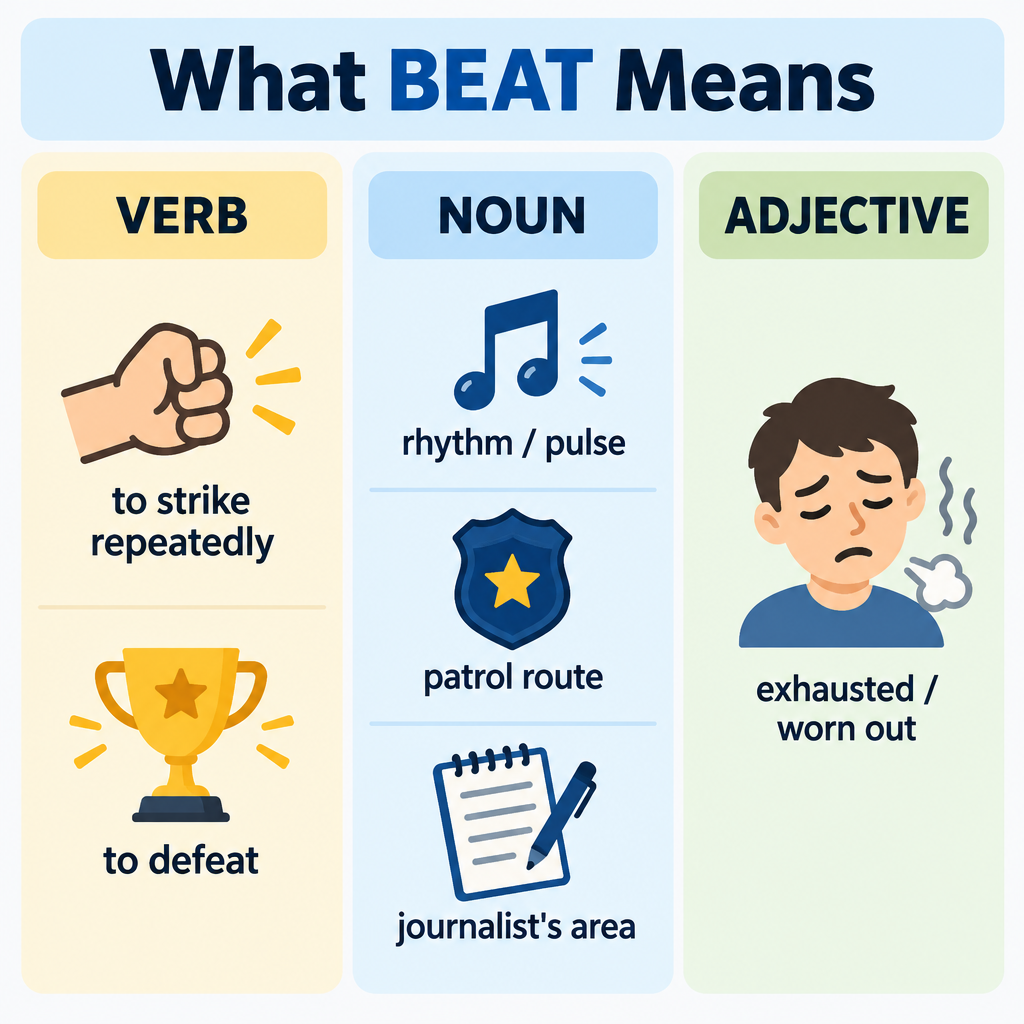
As a noun, “beat” most often means a single stroke or pulse, the rhythm made by a series of them, or a regular route or area someone covers. Merriam-Webster dates the noun to the 14th century.
| Sense | Meaning | Example |
|---|---|---|
| Stroke or pulse | One hit, or one throb of the heart | “Her heart skipped a beat.” |
| Rhythm (music) | The basic pulse of a piece, or the backing track in hip-hop | “The song has a slow, heavy beat.” “He produced the beat for that track.” |
| Route | The area a police officer or guard patrols on foot | “Officers walking a beat downtown.” |
| Area of reporting | The subject or region a journalist covers | “Her beat is city hall.” |
| Pause (drama, writing) | A short pause or a single unit of action in a script or story | “Hold for a beat, then answer.” |
| Physics | A regular rise and fall in loudness when two close frequencies combine | “Tune the strings until the beats disappear.” |
The route sense and the reporting sense are closely related. A journalist’s beat is the newsroom version of a patrol officer’s beat: a patch you know well and check all the time.
What “beat” means as an adjective
As an adjective, “beat” means very tired. It is informal: “After the double shift, I was completely beat.” Dictionaries mark it as colloquial, so keep it out of formal reports.
The longer form “dead beat,” meaning completely exhausted, appears in Pierce Egan’s Life in London (1821), according to Green’s Dictionary of Slang and Etymonline. Etymonline suggests the basic idea was “worn out, good for nothing.” By 1863, American English had the noun “deadbeat,” a lazy person who sponges off others. Today it more often means someone who avoids paying debts (“a deadbeat landlord,” “deadbeat dad”).
Where “beat” comes from
“Beat” is an old Germanic word with a clear family tree.
- Proto-Indo-European: Etymonline traces it to a root reconstructed as bhau-, “to strike.”
- Proto-Germanic: bautan, which also produced Old Norse bauta and Old High German bōzan.
- Old English: bēatan, “to inflict blows on, strike repeatedly, thrash.” It was a strong verb with the past tense bēot and the past participle beaten.
- Middle English: beten.
- Modern English: “beat,” with the past tense “beat” appearing around 1500.
Some older sources, such as Webster’s 1828 dictionary, linked “beat” to Latin batuo (“to strike”). Modern dictionaries trace it through Germanic instead, and Merriam-Webster’s entry does not mention Latin.
The Beat Generation and “beatnik”
“Beat” also names a famous American literary movement. Most accounts say Jack Kerouac used the phrase “Beat Generation” in a 1948 conversation with the novelist John Clellon Holmes. Etymonline dates the phrase in print to 1952.
At first, “beat” meant weary and beaten down, a sense already used in jazz and street slang of the time. Later, Kerouac said it also pointed to “beatific” and “beatitude,” a state of blessed happiness. His 1957 novel On the Road became the movement’s best-known book, alongside writers such as Allen Ginsberg.
“Beatnik” came later, and it was meant as an insult. San Francisco Chronicle columnist Herb Caen used it in April 1958, joining “beat” to the Russian suffix “-nik,” which was in the news after the Sputnik launch in 1957. Merriam-Webster gives 1958 as the first known use.
“Beat” in modern slang: a beat face
In makeup slang, to “beat” your face means to apply makeup with skill, and a “beat face” (or simply “a beat”) is a full, flawless look. The usage comes from drag and ballroom culture, and beauty creators on YouTube and Instagram spread it widely in the 2010s.
- “Her face was beat for the gala.”
- “That beat is flawless.”
There is no well-documented first use. Credit for the term belongs to the Black and Latino LGBTQ+ ballroom scene and to drag performers. It is still current in beauty and drag circles. Outside them, it can confuse people who only know the violent sense of “beat.”
Common idioms and phrases with “beat”
“Beat” turns up in dozens of everyday idioms. These are the ones readers search for most:
| Phrase | Meaning | Example |
|---|---|---|
| beat it | Go away (informal, often rude) | “Beat it, kid.” |
| beat around the bush | Avoid saying something directly | “Stop beating around the bush and tell me.” |
| beat a dead horse | Keep arguing about something already settled | “We’ve decided, so don’t beat a dead horse.” |
| beat someone to the punch | Do something before someone else can | “I meant to call her, but she beat me to the punch.” |
| beat the clock | Finish before time runs out | “We beat the clock by ten minutes.” |
| beat the rap | Escape punishment (informal) | “He was charged but beat the rap.” |
| beats me | I have no idea | “Where’s the remote? Beats me.” |
| can you beat that? | Expresses surprise | “He won the lottery twice. Can you beat that?” |
| off the beaten track/path | Away from popular places | “A small village off the beaten track.” |
| not miss a beat | Carry on smoothly despite an interruption | “The singer’s mic failed, but she didn’t miss a beat.” |
| march to the beat of a different drummer | Live by your own standards | Based on a line in Thoreau’s Walden |
| beat up | Hurt badly by hitting; also “beat-up,” meaning worn and damaged | “A beat-up old pickup.” |
Michael Jackson’s 1983 hit “Beat It” made the “go away” sense famous around the world. In the song, it means walk away from a fight.
Beat or beet?
“Beat” and “beet” sound the same but have nothing in common. A beet is a root vegetable (in British English, “beetroot”). “Beat” covers every other meaning on this page. If you can swap in “hit,” “defeat,” “rhythm” or “tired,” the spelling is “beat.”
“Beat” in other languages
“Beat” has no single translation, because its senses go in different directions. Pick the word that matches the sense.
| English | Spanish | French | German | Note |
|---|---|---|---|---|
| beat (hit) | golpear | battre, frapper | schlagen | Spanish pegar is also common for hitting a person |
| beat (eggs) | batir | battre | schlagen | German uses the same verb: Eier schlagen |
| beat (defeat) | vencer, ganar a | battre, vaincre | schlagen, besiegen | Ganar a is more casual in Spanish |
| beat (music) | ritmo, compás | rythme, temps | Takt, Rhythmus, Beat | German borrows Beat for pop and electronic music |
| beat (route) | ronda | ronde | Revier | Used for police patrols |
| I’m beat (tired) | estoy molido | je suis crevé | ich bin kaputt | All informal; formal choices are agotado, épuisé, erschöpft |
About this site and the old StarDict address
Star Dictionary is an independent reference for word meanings, origins, idioms and translations. It is not the StarDict project and has no connection to it. Until about 2013, this address carried the website of StarDict, an open-source dictionary program. This page started as a word lookup (“Query (beat)”) from that era.
StarDict is still developed by its own team. Wikipedia names Hu Zheng as its developer, and the project’s SourceForge site lists him as project leader. The source code is hosted on GitHub, the latest listed release is 3.0.7, and the program is licensed under GPL-3.0-or-later. It runs on Linux, Windows, FreeBSD and some other systems. Official information about the program, including its file format (a set of.ifo,.idx and.dict files for each dictionary), comes from the project’s own pages, not from this site.
Some dictionary files that circulated for StarDict in the past were unlicensed copies of commercial dictionaries. For reliable definitions today, you can use publishers’ own online dictionaries, such as Merriam-Webster, Oxford Learner’s Dictionaries and Cambridge Dictionary. Openly licensed projects such as Wiktionary and the GNU Collaborative International Dictionary of English (GCIDE) are also free to use.
FAQ
What does “I’m beat” mean?
It means “I’m very tired.” It is informal and mostly spoken. The stronger “dead beat,” meaning completely exhausted, goes back at least to 1821. In formal writing, use “exhausted” or “worn out.”
Is it “I got beat” or “I got beaten”?
Both are used. “Beaten” is the standard past participle and the safe choice in formal writing. “Got beat” is common in casual American English, especially in sports talk, and Merriam-Webster lists “beat” as a past participle as well.
What is a reporter’s or police officer’s beat?
It is the area someone covers regularly. For a police officer, it is the streets they patrol. For a journalist, it is a subject or region, such as health, sports or city hall. In both cases, the idea is a familiar patch you go over again and again.
Why were the Beat writers called “Beat”?
Jack Kerouac used “Beat Generation” around 1948 to describe young people who felt worn down and outside mainstream life, drawing on the slang sense of “beat” as exhausted. He later said the word also carried the idea of “beatific,” or blessed. “Beatnik” was a mocking label that Herb Caen added in 1958.
What does “beat face” mean?
It means makeup applied skillfully and fully, often a polished, flawless look. The phrase comes from drag and ballroom culture and spread through beauty creators online in the 2010s. It is praise, not violence.
Is this site the StarDict dictionary program?
No. Star Dictionary is an independent words and language reference that now uses an address that once belonged to the StarDict project. StarDict is developed by its own team elsewhere, and its official information is on the project’s own SourceForge and GitHub pages.
Sources
- Merriam-Webster: beat
- Merriam-Webster: beatnik
- Oxford Learner’s Dictionaries: beat
- Etymonline: beat
- Etymonline: beaten
- Etymonline: deadbeat
- Etymonline: beatnik
- Green’s Dictionary of Slang
- Encyclopedia.com: Beat Generation
- StarDict project site (SourceForge)
- StarDict on GitHub
- Wikipedia: StarDict
About this article
- Fact-checked before publication.
- Published · Updated