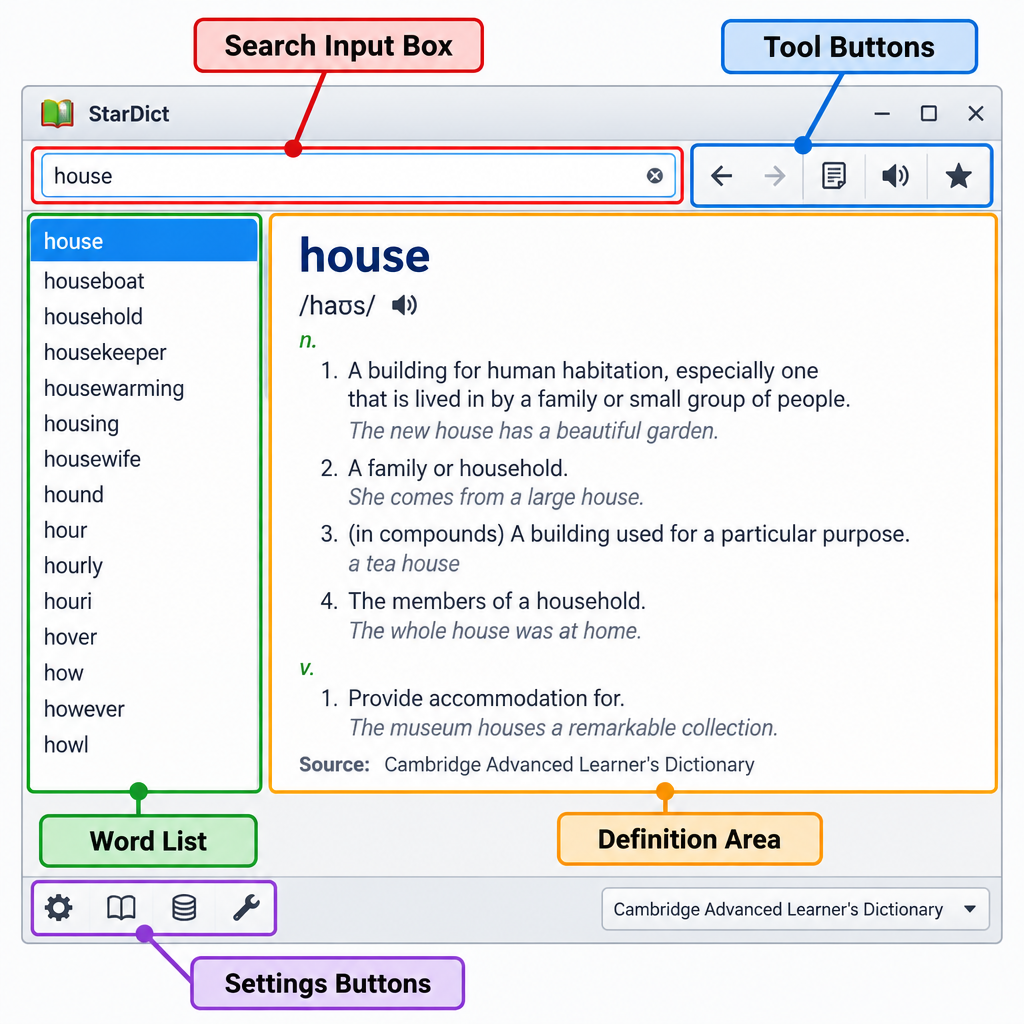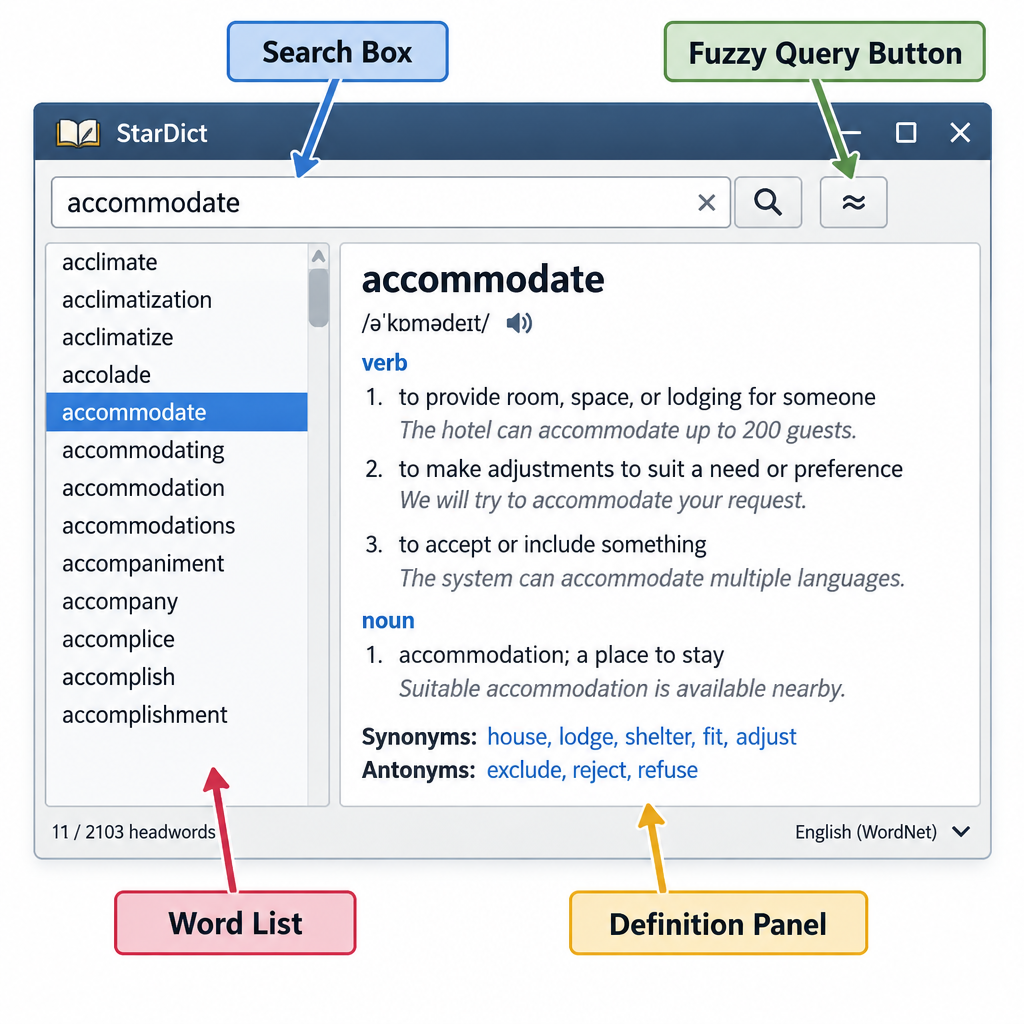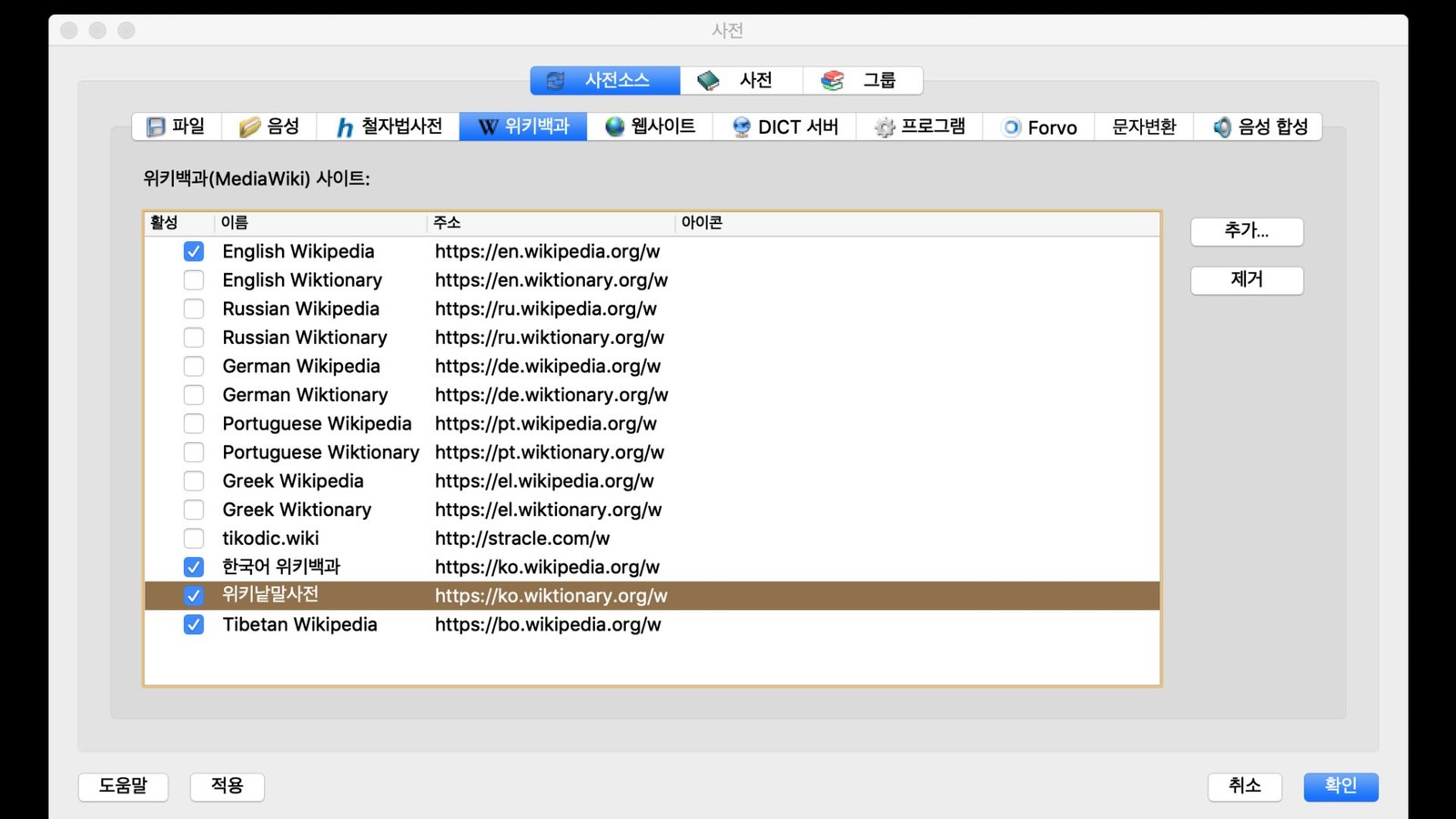
StarDict is a free, open-source dictionary program created by the Chinese developer Hu Zheng, and “StarDict dictionaries” are the word lists saved in its file format: a small set of files ending in.ifo,.idx and.dict. Star Dictionary is an independent words and language reference. It is not the StarDict project. The program and its format are maintained by their own developers elsewhere, and the official information is on the project’s SourceForge site (stardict-4.sourceforge.net) and in its code repository. In November 2026 the format is still widely used, and you can open these files in several programs, including StarDict itself, GoldenDict, KOReader and the command-line tool sdcv. Openly licensed collections such as FreeDict publish dictionaries in this format.
What a StarDict dictionary is
A StarDict dictionary is a group of files that share one base name and work together. One file describes the dictionary, one is a sorted index of headwords and one holds the entries themselves. The format is used for monolingual dictionaries, bilingual dictionaries, thesauri and glossaries alike.
Take a hypothetical English-Spanish word list with the base name “en-es”. It would be stored as en-es.ifo, en-es.idx and en-es.dict.dz, all in the same folder. When you look up “house”, the program finds the word in the.idx file. That entry points to the exact spot in the.dict file where the definition “casa” and its notes are stored.
The program behind the name is a separate thing from the files. StarDict is a desktop dictionary application. The English Wikipedia entry on it lists its licence as GPL-3.0-or-later, and its stable release as version 3.0.7.1, dated 2 October 2023. Linux distributions mostly ship a 3.0.7 development snapshot. For example, Ubuntu 24.04 “Noble” packages version 3.0.7+git20220909.
The StarDict file format
The format has three required parts and one optional part. The project’s own StarDictFileFormat document is the reference for them.
| File | Required? | What it holds | Notes |
|---|---|---|---|
| .ifo | Yes | Plain-text information about the dictionary | Opens with the line “StarDict’s dict ifo file”, followed by a version of 2.4.2 or 3.0.0 |
| .idx | Yes | A sorted list of headwords, each with the position and size of its entry | Can be gzip-compressed as.idx.gz |
| .dict | Yes | The text of the entries | Usually compressed with dictzip as.dict.dz |
| .syn | No | Synonyms and alternative spellings that point back to main entries | Lets a search for one form find another |
The.ifo file
The.ifo file is the only part you can read in a text editor. It lists details such as the dictionary’s name (the “bookname” field), its word count and the size of the index. Version 3.0.0 also accepts an “idxoffsetbits” option, which allows 64-bit offsets for very large dictionaries.
The.idx and.dict files
These two files do the real work. The index has to stay sorted, or lookups fail. The dictzip compression used for.dict.dz files keeps random access, so a program can jump straight to one entry without unpacking the whole file.
Damaged or non-standard files
Many StarDict dictionaries that circulate online do not follow the format guide exactly. The StarDict tools package includes a verifier and a repair utility for this reason. A dictionary that opens in one program and fails in another often has a badly sorted index or a wrong word count in its.ifo file.
Programs that read StarDict dictionaries
You are not tied to the StarDict program itself. Several actively used tools read the format directly.
| Program | Type | What it does with StarDict files |
|---|---|---|
| StarDict | Desktop application | The original reader, developed by Hu Zheng and contributors |
| GoldenDict | Desktop application | Reads StarDict alongside Babylon, ABBYY Lingvo, dictd, Aard, MDict and SDict formats, plus online dictionaries |
| KOReader | E-reader software | Uses StarDict dictionaries for word lookup while you read, on e-ink readers and Android |
| sdcv | Command line | A text-based “console version” of StarDict, maintained by Evgeniy Dushistov, with synonym (.syn) support and JSON output |
| PyGlossary | Conversion tool | Reads and writes StarDict, so you can convert to and from other dictionary formats |
KOReader accepts files ending in.idx,.ifo or.ifo.gz, and.dict or.dict.dz. Its documentation explains where each device keeps its dictionary folder.
History of StarDict and its dictionary files
StarDict started in the early 2000s. The copyright notices that Debian ships with the package credit Hu Zheng from 2003. The project grew quickly in the Linux world because it was free, fast and could hold many dictionaries at once.
Its history also includes several disputes:
- Paid downloads (2006). In late 2006 Hu Zheng cited personal financial problems as the reason for charging users to download dictionary files from his website. Many people in the Linux community questioned this.
- Copyright complaints. Wikipedia reports that the project was removed from SourceForge after copyright infringement reports, though the article flags that claim as not fully verified. The project later moved to Google Code and then returned to SourceForge.
- Questionable dictionary files. Many dictionaries passed around in StarDict format were converted copies of commercial dictionaries, made without the publishers’ permission. Distributions such as Gentoo have raised doubts about whether StarDict dictionaries can legally be redistributed when the source material is copyrighted.
- Licence changes. The project’s changelog records the licence moving between GPLv3 and “public domain” around the 3.0.7 releases. Wikipedia currently lists GPL-3.0-or-later.
Until about 2013, the stardict.org address carried the StarDict project’s website. That address now belongs to Star Dictionary, which has no connection to the software or its developers.
Where legitimate dictionaries come from today
The safest way to get StarDict dictionaries is from openly licensed projects. Old file collections are risky because many of them were unlicensed copies.
- FreeDict publishes more than 140 bilingual dictionaries in about 45 languages, most of them under the GPL. It writes its dictionaries in TEI XML and exports them to StarDict with the help of PyGlossary. It also offers other formats, such as dict and SLOB.
- Linux distributions such as Debian package FreeDict dictionaries through their normal software channels.
- Established online dictionaries are a better fit when you want an authoritative English definition rather than an offline file. Merriam-Webster, Oxford and Cambridge all publish dictionaries online. The free Cambridge Dictionary site gives British and American pronunciations, real example sentences and bilingual dictionaries such as English-Spanish.
The trade-off is simple. Offline StarDict files are fast, private and work without a connection, but their quality depends entirely on where they came from. Publisher websites are kept current and are reliable, but they need a connection and come with the publisher’s terms of use.
The word itself: “dictionary”
“Dictionary” (noun, said DIK-shuh-nair-ee in American English and DIK-shuhn-ree in British English) is a reference work that lists words with their meanings. It comes from Medieval Latin dictionarium, a book of words or phrases, built on Latin dictio, “a saying, a word”. A glossary is narrower: a list of terms for one book or field. A lexicon is the full vocabulary of a language or a speaker. A thesaurus groups words by meaning rather than defining them.
Example: “The app comes with an English dictionary and a medical glossary, but the slang lexicon has to come from somewhere else.”
FAQ
Is this site the official StarDict website?
No. Star Dictionary is an independent words and language reference with no connection to the StarDict software. The project’s official information is on its SourceForge site, stardict-4.sourceforge.net, and in its code repository on GitHub.
What files make up a StarDict dictionary?
Every StarDict dictionary needs three files with the same base name: an.ifo information file, an.idx index and a.dict file with the entries, which is often compressed as.dict.dz. An optional.syn file adds synonyms and alternative spellings. If any of the required files is missing, the dictionary will not load.
Can GoldenDict or KOReader open StarDict dictionaries?
Yes. GoldenDict reads StarDict files directly, along with formats such as Babylon, Lingvo, dictd and MDict. KOReader uses StarDict as its main dictionary format for looking up words on e-readers and Android devices.
Are old StarDict dictionary files legal to use?
It depends on where they came from. Many files shared in the 2000s were converted from commercial dictionaries without permission, so they were never properly licensed. Openly licensed sources such as FreeDict are the clean choice.
Is StarDict still being developed?
The program still exists and still ships in Linux distributions. Wikipedia lists version 3.0.7.1 from October 2023 as its stable release, and the project’s changelog records a 3.0.7-2 build from January 2024. Much of the format’s everyday use now runs through other programs, such as GoldenDict, KOReader and sdcv.
How do you convert a dictionary to or from StarDict format?
PyGlossary is the best-known tool for this. It reads and writes StarDict as well as many other dictionary formats. FreeDict uses it to produce its own StarDict editions.
Sources
- StarDict, Wikipedia
- StarDict file format, StarDict project on SourceForge
- StarDict changelog, Hu Zheng’s code repository
- StarDict format notes, PyGlossary documentation
- GoldenDict package description, Fedora Packages
- sdcv manual page
- FreeDict project
- Ubuntu stardict package, Launchpad
- Cambridge Advanced Learner’s Dictionary, Wikipedia