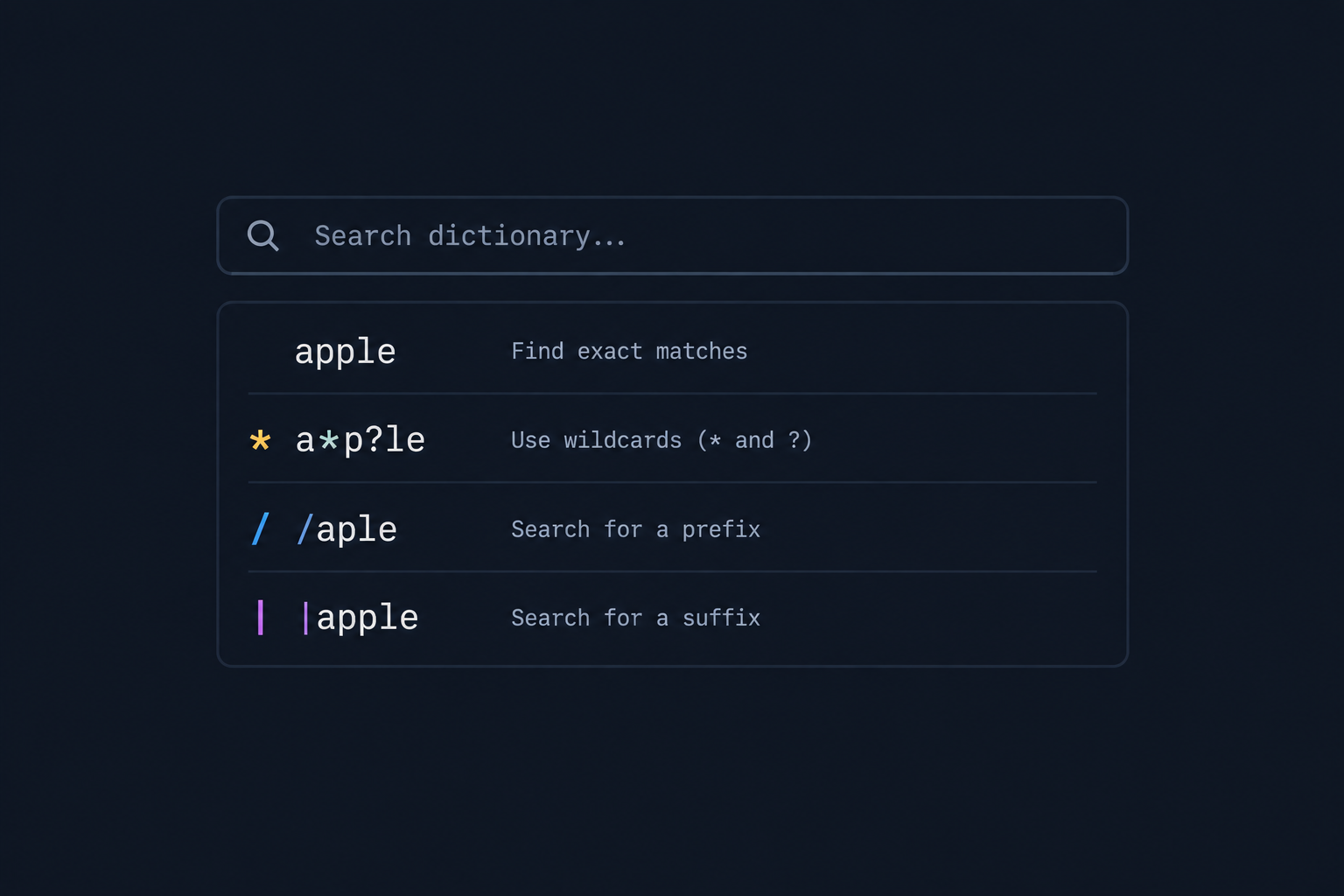
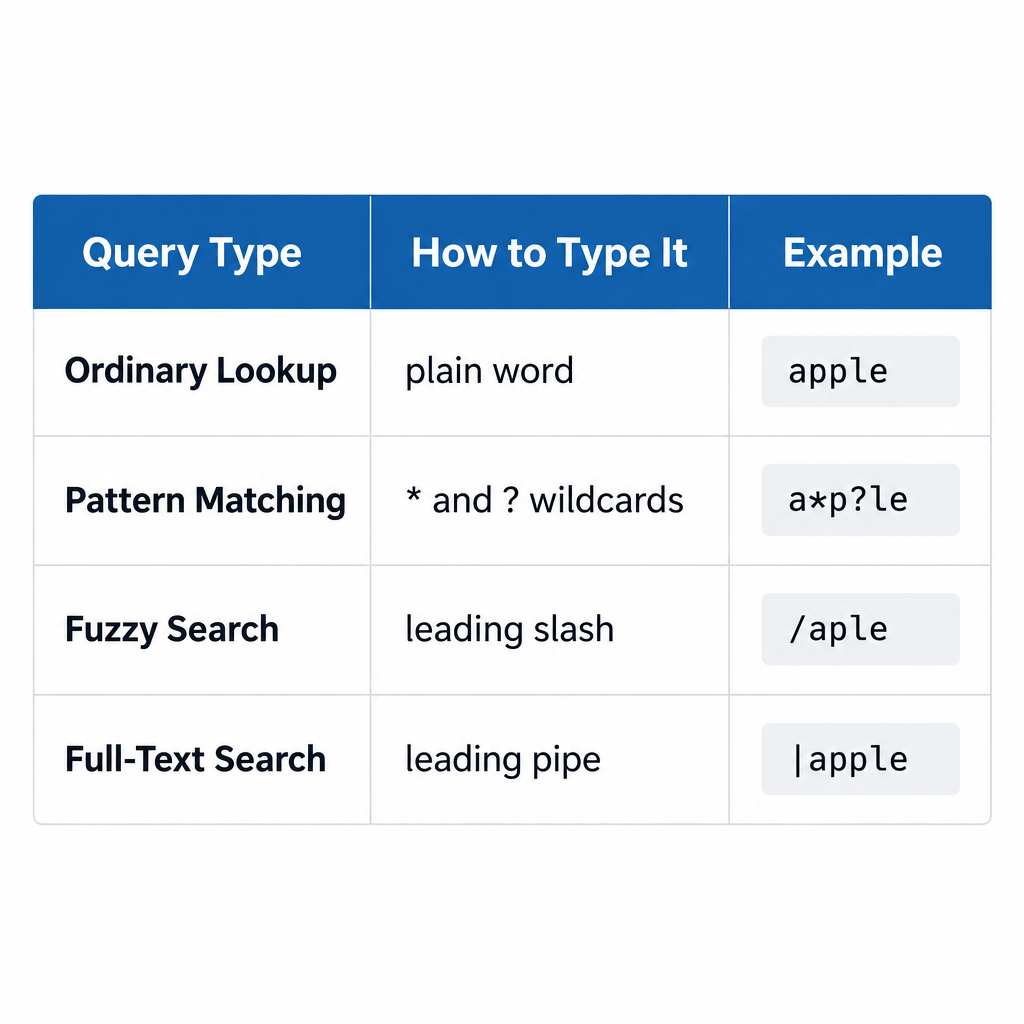
In the StarDict dictionary program, a “query” is the word or pattern you type into the search box. The first character of what you type decides how StarDict searches: a plain word gets an ordinary lookup, * and ? turn on pattern matching, a leading / runs a fuzzy search and a leading | searches inside definitions. Star Dictionary is an independent words and language reference and is not the StarDict project. StarDict’s developers maintain the program elsewhere: the official site is on SourceForge, where version 3.0.7 is listed as released on 3 October 2023, and the same site holds the project documentation, including the file-format and protocol documents.
What “query” means
Query is a noun and a verb, pronounced KWEER-ee. Merriam-Webster gives the US pronunciation as /ˈkwir-ē/ and lists KWERR-ee as a variant. As a noun it means a question, especially one that asks for information or expresses doubt. As a verb it means to ask or to question something. Merriam-Webster says the noun is an alteration of the earlier spelling quere, from Latin quaere, the command form of quaerere, “to ask”. Merriam-Webster dates the verb to 1614 and the noun to 1620. Etymonline dates the noun earlier, to the 1530s, as quaere, which writers often put in a margin to flag a question or a doubt.
In software, a query is a request sent to a program or database. In StarDict it is simply what you type into the lookup box, and the rules below describe how the program reads it.
The four query types
StarDict treats your input in one of four ways, depending on the characters in it. The project’s own StarDict Protocol document, which defines how StarDict clients talk to a dictionary server, lists the same types and gives a*p?le, /apple and |apple as examples.
| Query type | How to type it | Example | What it returns |
|---|---|---|---|
| Ordinary lookup | Just the word | apple |
The headword and close matches from the word list |
| Pattern matching (glob style) | Use * for any run of characters and ? for exactly one |
a*p?le |
Every headword that fits the pattern |
| Fuzzy query | Start with / |
/aple |
Headwords spelled close to your input, which helps with misspellings |
| Full-text search | Start with \| |
\|apple |
Entries whose definitions contain the word |
StarDict’s feature list also names regular expression matching. For the exact rules, the protocol document points readers to the help file that ships with the program.
Pattern matching with * and ?
Pattern matching helps when you know part of a word. The asterisk stands for any number of characters, including none. The question mark stands for exactly one.
colo?rmatches color, but also any other five-letter word that fits.*ologylists every headword ending in -ology.wo?d*(the example used in StarDict’s own package description) matches word, words, wordy and more.
Use pattern matching for crosswords and for finding word families. A pattern that starts with * makes the program scan the whole word list, so it is slower on large dictionaries.
| appendix |
Fuzzy query with /
A fuzzy query finds words spelled close to your input. Type / and then your best guess at the word, such as /recieve, and StarDict suggests the closest real headwords, including receive.
Use it when you only half know a spelling. The catch is that you get a list of possible words, not one answer, so check the definition before you trust the match.
Full-text search with |
Full-text search looks inside the definitions. Type | and a word, and StarDict lists every entry whose definition text contains it. Searching |fruit, for example, can bring up apple, mango and pome.
This is the most useful mode for going backwards from a meaning to a word. It is also the slowest, because the program has to read the definition data and not just the index. Some old guides call this mode “full-text translation”, but StarDict’s documents call it full-text search.
The console version: sdcv
sdcv is a separate command-line program that reads StarDict dictionaries, and it uses the same prefixes. Its manual page says each query can start with / for fuzzy search or | for full-text search, and can contain ? and * for pattern search. A few options matter in practice:
| Option or setting | What it does |
|---|---|
-e / , exact-search |
Turns off fuzzy matching and returns exact matches only |
, list-dicts |
Lists the dictionaries sdcv can see |
, json |
Prints results in a format other programs can read |
, data-dir or STARDICT_DATA_DIR |
Points sdcv to a folder of dictionaries other than the default |
| Ctrl+D | Leaves interactive mode |
On Linux, man sdcv shows the manual for the version you have installed. Details such as where the search history is saved differ between versions.
How StarDict dictionary files work
A StarDict dictionary is a small set of files that share one base name. The project’s file-format document describes them:
| File | Role | Required? |
|---|---|---|
.ifo |
Plain-text information: name, word count, format version (2.4.2 or 3.0.0) | Yes |
.idx or .idx.gz |
The sorted index of headwords | Yes |
.dict or .dict.dz |
The definitions, often compressed | Yes |
.syn |
Extra synonyms that point to existing entries | No |
The queries above work against these files. Ordinary lookups, pattern matching and fuzzy queries mostly use the index. Full-text search has to read the definition file too, which is why it is slower.
Other programs read the format as well. GoldenDict-ng lists StarDict .ifo, .dict, .idx and .syn files among the formats it supports, and the e-reader app KOReader uses StarDict files for its dictionary lookups. The free, openly licensed FreeDict project publishes dictionaries in StarDict format. Many dictionary packs that circulated in the 2000s were unlicensed copies of commercial dictionaries, so use only files whose license you can check.
About the original appendix
This appendix was first published in 2006, when the address carried the StarDict project’s website, and it carried the notice “©2006 StarDict”. The menu around it linked to pages called Download StarDict, FAQ and Help, and a recruitment notice asked: Looking for chinese translators? Those pages belonged to the StarDict developers and are not part of the current site. Official information about the program and its formats now lives on the project’s SourceForge site.
Questions readers ask
Is this site the official StarDict website?
No. Star Dictionary is an independent words and language reference with no connection to the StarDict software. The program’s developers maintain it elsewhere, and its official pages, including the file-format and protocol documents, are on SourceForge.
Is StarDict still maintained?
Yes, but releases are rare. The official site lists version 3.0.7 as released on 3 October 2023, and Linux distributions such as Debian and Ubuntu still ship 3.0.x packages. Code marked 4.0.0 exists in the developer’s repositories, but no stable 4.0 release has been confirmed on the official site.
What is the difference between fuzzy search and pattern matching?
Pattern matching follows your exact pattern: * stands for any run of characters and ? for one character, so you have to know part of the word. A fuzzy query (/word) guesses at words spelled close to what you typed. Use it when you don’t know the spelling.
How do I search inside definitions in StarDict?
Start the query with a pipe character, as in |harvest. StarDict then returns the entries whose definition text contains that word. This mode is slower than a normal lookup because it reads the full definition data.
Do StarDict search tricks work in other dictionary apps?
Only partly. sdcv uses the same /, |, * and ? rules: its manual page lists / for fuzzy search, | for full-text search and ? and * for pattern search. Apps like GoldenDict-ng and KOReader can open StarDict files, but each has its own search box and its own rules, so check that app’s help.
Where can I get legal StarDict-format dictionaries?
Look for projects that state their license clearly. FreeDict, for example, publishes free bilingual dictionaries in StarDict format. Many older dictionary packs were unlicensed copies of commercial works, so avoid any file whose origin and license you can’t confirm.
Sources
- StarDict official site (SourceForge): stardict-4.sourceforge.net
- StarDict Protocol v0.4: stardict-4.sourceforge.net/StarDict-Protocol_v04
- StarDict file format: stardict-4.sourceforge.net/StarDictFileFormat
- sdcv manual page (Debian 13): dokk.org/manpages/debian/13/sdcv/sdcv.1.en
- Merriam-Webster, “query”: merriam-webster.com/dictionary/query
- Etymonline, “query”: etymonline.com/word/query
- GoldenDict-ng supported formats: xiaoyifang.github.io/goldendict-ng/dictformats
- StarDict on Wikipedia: en.wikipedia.org/wiki/StarDict
About this article
- Fact-checked before publication.
- Published · Updated