

Last updated: November 23, 2026
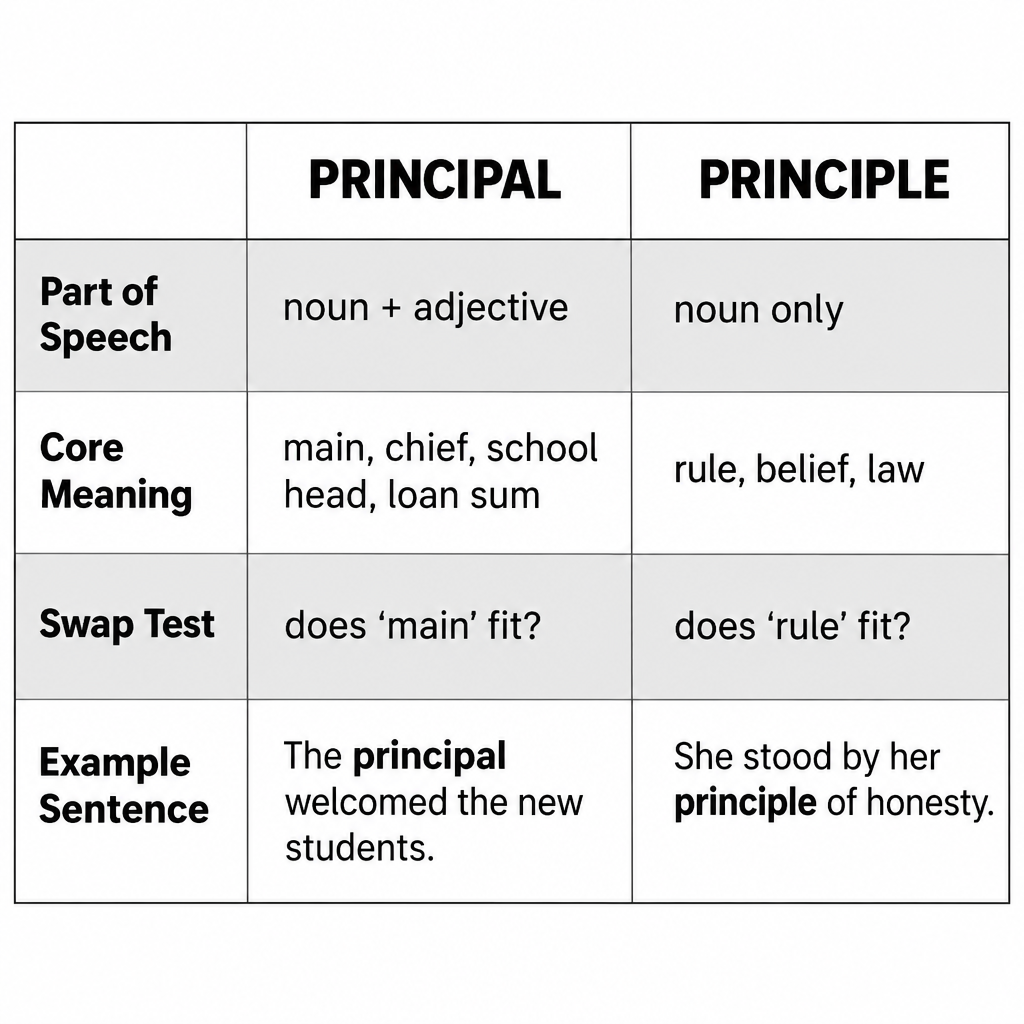
Principal is an adjective meaning “main” or “most important.” As a noun, it names the head of a school, a person in a leading role, or a sum of money. Principle is only ever a noun, and it means a rule, a belief or a basic truth.
The two words sound exactly the same, and that’s why so many people mix them up. Below you’ll find every sense of each word, a test you can use on any sentence, the fixed phrases people get wrong most often, and a quiz to check yourself.
Key takeaways
- If “main” or “chief” fits, write principal. If “rule,” “law” or “belief” fits, write principle.
- Principle is never an adjective. A moral person takes a “principled” stand.
- The money on a loan is the principal, so write “principal balance” and “principal and interest.”
- It’s always “in principle,” because that phrase means “in theory.”
- Both words come from Latin princeps, “first, chief,” the same root as prince.
Fact-checked
We checked these key facts against the sources named, on November 23, 2026:
- It’s a basic law that describes how nature works, such as the Heisenberg uncertainty principle (1927), the Pauli exclusion principle (1925) or Archimedes’ principle of buoyancy (source: aps.org)
- Etymonline dates the sense “chief, most important” to around 1300, and the noun for a leading person to the same period. Latin principium (“a beginning, a source, a first part”), whose plural principia meant foundations (source: etymonline.com)
- Merriam-Webster has legal entries for principal in the first degree and principal in the second degree (source: merriam-webster.com)
- Merriam-Webster’s first sense is “a comprehensive and fundamental law, doctrine, or assumption.” Its other senses include a rule or code of conduct (source: merriam-webster.com)
- Principal means “first in importance.” Merriam-Webster’s usage guide defines the adjective as “the most important.” The noun covers a leader, the executive officer of a school, and other people or things that come first (source: merriam-webster.com)
Principal or principle? The quick answer
Use principal for anything that means main, chief, the person in charge or the original sum of money. Use principle for a rule, law, belief or basic truth. The two are homophones, pronounced /ˈprɪnsəpəl/ (PRIN-suh-pul), so you can’t tell them apart by ear.
| Word | Part of speech | Core meaning | Swap-in test | Example |
|---|---|---|---|---|
| principal | adjective | main, most important | “main” or “chief” fits | the principal reason |
| principal | noun | head of a school; a leading person; a sum of money | “head,” “lead” or “original sum” fits | The principal called my parents. |
| principle | noun only | a rule, belief, law or basic truth | “rule,” “law” or “belief” fits | She refused on principle. |
The plurals follow the spellings: one principal, two principals; one principle, two principles.
Which should you choose? A verdict for every sentence
Most of the time the answer is principal, because it covers far more ground: an adjective plus three noun senses. Principle has one job. It names an idea that guides something, such as a rule, a law of nature or a moral code.
| Principal | Principle | |
|---|---|---|
| What it covers | Adjective “main”; heads of schools; lead roles; loan sums; legal principals | Rules, beliefs, laws, basic truths |
| Can it describe a noun? | Yes (principal reason) | Not as an adjective. Use “principled” |
| Usually goes wrong when | Writers assume only the school head takes -pal | Writers use it as an adjective (“principle reason”) |
| Safe default when you’re unsure | If the word comes before a noun to describe it | If you could swap in “rule” |
What does “principal” mean?
Principal means “first in importance.” Merriam-Webster’s usage guide defines the adjective as “the most important.” The noun covers a leader, the executive officer of a school, and other people or things that come first. Each sense below still carries that idea of being first or chief.
| Sense | Field | Example phrase | Example sentence (original) |
|---|---|---|---|
| Main, most important (adj.) | General | principal reason | Cost was the principal reason the plan failed. |
| Head of a school (n.) | Education | the school principal | The principal welcomed new students at the gate. |
| Lead performer or player (n./adj.) | Dance, music | principal dancer, principal violin | She was promoted to principal dancer last season. |
| Senior professional title (adj.) | Work, research | principal engineer, principal investigator | The principal investigator signed the grant report. |
| Original sum of money (n.) | Finance | principal balance | Extra payments lower your principal faster. |
| Person an agent acts for (n.) | Law | principal and agent | The agent cannot bind the principal beyond their authority. |
| Main offender in a crime (n.) | Criminal law | principal in the first degree | The driver was charged as a principal. |
Principal as an adjective: main, most important
Before a noun, principal means “main” or “chief.” You’ll see it in phrases like principal reason, principal cause, principal character and principal cast. Because principle is not an adjective meaning “main,” the word that does this job is spelled -pal.
Example: The principal cause of the delay was a missing signature.
Principal as a person: school heads and job titles
In American English, the principal is the head of a school. Oxford Learner’s Dictionaries labels that sense especially North American. In British English, Oxford gives the principal as the head of a college, or of a university in Scotland and Canada. A British school is usually run by a head teacher.
The same “lead person” idea shows up in many job titles:
- Principal investigator (PI): the lead researcher responsible for a study or grant.
- Principal engineer or principal consultant: a senior rank in many companies.
- Principal dancer: the highest rank in many ballet companies.
- Principal violin, principal cello and similar: the section leader in an orchestra.
In every one of these, “chief” or “lead” fits. That’s your signal for -pal.
Principal as money: the original sum
In finance, the principal is the amount you borrowed or invested, before interest. Dictionary.com defines it as the original amount of money lent, not counting profits and interest. Mortgage lenders such as Rocket Mortgage describe it the same way: the loan amount, without interest or fees.
The money sense is old. Etymonline notes that medieval Latin capitalis (pars) named the principal sum of a loan. That’s why “capital” and “principal” can still mean the same pot of money.
Principal in law: principal and agent
In agency law, the principal is the person an agent acts for. The Cornell Legal Information Institute’s Wex dictionary describes agency as a common-law doctrine governing agents and principals. The relationship starts once the agent gets authority to act for the principal. It can be set up on purpose or implied by conduct.
A power of attorney works the same way. The person who grants the power is the principal. The person who receives it is the agent, often called the attorney-in-fact.
Criminal law uses the word too. Merriam-Webster has legal entries for principal in the first degree and principal in the second degree. Both are ways of classing people who took part in a crime.
Principally means “mainly”
The adverb from principal is principally, meaning “mainly” or “chiefly.” Don’t confuse it with in principle, which means “in theory.”
Example: The festival is funded principally by ticket sales.
What does “principle” mean?
A principle is a rule, a belief or a basic truth that other things rest on. Merriam-Webster’s first sense is “a comprehensive and fundamental law, doctrine, or assumption.” Its other senses include a rule or code of conduct. Principle is a noun only.
| Sense | Field | Example phrase | Example sentence (original) |
|---|---|---|---|
| Moral rule or belief | Ethics, daily life | on principle; a person of principle | He returned the extra change on principle. |
| Basic law or truth | Any discipline | principles of economics; first principles | The course starts with the principles of accounting. |
| Law of nature | Science | uncertainty principle | The exclusion principle explains how electrons fill shells. |
| Underlying idea or method | Design, engineering | the principle behind a pump | The principle behind a siphon is simple. |
| In theory | Fixed phrase | in principle | They agreed in principle but haven’t signed. |
Principle as a rule or belief
This is the moral sense: the rules a person lives by. You’ll hear a man of principle, a woman of principle, on principle and it goes against my principles. Etymonline dates the use of the word on its own to mean good or moral principle to the 1650s.
The everyday saying is “It’s the principle of the thing.” It means the rule matters more than the money or effort involved, so it takes -ple.
Principle as a basic truth or law
Every field has its foundations, and those are principles. Think of the principles of economics, democratic principles or design principles. Reasoning “from first principles” means building an argument up from the most basic truths you can find.
What is a principle in science?
In science, a principle is a basic law that describes how nature behaves. It’s often named after the person who stated it:
- Heisenberg uncertainty principle (1927): Werner Heisenberg stated that you can’t know both the position and the momentum of a particle exactly at the same time. Britannica stresses this isn’t a flaw in the measuring tools.
- Pauli exclusion principle (1925): Austrian physicist Wolfgang Pauli proposed that no two electrons in an atom can be in the same state at the same time.
- Archimedes’ principle: an object in a fluid is pushed up by a force equal to the weight of the fluid it displaces. Britannica notes this holds for gases as well as liquids.
Did you know?
According to Britannica, the Pauli exclusion principle sorts particles into two families. Fermions obey it; bosons don’t.
Principled: the adjective you’re looking for
If you need an adjective about having morals, the word is principled. Merriam-Webster’s usage guide gives the example “taking a principled stand.” Its opposite is unprincipled.
Often confused with
Principled (having strong morals) vs principal (main). “A principled leader” is honest; “the principal leader” is the main one.
In principle: “in theory,” never “in principal”
In principle means “in theory” or “as a general idea.” Merriam-Webster glosses it as “with respect to fundamentals.” “In principal” is always a mistake. That includes a contract email saying a deal was “agreed in principal.” The correct form is agreed in principle.
Usage tip
If “in theory” fits the sentence, write “in principle.” If “mainly” fits, write “principally.”
Is it principle or principal money?
It’s principal. The amount you borrow, or the amount you invest, is the principal. Interest is what you pay or earn on top of it. So you’d write principal balance, principal amount, principal-only payment and principal and interest (P&I).
How a payment splits between principal and interest
The Consumer Financial Protection Bureau (CFPB) explains that for most mortgages, lenders use a standard formula based on the loan’s terms to set the principal-and-interest payment. That monthly figure stays the same on a fixed-rate loan, but the split inside it changes.
Early on, most of each payment goes to interest. Over time, more of it goes toward the principal.
A worked example with round, illustrative numbers:
- You borrow $300,000. That’s your principal.
- Your monthly payment is $1,900.
- Say $1,500 of that month’s payment is interest.
- The other $400 reduces the principal to $299,600.
- Next month, interest is charged on the smaller balance, so a little more goes to principal.
A “principal-only payment” is extra money you send that goes straight to the principal balance. That’s why it shortens a loan.
Before you hit send
On loan statements, budgets and financial emails, the balance is always “principal.” Search your draft for “principle balance” or “principle amount” before you send it.
How to remember the difference (and why the “pal” trick isn’t enough)
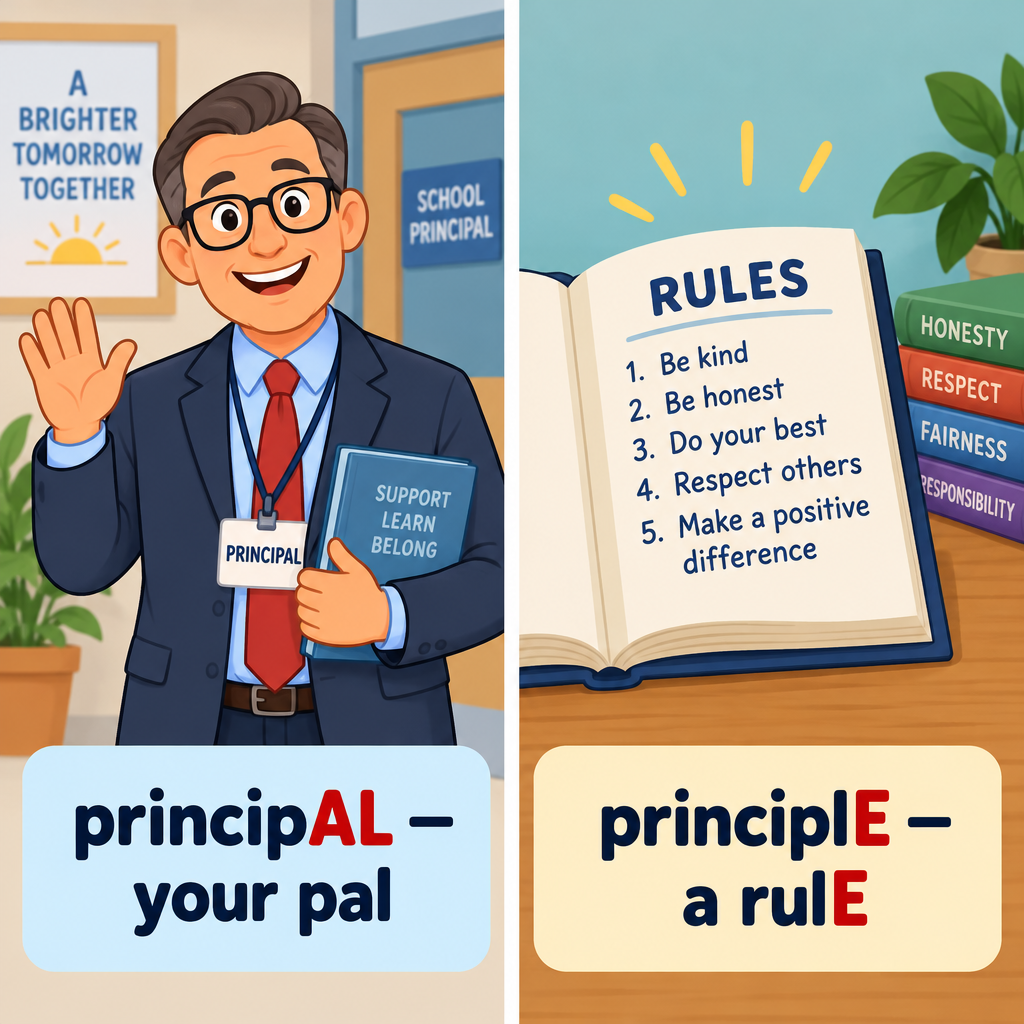
The best-known trick is “the principal is your pal.” It works for the school head, but it stops there. Readers ask why the loan amount is also spelled principal when it isn’t a pal at all. The answer is that “pal” is just one of four principal senses. You need a test that covers all of them.
Here are four memory aids that work together:
- Pal = person. A principal can be a real person: the head of a school, a lead dancer, a legal principal. Merriam-Webster’s usage guide makes the same point.
- -le = rule. Principle and rule both end in -le. Merriam-Webster recommends this one too.
- principAl = Adjective. The -al word is the adjective that means “main.”
- Swap test. Swap in “main” or “rule” and see which one reads well (below).
The substitution test that works every time
Run these three checks in order:
- Does it sit before a noun to describe it? Write principal. Principle is never an adjective.
- Can you swap in “main,” “chief,” “head,” “lead” or “original sum”? Write principal.
- Can you swap in “rule,” “law,” “belief,” “truth” or “in theory”? Write principle.
Try it on “the ___ amount of the loan.” “The main amount” works. “The rule amount” doesn’t. So it’s principal amount.
The trap: non-school meanings still take -pal
People who rely only on the pal trick reason like this: “It’s not a school head, so it must be principle.” That logic produces principle amount, principle reason and principle investigator. All three are wrong. The pal trick tells you one sense of principal. It doesn’t tell you that everything else is principle.
Did you know?
Merriam-Webster’s usage guide notes that principal/principle mix-ups turn up even in publications overseen by professional editors.
That also explains why spell-check misses the error. Both words are spelled correctly, so the software only flags them when its grammar check catches the context, and it often doesn’t. It’s the same blind spot that makes other commonly misspelled words survive proofreading.
Ten example sentences
Each sentence below is an original example written for this page.
- Example: The principal announced that school would close early because of snow.
- Example: Rising rent was the principal reason they moved out of the city.
- Example: She refuses to shop there on principle.
- Example: Your monthly payment covers both principal and interest.
- Example: The two sides agreed in principle, but the details took months.
- Example: He was named principal dancer after ten years with the company.
- Example: The course teaches the basic principles of supply and demand.
- Example: As principal investigator, Dr. Ortiz submitted the final grant report.
- Example: The museum is funded principally by private donors.
- Example: Honesty is a principle she has never compromised.
Common mistakes, corrected
Most errors come from using principle where an adjective or a person is needed. The fixes below cover the contexts where people get stuck most.
| Wrong | Right | Why |
|---|---|---|
| Our school principle retired. | Our school principal retired. | A person in charge takes -pal. |
| My principle balance is $12,000. | My principal balance is $12,000. | The loan sum is the principal. |
| We agreed in principal. | We agreed in principle. | “In theory” = in principle. |
| The principle reason was cost. | The principal reason was cost. | Describes a noun; means “main.” |
| She took a principal stand. | She took a principled stand. | The moral adjective is “principled.” |
| He has strong principals. | He has strong principles. | Beliefs are principles. |
| The principle investigator signed off. | The principal investigator signed off. | Lead researcher = chief. |
| She’s a principle dancer at the ballet. | She’s a principal dancer at the ballet. | Highest rank = lead. |
| It’s the principal of the thing. | It’s the principle of the thing. | The saying is about a rule. |
| Make a principle-only payment. | Make a principal-only payment. | The payment goes to the loan sum. |
Fixed phrases cheat sheet
If you’re halfway through typing a phrase, look it up here.
| Phrase | Correct spelling | Meaning |
|---|---|---|
| in principle | principle | in theory, in general |
| on principle | principle | because of a moral rule |
| a person of principle | principle | someone with firm morals |
| guiding principle | principle | the main rule behind decisions |
| first principles | principle | the most basic truths |
| the principle of the thing | principle | the rule matters more than the cost |
| uncertainty principle | principle | Heisenberg’s law of physics |
| principal amount | principal | original sum of a loan |
| principal balance | principal | what’s left of the original loan |
| principal and interest (P&I) | principal | the two parts of a loan payment |
| principal investigator (PI) | principal | lead researcher |
| principal dancer | principal | top ballet rank |
| principal reason | principal | main reason |
| principal in the first degree | principal | a main party to a crime (law) |
| vice principal | principal | deputy head of a school |
Where the two words come from
Both words go back to Latin princeps, “first, chief.” That’s also where English gets prince. Princeps is usually broken down as primus (“first”) plus the root of capere (“to take”), so literally “one who takes first.”
From that root, Latin built two separate words:
- principalis (“first, chief”), which became English principal. Merriam-Webster dates the adjective to the 14th century, via Anglo-French. Etymonline dates the sense “chief, most important” to around 1300, and the noun for a leading person to the same period.
- principium (“a beginning, a source, a first part”), whose plural principia meant foundations. Through Old French principe and Anglo-French, it became English principle in the late 1300s. Etymonline notes that the earliest sense, “origin, source,” is now obsolete.
So the two words are cousins, not twins. One meant the first person or thing. The other meant the first cause or foundation. That’s why a principle is still something everything else rests on.
The etymology of the word also explains the confusion. Both share a root, both came through French, and both ended up sounding identical in English. Only the last three letters kept them apart.
Synonyms and related words
Synonyms help with the swap test. If one of these fits, you know which spelling you need.
Synonyms for principal
- Adjective: main, chief, primary, leading, foremost
- School head: head teacher (British), headmaster, headmistress, head of school
- Money: capital, the sum lent, the loan balance
Synonyms for principle
- rule, tenet, doctrine, law, ethic, axiom, standard, value
Related words
- principality: a territory ruled by a prince, from the same root
- prince: from princeps
- principled / unprincipled: adjectives formed from principle
- principally: the adverb of principal, meaning “mainly”
Other commonly confused words
Principal and principle belong to a family of pairs that sound alike or nearly alike but mean different things. The same swap-in approach works for most of them.
| Pair | Quick difference |
|---|---|
| affect / effect | affect is usually the verb; effect is usually the noun |
| complement / compliment | complement completes; compliment praises |
| stationary / stationery | stationary stays still; stationery is paper (e for envelope) |
| capital / capitol | capital is a city or money; capitol is the building |
| discreet / discrete | discreet is tactful; discrete is separate |
Quick quiz: principal or principle?
Fill in each blank, then check your answers below.
- The ___ of the high school gave a speech at graduation.
- Lying goes against her ___.
- Paying an extra $100 a month reduces your ___ faster.
- The two companies agreed in ___ to merge.
- Fear of failure was the ___ reason he never applied.
- Archimedes’ ___ explains why ships float.
- Dr. Lee is the ___ investigator on the study.
- He’s a ___ man who keeps his word.
- She plays ___ cello in the city orchestra.
- It’s not the money; it’s the ___ of the thing.
Answers
- principal. The head of a school.
- principles. Her moral rules.
- principal. The loan sum.
- principle. “In theory.”
- principal. “Main” fits.
- principle. A law of nature.
- principal. Lead researcher.
- principled. The moral adjective.
- principal. Section leader.
- principle. A rule matters more than the cost.
If you missed questions 3, 5, 7 or 9, the pal trick is probably catching you out. Use the swap test.
FAQ
What does “principal” mean?
As an adjective, principal means “main” or “most important.” As a noun, it means the head of a school, a person in a lead role, the original sum of a loan or investment, or, in law, the person an agent acts for.
What is a principle in science?
It’s a basic law that describes how nature works, such as the Heisenberg uncertainty principle (1927), the Pauli exclusion principle (1925) or Archimedes’ principle of buoyancy.
How do you use the word “principle” in a sentence?
Use it as a noun for a rule, belief or basic truth. For example: “Fairness is the guiding principle of the club,” or “She quit on principle.”
Is it principle or principal money?
Principal. The money you borrow or invest is the principal, and the extra charged or earned on it is interest.
Is it “in principle” or “in principal”?
Always “in principle.” It means “in theory” or “as a general idea,” so it takes the -ple spelling.
Is it “principal investigator” or “principle investigator”?
“Principal investigator.” The PI is the lead researcher on a study or grant, so “chief” fits and the word takes -pal.
Is it “principal amount” or “principle amount”?
“Principal amount.” It’s the original sum of a loan, not a rule.
Can “principle” be used as an adjective?
No. Principle is only a noun. For the adjective meaning “having strong morals,” use “principled.” For “main,” use “principal.”
What is the plural of principal and principle?
Principals and principles. Just add -s to each.
Do principal and principle sound the same?
Yes. Both are pronounced /ˈprɪnsəpəl/ (PRIN-suh-pul), which makes them homophones. Only the spelling tells them apart.
Next time you get to that word, don’t ask “is it a pal?” Ask whether “main” or “rule” fits. That one swap settles every sense of both words.