Abstract works as an adjective, a noun and a verb. As an adjective it describes ideas, qualities or art that aren’t tied to any particular physical thing. As a noun it usually means a short summary of a longer text, and as a verb it means to remove something or to summarize it. The word came into English in the 14th century from Latin abstractus, “drawn away.” This page started as a word lookup on the old StarDict website. Star Dictionary is an independent reference and is not the StarDict project, whose program is still maintained by its own developer, Hu Zheng, on GitHub and SourceForge.
The word abstract at a glance
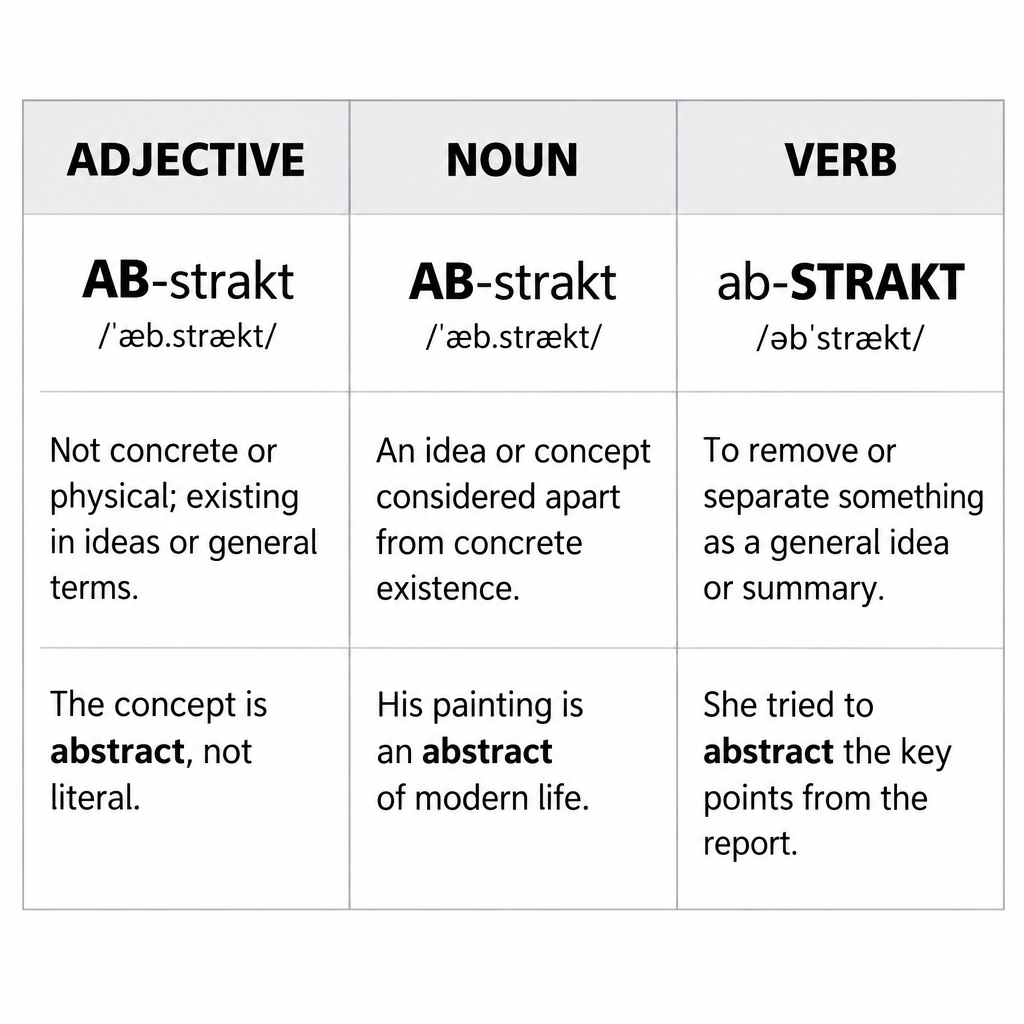
Abstract has three parts of speech, and the stress moves depending on which one you mean. The adjective and noun are usually stressed on the first syllable. The verb is usually stressed on the second.
| Part of speech | Says | Core meaning | First known use (Merriam-Webster) |
|---|---|---|---|
| Adjective | AB-strakt (US also ab-STRAKT) | not tied to a specific instance or physical thing | 14th century |
| Noun | AB-strakt | a summary of the main points of a text | 15th century |
| Verb | ab-STRAKT | to remove or separate; to summarize | 15th century |
In IPA the common form is /ˈæbstrækt/. The WordReference Random House Learner’s Dictionary of American English also gives /æbˈstrækt/ for the adjective in American English.
What abstract means
The adjective is by far the most common use. It means existing as an idea rather than as a concrete, physical thing. The noun sense of “summary” is everyday vocabulary in academic and legal writing.
Abstract as an adjective
Merriam-Webster’s first sense is “disassociated from any specific instance,” as in an abstract entity. Oxford Learner’s Dictionaries puts it in plainer terms: “based on general ideas and not on any particular real person, thing or situation.”
Three uses come up most often:
- Ideas and thinking. Justice, freedom and time are abstract concepts. You can’t point at them, but you can reason about them.
- Art. Abstract art doesn’t try to show people or objects realistically. It works through color, shape and line instead. Oxford’s American entry gives the American abstract expressionists, such as Mark Rothko, as an example.
- Grammar. An abstract noun names a quality, state or idea (happiness, honesty, childhood), as opposed to a concrete noun (table, dog, rain).
Abstract as a noun
Here an abstract is a short summary, which Merriam-Webster defines as “a summary of points (as of a writing) usually presented in skeletal form.” A research paper opens with an abstract of around one paragraph. In law, an abstract of title summarizes the history of ownership of a piece of land.
The noun also appears in the fixed phrase in the abstract, meaning “in general terms, without reference to real cases”: Everyone supports the plan in the abstract; the trouble starts with the budget.
Abstract as a verb
The verb is formal and much rarer. It means to draw something away or separate it out (to abstract a principle from several examples), or to write a summary (the service abstracts thousands of journal articles a year). The related adjective abstracted means absent-minded, as if your attention had been drawn away: She nodded in an abstracted way, still reading.
| abstract |
Where the word abstract comes from
Abstract comes from Latin abstractus, the past participle of abstrahere, “to draw away.” That verb joins abs- or ab- (“from, away”) with trahere (“to draw, to pull”). Etymonline records that the adjective first appeared in English grammar in the late 14th century, describing nouns that name things with no physical form.
The picture behind the word is literal: an abstract idea has been “pulled away” from the particular things it was noticed in. Take a red apple, a red car and a red flag, pull out what they share, and you get the abstract idea of redness.
Many other English words come from the same Latin root trahere:
- extract: to draw out
- distract: to draw (attention) apart
- attract: to draw toward
- subtract: to draw away from below, to take off
- retract: to draw back
- tractor: a machine that pulls
Merriam-Webster dates abstraction to the 15th century, from Middle French and Late Latin, built on the same stem of abstrahere.
Example sentences
These sentences show each sense in a natural setting:
- Toddlers struggle with abstract ideas like “next week.” (adjective, ideas)
- The gallery’s top floor is given over to abstract painting from the 1950s. (adjective, art)
- Read the abstract first to see whether the full study is worth your time. (noun, summary)
- In the abstract, a four-day week sounds ideal. (idiom)
- The model abstracts away the details of the hardware. (verb, in computing)
- He looked abstracted all through dinner. (related adjective)
In software and mathematics, abstract and abstraction carry a precise sense: hiding details so you can work with a general structure. An abstract class in programming, for example, defines a general shape that more specific classes fill in.
Related words and opposites
The standard opposite of abstract is concrete. Its closest synonyms change with the sense.
| Sense | Synonyms | Opposites |
|---|---|---|
| Adjective, ideas | theoretical, conceptual, general, intangible | concrete, tangible, practical, specific |
| Adjective, art | nonrepresentational, nonfigurative | representational, figurative, realistic |
| Noun, summary | summary, synopsis, digest, précis | full text |
| Verb, remove | extract, separate, withdraw | insert, add |
Abstract in other languages
The adjective and the noun usually translate differently. Many languages use a word built on the same Latin root for the adjective, and a separate word for “summary.”
| English | Translation | Note |
|---|---|---|
| abstract (adj.) | French abstrait | the noun “summary” is résumé |
| abstract (adj.) | Spanish abstracto | the noun “summary” is resumen |
| abstract (adj.) | German abstrakt | academic German also uses Abstract for a paper summary |
| abstract (adj.) | Italian astratto | the Latin bs became s |
| abstract (adj.) | Chinese 抽象 (chōuxiàng) | literally “draw out the image” |
| abstract (noun) | Chinese 摘要 (zhāiyào) | the usual word for a paper’s summary |
Words often confused with abstract
Abstract is often confused with abstruse. Abstruse means hard to understand, while abstract only means not concrete. An abstract idea can be simple (kindness), and an abstruse explanation can be entirely about concrete things.
People also mix up an abstract and a synopsis. In academic writing, an abstract summarizes a paper’s purpose, method and findings. A synopsis is the usual term for summarizing the plot of a book or film.
The StarDict program behind the old lookup page
Up to about 2013, this address was the website of StarDict, a free, open-source dictionary program. Pages like this one showed the results of a word lookup. The original page carried the line “©2006 StarDict.” Its menus pointed to the project’s own FAQ and a Help page. One notice on the site asked, “Looking for chinese translators?”, a recruiting call from the project’s volunteer days.
Star Dictionary now runs at this address under new, unrelated ownership and has nothing to do with the StarDict project. StarDict was written by Hu Zheng (胡正) and is released under the GPL-3.0-or-later license. Wikipedia lists 3.0.7.1, dated 2 October 2023, as the latest stable release, and gives github.com/huzheng001/stardict-3 as the repository. The project’s own site, stardict-4.sourceforge.net, names Hu Zheng as project leader and hosts the official documentation. A 4.0.0 source tree on GitCode moves the code to GTK4. Its changelog says the code is “almost the same as StarDict-3.0.7.”
The StarDict dictionary format today
The StarDict file format has outlived the program’s heyday. Other dictionary software still reads it. According to the official format document, each dictionary is a set of files that share one base name:
- .ifo: a small text file with the dictionary’s name, word count and format version.
- .idx or .idx.gz: a sorted index of headwords that points into the data file.
- .dict or .dict.dz: the definitions themselves, usually compressed with dictzip so the program can jump straight to one entry.
- .syn (optional): extra spellings or forms that point to existing headwords.
Today, GoldenDict-ng reads StarDict files alongside formats such as MDict, Babylon, Lingvo DSL, XDXF and DICT. The KOReader e-book reader uses StarDict as its dictionary format.
Some dictionary files that circulated in the old StarDict community were unlicensed copies of commercial dictionaries. For a reference you can trust and reuse, go to the publishers themselves (Merriam-Webster, Oxford, Cambridge), or to projects like FreeDict that publish openly licensed dictionaries. For anything about the program itself, the developers’ GitHub repository and SourceForge site are the official sources.
©2006 StarDict
FAQ
What is the simplest definition of abstract?
Something abstract exists as an idea, not as a physical thing you can touch or point to. Love, time and fairness are abstract. A chair is concrete. As a noun, an abstract is a short summary of a longer piece of writing.
How do you pronounce abstract?
The adjective and the noun are usually said AB-strakt, /ˈæbstrækt/. The verb usually takes the stress on the second syllable, ab-STRAKT. Some American speakers stress the adjective on the second syllable too.
What is the opposite of abstract?
The usual opposite is concrete, meaning real, physical or specific. In art, the opposite of abstract is representational or figurative, meaning a work that shows recognizable people or objects.
What is an abstract noun?
An abstract noun names something you can’t perceive with your senses, such as a quality, feeling, state or idea. Courage, anger, childhood and democracy are all abstract nouns. Concrete nouns like apple or river name physical things.
Is this website the official StarDict site?
No. Star Dictionary is an independent words and language reference that now runs at the old StarDict address under unrelated ownership. The StarDict program is developed by Hu Zheng, and its official information is on the project’s GitHub repository and its SourceForge site.
Which programs can open StarDict dictionary files?
Besides StarDict itself, GoldenDict-ng and the KOReader e-book reader both read StarDict-format dictionaries. Stick to dictionaries whose license lets them be shared, such as those from the FreeDict project.
Sources
- Merriam-Webster: abstract
- Merriam-Webster: abstraction
- Oxford Learner’s Dictionaries: abstract (adjective)
- Oxford Learner’s Dictionaries: abstract (American English)
- Online Etymology Dictionary: abstract
- StarDict project site
- StarDict file format documentation
- Wikipedia: StarDict
- GoldenDict-ng: supported dictionary formats
- FreeDict
About this article
- Fact-checked before publication.
- Published · Updated