

Weather is the state of the air outside: rain, sun, wind and temperature. As a verb it means to come safely through something or to wear away from exposure. Whether is a conjunction that introduces a choice or a doubt, as in “I don’t know whether to go.”
The two words usually sound the same, so a spell-checker can’t tell you when you’ve used the wrong one. A few quick tests can.
Key takeaways
- Weather is about the sky, or about getting through hard times (“weather the storm”).
- Whether introduces a choice or a doubt. If you can swap in “if,” you need whether.
- “Weather or not” is always wrong. The phrase is “whether or not.”
- “If” can replace “whether” in simple indirect questions, but not after prepositions, before “to” or at the start of a sentence.
- A third sound-alike, wether, means a castrated ram and survives in “bellwether.”
Fact-checked
We checked these key facts against the sources named, on November 23, 2026:
- Then most speakers stopped making it (source: britannica.com)
- Grammar Girl calls the “or not” fluff in most cases (source: quickanddirtytips.com)
- For most English speakers, yes: both are pronounced WETH-er (source: merriam-webster.com)
- English has three words that most speakers pronounce identically (source: dictionary.com)
- Weather and whether come from different Old English words with different first sounds (source: etymonline.com)
Whether vs weather: the quick answer
Use weather for conditions outside, or for the verb meaning “come through” or “wear down.” Use whether when the sentence weighs two or more possibilities.
- Weather: The weather in Chicago turned cold overnight.
- Whether: She asked whether the train was on time.
The fastest check is a swap. Put “if” in the gap. If the sentence still makes sense, write whether. If “the conditions” or “the climate” fits better, write weather.
What you need for the check
- The sentence with the doubtful word in it.
- The swap words “if” and “the conditions.”
- About ten seconds.
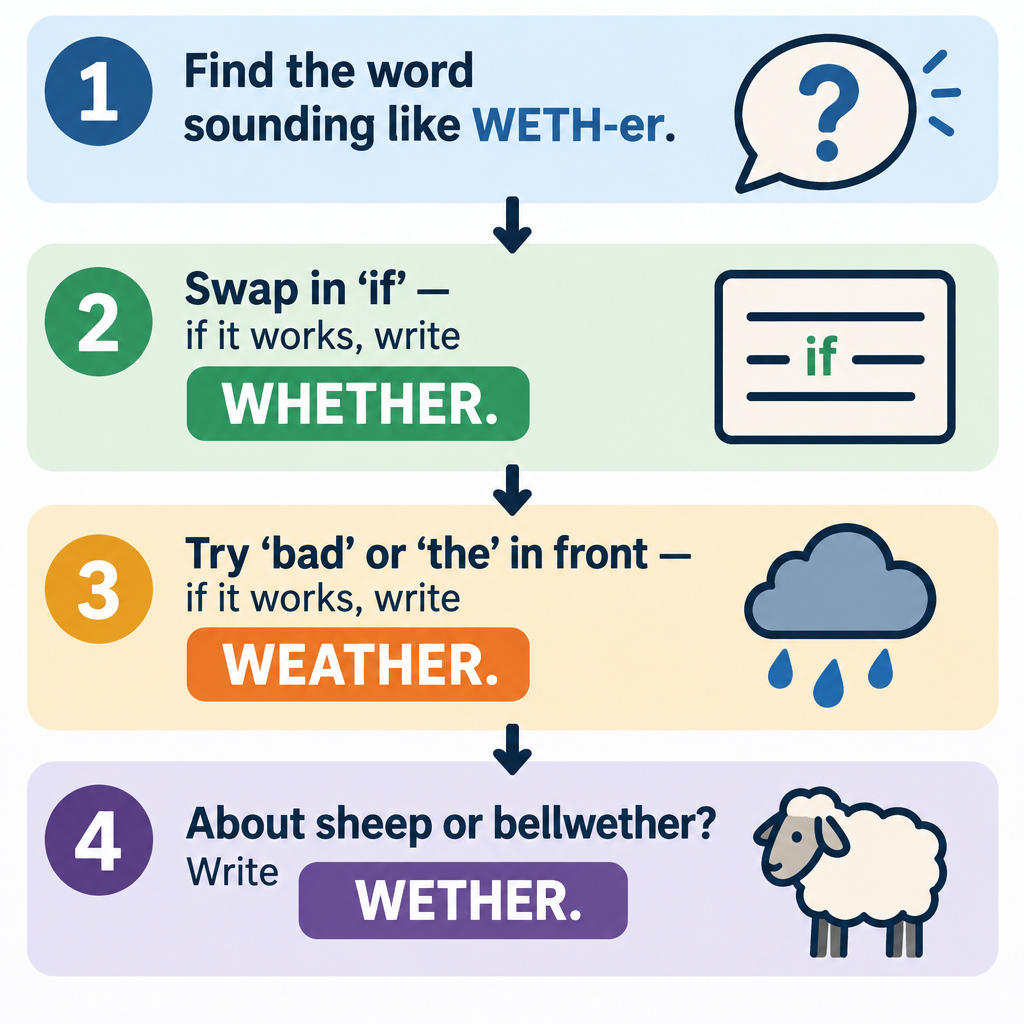
The 10-second check, step by step
- Find the word that sounds like “WETH-er.”
- Swap in “if.” Read the sentence aloud. If it still makes sense (“I wonder if it’s open”), the word is whether.
- If “if” fails, try putting “the” or “bad” in front of it. “Bad weather” works, and “bad whether” doesn’t. If it works, it’s weather.
- Check whether the word means getting through something (“weather a crisis”) or wearing down something (“weathered stone”). Both senses are spelled weather.
- If the word comes right before “or not,” it is whether. No exceptions.
- If the sentence is about sheep, or the word is part of “bellwether,” the spelling is wether.
When you’ve finished, every “WETH-er” in your text should match exactly one meaning: sky or endurance (weather), choice or doubt (whether), or the ram (wether).
Usage tip
If “if” fits, it’s whether. If “bad” or “the” fits in front, it’s weather. Those two checks cover almost every sentence you’ll write.
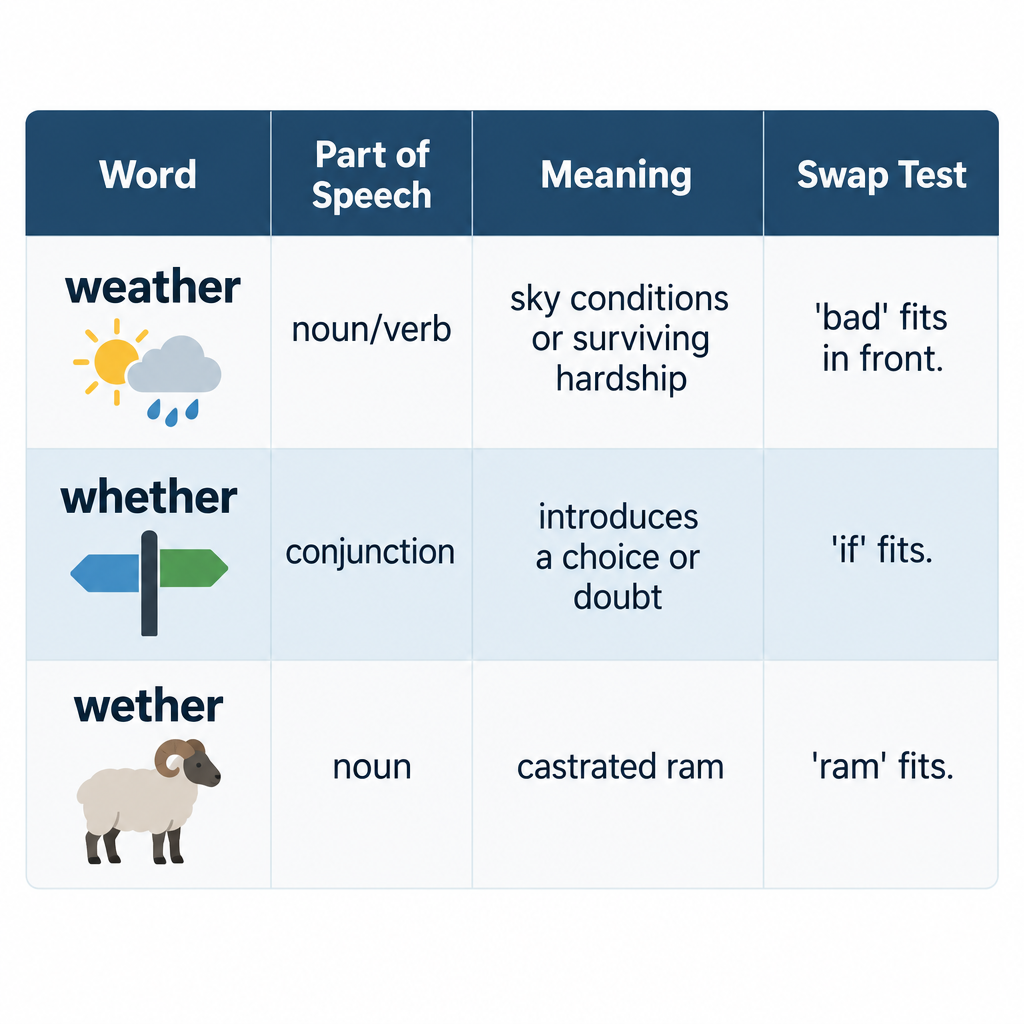
Weather vs whether vs wether at a glance
English has three words that most speakers pronounce identically. Here are their meanings side by side, based on definitions from Merriam-Webster, Dictionary.com and Grammar Monster.
| Word | Part of speech | Meaning | Example | Swap test |
|---|---|---|---|---|
| weather | Noun | The state of the atmosphere: temperature, rain, wind, cloud | The weather in Lisbon was mild. | “the conditions” fits |
| weather | Verb | To come safely through trouble; to wear, change or dry out through exposure | The firm weathered the recession. | “survive” or “wear down” fits |
| whether | Conjunction | Introduces alternatives or doubt | Tell me whether you’re coming. | “if” usually fits |
| wether | Noun | A castrated male sheep (or goat) | The wether grazed apart from the ewes. | “ram” fits |
Often confused with
Wether (a castrated ram) is spelled without the h, like weather without the a. You’ll mostly see it inside “bellwether,” never “bellweather.”
What “weather” means (noun and verb)
Weather is mostly a noun for what’s happening in the atmosphere at a given place and time. It is also a verb with two quite different senses: surviving something hard, and being worn by sun, wind and rain.
Weather as a noun
The noun covers the short-term conditions outside: heat, cold, rain, snow, wind and cloud. Climate is the long-term average. Weather is what you get today.
It usually takes “the” or an adjective in front of it: the weather, bad weather, wet weather. That’s why the “bad” test in the steps above works so well. “Whether” never takes “the.”
Weather is also uncountable in standard use. You say “terrible weather,” not “a terrible weather.” The fixed expression “in all weathers” is the main exception, and you’ll hear it more in British English.
Weather as a verb: “weather the storm” and “weathered wood”
The verb has two senses, and they are centuries old.
To come safely through. According to the Online Etymology Dictionary, this sense dates from the 1650s. It comes from the picture of a ship riding out a storm without damage. Dictionary.com also links “weather the storm” to a ship getting through bad weather and dates the idiom to the mid-1600s. Today you can weather a crisis, a scandal, a market crash or a hard winter.
To be worn or changed by exposure. The Online Etymology Dictionary dates this sense to 1757. Wood goes grey, stone softens and paint fades: they are weathered. Geologists use the noun “weathering” for the same process in rock.
Example: The cedar fence had weathered to a soft silver.
Example: The small bakery weathered two lockdowns and a rent rise.
Idioms built on weather
All of these are spelled with weather, because each one comes from the sky or the sea.
| Idiom | Meaning | Note |
|---|---|---|
| weather the storm | Get through a difficult period | From sailing, 1650s sense |
| under the weather | Slightly ill | Dictionary.com also lists “suffering from a hangover” |
| fair-weather friend | Someone loyal only when things go well | Merriam-Webster defines “fair-weather” as “loyal only during a time of success”; Dictionary.com dates the adjective to 1730-40 |
| weather permitting | If conditions allow | Never “whether permitting” |
| make heavy weather of | Make a task seem harder than it is | Mainly British |
People sometimes ask about “two types of weather” or how weather affects mood. Those are science questions, not word questions. On the language side, English does link weather and feelings in idioms like “under the weather,” “a sunny disposition” and “a stormy relationship,” and all of them use the weather spelling.
Did you know?
According to the Online Etymology Dictionary, “weather the storm” goes back to the 1650s and pictures a ship riding out bad weather without loss. The “worn by exposure” sense came about a century later, in 1757.
What “whether” means and how to use it
Whether is a conjunction that introduces two or more alternatives, or a question that hasn’t been answered yet. It almost never means anything to do with the sky. It points to a choice.
Whether in indirect questions
An indirect question reports a yes/no question inside a longer sentence. “Is the shop open?” becomes “She asked whether the shop was open.”
Merriam-Webster notes that “if” and “whether” are interchangeable in sentences like this: I don’t know if/whether the mail has arrived. So the community question “Do you say ‘I don’t know if’ or ‘I don’t know whether’?” has a simple answer. Both are correct. “Whether” sounds a little more formal.
Whether for “in either case” sentences
Whether also introduces a clause that holds true in every case. That makes it concessive: the outcome doesn’t change.
Example: We’re hiking on Saturday whether it rains or not.
Here “if” is a poor fit. “We’re hiking if it rains” says the hike will happen in the rain, but it doesn’t make clear that the hike also happens when it doesn’t rain. QuillBot’s usage guide makes the same point with its example “I’m wearing the blue dress whether you like it or not.”
Whether after prepositions and in subject clauses
Some positions accept only whether. “If” can’t go there.
- After a preposition: the question of whether, a debate about whether, depending on whether. Kory Stamper, a lexicographer, wrote in a Britannica Dictionary answer that whether tends to be the word used after prepositions.
- At the start of a sentence, as the subject: Whether he knew is still unclear. “If he knew is still unclear” is not standard English. The Chicago Manual of Style recommends “whether” when a noun clause opens the sentence.
- Before an infinitive: She can’t decide whether to stay. Merriam-Webster points out that “whether” can come before “to + verb” and “if” can’t.
“Whether or not” vs “weather or not”
“Weather or not” is always a spelling mistake. The correct phrase is whether or not, because it presents two alternatives: the thing happens or it doesn’t.
When you can drop “or not”
In many sentences, “or not” adds nothing. Delete it and see whether the meaning changes.
Example: I can’t decide whether (or not) to bring an umbrella.
Grammar Girl (Quick and Dirty Tips) recommends cutting the “or not” in sentences like that. If your teacher marked “or not” as redundant, this is the kind of sentence they had in mind.
When “or not” must stay
Keep it when the sentence means “in either case.”
Example: Whether or not she gets the job, she’ll need a new laptop.
Remove “or not” and the sentence becomes “Whether she gets the job, she’ll need a new laptop.” That reads as broken. The “or not” carries the “either way” meaning.
Where the authorities differ
Usage guides don’t fully agree here. Grammar Girl calls the “or not” fluff in most cases. Michigan Public’s That’s What They Say program reported that Merriam-Webster’s Dictionary of English Usage calls “whether or not” perfectly good, idiomatic English. In practice, the phrase is never wrong. It’s just sometimes longer than it needs to be.
Never "weather or not"
If the next two words are “or not,” the word before them is whether. Fix it the moment you see it.
Whether vs if
“If” and “whether” overlap only in indirect yes/no questions. Merriam-Webster’s guidance is to use whether for alternatives and if for conditions. Outside indirect questions, swapping them is either ungrammatical or changes the meaning.
| Sentence type | Whether | If | Example |
|---|---|---|---|
| Indirect yes/no question | Yes | Yes | Ask whether/if the shop is open. |
| Before “to + verb” | Yes | No | She can’t decide whether to stay. |
| After a preposition | Yes | No | The debate about whether to raise fees. |
| Clause opening the sentence | Yes | No | Whether he knew is unclear. |
| “In either case” meaning | Yes | No | We’re playing whether it rains or not. |
| A condition | No | Yes | We’ll cancel if it rains. |
| Directly before “or not” | Yes | Avoid | Tell me whether or not you can come. |
When “if” changes the meaning
Some sentences read correctly with either word but mean different things.
- Let me know if you can come. You only need to reply if the answer is yes.
- Let me know whether you can come. You need to reply either way.
In emails, invitations and contracts, that difference matters. When the reader must answer either way, use whether.
The third homophone: wether (and bellwether)
A wether is a male sheep castrated before maturity. Merriam-Webster also applies the word to a castrated male goat and notes that it once meant any male sheep. It’s farm vocabulary, but you see it every week in the word bellwether.
Merriam-Webster traces bellwether to Middle English bellewether, first known from the 15th century. It meant the castrated ram that wore a bell and led the flock. Shepherds hung the bell on one animal so the others would follow its sound. The ram wasn’t chosen for natural leadership.
Today a bellwether is anything that shows where a trend is going: a bellwether stock, a bellwether county in an election. It is spelled bellwether, with no “a.” As Merriam-Webster points out, the word has nothing to do with meteorology.
Example: Analysts treat the county as a bellwether because it has backed the winner in most recent elections.
Why do they sound the same?
Weather and whether come from different Old English words with different first sounds. They became homophones for most speakers only after English lost the breathy “hw” sound.
Where the words come from
| Word | Old English form | Original meaning | Later sense and date |
|---|---|---|---|
| weather | weder | “air, sky; breeze, storm” | Verb “come safely through,” 1650s; “be worn by exposure,” 1757 |
| whether | hwæðer / hweðer | “which of two” | Conjunction introducing alternatives or doubt |
| wether | weþer | “ram, male sheep” | Bellwether, Middle English, 15th century |
According to the Online Etymology Dictionary, weder goes back to Proto-Germanic *wedra- (“wind, weather”). Its relatives include German Wetter and Dutch weer.
Hwæðer is built from Proto-Germanic *hwa- (“who”) plus a comparative suffix, which is why it meant “which of the two.” That original meaning still shapes the modern word. Whether is about choosing between options.
The same root shows up in two everyday words. “Either” comes from Old English ægðer, a shortened form of æghwæðer (“each of two”). “Neither” comes from nawþer, a shortened form of nahwæþer (“not of two”).
Did you know?
According to the Online Etymology Dictionary, “whether” originally meant “which of two.” It belongs to the same family as “either” and “neither,” which grew out of Old English æghwæðer and nahwæþer.
The lost “h” sound
In Old English, the word was written with hw-. An OUP blog post on the word’s spelling notes that the full forms were hweþer and hwæþer. Middle English scribes later flipped the letters to wh-, the spelling we still use. The breathy sound survived for centuries after the spelling changed.
Then most speakers stopped making it. Linguists call this the wine-whine merger: “wine” and “whine,” “witch” and “which,” “weather” and “whether” all fell together as /w/. Wiktionary notes that dropping the h was considered unacceptable in educated speech until the late 18th century. Today neither pronunciation carries a general stigma.
Pronunciation today
- Most speakers: both words are said WETH-er, IPA /ˈwɛðər/ in American English and /ˈweðə/ in British English. Wether sounds the same.
- Speakers who keep “hw”: whether is HWETH-er, /ˈʍɛðər/ or /ˈhwɛðər/. This survives in much of Scottish English, Irish English and some older Southern American English.
So if someone you know pronounces the h in whether, they’re not wrong. They’re using an older distinction that many speakers have lost. A 2024 corpus study of the US South, published by De Gruyter, describes the merger as having gone from a regional feature to a nearly universal feature of US English. For most American learners, the spelling is now the only clue.
Ten example sentences
These are original examples written to show each sense.
- Example: The weather in Denver can change within an hour.
- Example: Nobody knew whether the ferry would run.
- Example: The village weathered three floods in ten years.
- Example: Whether you agree or not, the vote has passed.
- Example: The deck boards had weathered badly after one wet winter.
- Example: I’m a bit under the weather, so I’ll work from home.
- Example: She asked whether the price included delivery.
- Example: The match will go ahead, weather permitting.
- Example: The debate was about whether to close the library on Sundays.
- Example: Retail sales are a bellwether for the wider economy.
Common mistakes and how to fix them
Both spellings are real words, as LanguageTool’s writing guide points out. That’s why spell-checkers stay silent, and why a careful reread matters more than software. Tools that check grammar in context sometimes catch “weather or not,” but don’t count on them to catch everything.
| Wrong | Right | Why |
|---|---|---|
| I don’t know weather to go. | I don’t know whether to go. | A choice, and “if” almost fits |
| Weather or not you like it… | Whether or not you like it… | Before “or not” it is always whether |
| The whether was awful. | The weather was awful. | “The” plus sky conditions means weather |
| We’ll whether the storm. | We’ll weather the storm. | Verb meaning “get through” |
| He’s feeling under the whether. | He’s feeling under the weather. | Fixed idiom with weather |
| Whether permitting, we’ll sail. | Weather permitting, we’ll sail. | “If conditions allow” |
| A bellweather for the market | A bellwether for the market | From wether, the lead ram |
| I can’t decide if to stay. | I can’t decide whether to stay. | Only whether goes before “to + verb” |
| The question of if he lied | The question of whether he lied | Only whether follows a preposition |
Memory tricks that actually stick
Three tricks cover nearly every case. They work well for children and English learners because each one ties the spelling to something you can see.
- Weather has “ea,” like sea and heat. The sky, the sea and the heat all sit together. If the sentence is about any of them, spell it with “ea.”
- Whether starts with “wh,” like question words. Which, what, where, when, why, and whether. All of them ask something. Whether asks “which one?”
- Swap in “if.” If the sentence survives, it’s whether. If it collapses, check for weather.
Teaching kids and ESL learners
Draw a cloud over the “ea” in weather and a question mark after the “wh” in whether. The picture does the remembering.
Quiz: weather or whether?
Fill each blank with weather, whether or wether. The answers are below.
- We’ll eat outside if the ______ holds.
- She wasn’t sure ______ to accept the offer.
- The company managed to ______ the downturn.
- ______ or not the bus is late, the meeting starts at nine.
- The old barn door had ______ed to a dull grey.
- The farmer kept one ______ with a bell around its neck.
- Tell me ______ you’ll be home for dinner.
- Tech stocks are seen as a bell______ for the index.
- He stayed home because he felt under the ______.
- The committee debated ______ to delay the launch.
Answer key
- weather (the “if” test fails; “the” fits)
- whether (comes before “to accept”)
- weather (verb: come safely through)
- Whether (always before “or not”)
- weather (verb: worn by exposure)
- wether (the castrated ram)
- whether (indirect question; “if” also fits)
- wether (bellwether)
- weather (fixed idiom)
- whether (comes before “to delay”)
If you got 8 or more right, your swap test is working. If the mistakes all came from the verb sense (questions 3 and 5), remember that anything you endure or that time wears down is spelled with “ea.”
One habit that fixes it for good
Search your draft for “WETH-er” sounds before you send anything important. Look for “weather,” “whether” and “or not,” and give each one the “if” test. It takes seconds. The same habit catches other sound-alikes on any list of commonly misspelled words, and vice versa: once you check one homophone pair, you’ll start noticing the others.
FAQ
When do you use “whether”?
Use whether when a sentence presents alternatives or an open question: “I wonder whether it’s true,” “whether to stay or go.” It’s also the only correct choice after a preposition, before “to + verb,” and at the start of a sentence as the subject.
What is the definition of weather?
As a noun, weather is the state of the atmosphere at a given time and place: temperature, rain, wind and cloud. As a verb, it means to come safely through difficulty, or to be worn and changed by exposure to the elements.
Is it “weather or not” or “whether or not”?
It’s always “whether or not.” The phrase sets up two alternatives, and choosing between alternatives is the job of whether.
Can I use “if” instead of “whether”?
Yes, but only in simple indirect questions such as “Ask if the shop is open.” Use whether after prepositions, before infinitives, at the start of a sentence, and when you mean “in either case.”
Is “whether or not” redundant?
Sometimes. In “I can’t decide whether or not to go,” you can drop “or not.” In “Whether or not it rains, we’re going,” it must stay, because it carries the “either way” meaning. Usage guides differ on style, but the phrase is never ungrammatical.
What does “weather the storm” mean?
It means getting through a hard period without serious damage. The Online Etymology Dictionary dates this sense to the 1650s and traces it to a ship riding out a storm. It’s always spelled weather, never “whether the storm.”
Do “weather” and “whether” sound the same?
For most English speakers, yes: both are pronounced WETH-er. Some speakers in Scotland, Ireland and parts of the American South still say whether with a breathy “hw” sound. That pronunciation is correct too.
What does “wether” mean?
A wether is a castrated male sheep, and Merriam-Webster also applies the word to a castrated male goat. It survives in “bellwether,” originally the belled ram that led the flock.
What does “under the weather” mean?
It means feeling slightly ill or run down. Dictionary.com also lists “suffering from a hangover” as a sense.
Is it “weather permitting” or “whether permitting”?
It’s “weather permitting,” meaning “if the conditions allow.” The phrase is about the sky, so it takes the “ea” spelling.