

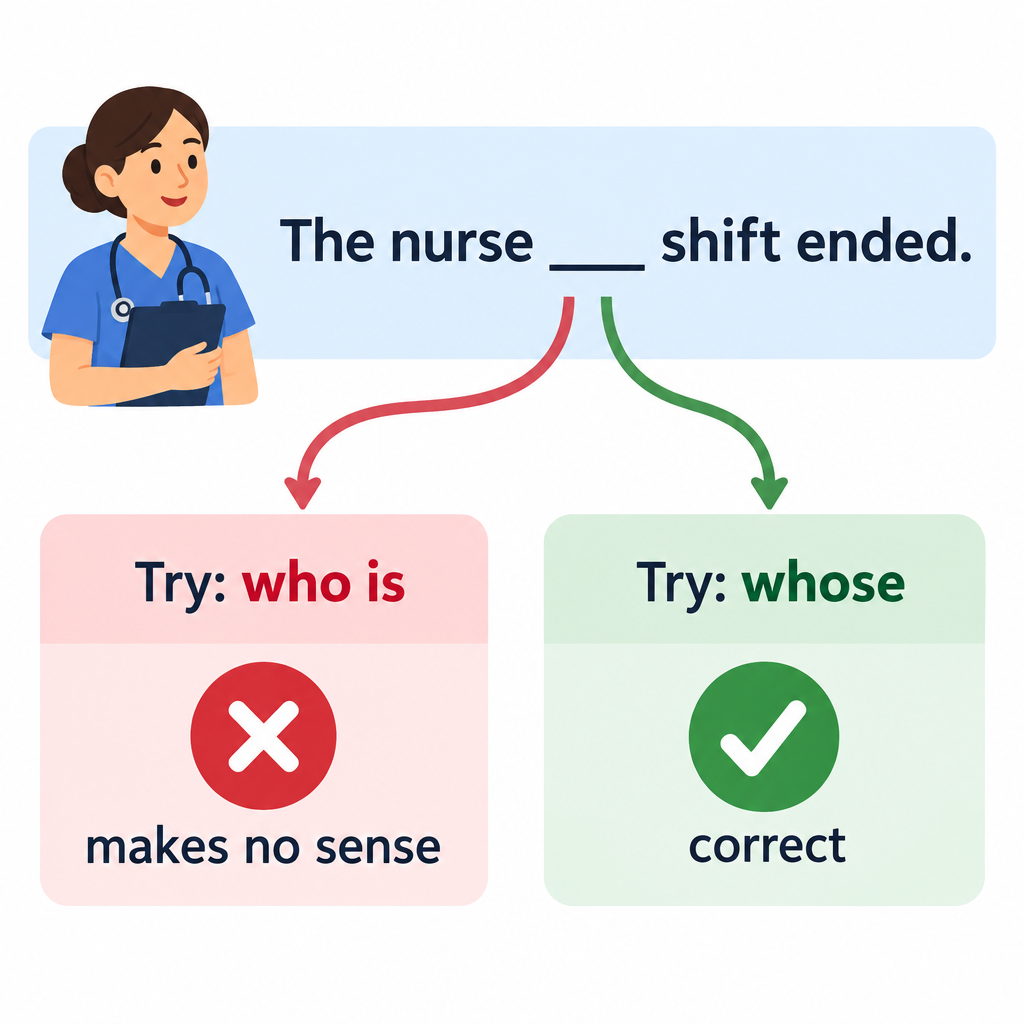
Whose shows possession. It is the possessive form of who, and you can use it for things as well as people. Who’s is a contraction of “who is” or “who has.” To check, read the sentence with “who is” or “who has” in place of the word. If it still makes sense, write who’s. If it doesn’t, write whose.
In a word
- Who’s always means “who is” or “who has.” The apostrophe marks the missing letters.
- Whose means “belonging to whom or which.” Like his, its and theirs, it never takes an apostrophe.
- If a noun follows the word (whose birthday, whose fault), the answer is nearly always whose.
- Whose for things (“a house whose roof leaks”) is standard English. Merriam-Webster calls the objection to it a superstition.
- Both words sound the same, /huːz/. Choose by meaning, because they sound identical.
Fact-checked
We checked these key facts against the sources named, on November 27, 2026:
- Wikipedia reports that the 2010 Chicago Manual of Style described the construction as widely accepted for avoiding awkwardness (source: en.wikipedia.org)
Whose vs. who’s: the quick answer
Who’s is short for who is or who has. Whose asks or tells you who owns something, or who or what something is connected to.
The words are homophones. Both are pronounced HOOZ (IPA /huːz/), so your ear can’t help you. Only the meaning can.
| Who’s | Whose | |
|---|---|---|
| What it is | Contraction | Possessive word |
| Part of speech | Pronoun + verb (is or has) | Possessive adjective or determiner; also pronoun |
| Stands for | who is / who has | of whom, of which |
| Used for | People (as the subject) | People, animals and things |
| Usually followed by | A verb, -ing word, adjective or place | A noun |
| Question example | Who’s at the door? | Whose coat is this? |
| Mid-sentence example | The nurse who’s on call tonight | The nurse whose shift ended |
| Has an apostrophe? | Yes (letters are missing) | Never |
The dictionaries label whose slightly differently. Merriam-Webster calls it an adjective meaning “of or relating to whom or which,” and also a pronoun meaning “that which belongs to whom.” Oxford Learner’s Dictionaries call it a determiner and a pronoun. The labels differ, but the usage rule is the same in both.
Usage tip
Read the sentence aloud twice, once with “who is” and once with “who has.” If either version makes sense, write who’s. If neither does, write whose.
Is it whose or who’s? Answers for the phrases people actually search
Nearly every common search phrase takes whose, because a noun follows the word. The exceptions are phrases where a verb or adjective comes next, such as guess who’s coming, guess who’s back and who’s who.
| Phrase people search | Correct form | Why (substitution test) | Example sentence |
|---|---|---|---|
| whose / who’s birthday | whose birthday | “Who is birthday” makes no sense | Whose birthday is on Friday? |
| whose / who’s wife | whose wife | “Who has wife” breaks the sentence | The man whose wife won the race waved. |
| whose / who’s name | whose name | You’re asking about ownership of a name | The student whose name was called stood up. |
| whose / who’s idea | whose idea | “Who is idea” makes no sense | Whose idea was the picnic? |
| whose / who’s fault | whose fault | You mean the fault belonging to someone | It doesn’t matter whose fault it was. |
| whose / who’s wedding | whose wedding | A noun follows the word | Whose wedding are you flying to? |
| whose / who’s turn | whose turn | “Who is turn” breaks the sentence | Whose turn is it to wash up? |
| whose / who’s house | whose house | A noun follows the word | Whose house has the blue door? |
| guess who’s / whose coming | guess who’s coming | “Guess who is coming” works | Guess who’s coming to dinner. |
| guess who’s / whose back | guess who’s back | “Guess who is back” works | Guess who’s back in town. |
| as someone who’s / whose | both, depending on what follows | Before a noun: whose. Before a verb or adjective: who’s | As someone whose job is editing… / As someone who’s edited for years… |
| who’s who / whose who | who’s who | “Who is who” | The program is a who’s who of jazz. |
| the guy who’s / whose car got towed | whose car | “Who is car” breaks the sentence | The guy whose car got towed is furious. |
Whose birthday, whose wedding, whose house
Each of these is a noun that belongs to someone, so the answer is whose. Put “his” or “their” in the same spot to check: “It’s their birthday” works, so “Whose birthday is it?” is right.
You might write “who’s birthday” because the word sounds like it should carry an apostrophe, the way Maria’s birthday does. Possessive pronouns break that pattern, as explained further down.
Whose fault, whose idea, whose turn
These follow the same rule. “Who is fault?” and “Who has idea?” don’t make sense, so who’s can’t be right.
The question “Is it who’s turn is it or whose turn is it?” comes up constantly in game chats and group texts. The answer is always whose turn.
Whose wife, whose name
“The writer whose wife illustrated the book” and “a singer whose name escapes you” both use whose to connect a person to something linked to them. You’ll see it mid-sentence more often than at the start of a question, and that’s where most mistakes happen.
Guess who’s coming (and when “guess whose” is right)
“Guess who’s coming” expands to “guess who is coming,” so the contraction is correct. “Guess who’s back” works the same way.
Guess whose is right when you’re asking about ownership, with or without a noun after it: “Guess whose car just pulled in,” or simply “Guess whose!”
As someone whose…
This phrase takes either word. The next word decides it.
- Noun next: “As someone whose family is from Ohio…”
- Verb, -ing word or adjective next: “As someone who’s lived in Ohio…” (who has lived), “As someone who’s curious about maps…” (who is curious)
Usage tip
Check the word right after the gap. A noun (birthday, fault, name, car) almost always calls for whose. A verb, -ing word or adjective (coming, been, back, happy) almost always calls for who’s.
Who’s: the contraction of who is and who has
Who’s joins who to a shortened is or has. The apostrophe shows where letters were dropped. It works in questions and in the middle of sentences, which is why the tip “who’s is usually a question” is misleading.
Who’s = who is
This is the more common meaning.
- In a question: “Who’s ready?”
- In a relative clause: “She’s a teacher who’s admired by every class.”
- In an indirect question: “Nobody knows who’s in charge.”
Who’s = who has
Who’s can also stand for who has, but only when has is a helper verb before a past participle.
- “Who’s seen the remote?” (who has seen)
- “Anyone who’s tried this recipe knows it takes hours.” (who has tried)
- “The neighbor who’s been feeding the cat is away.” (who has been)
When “who has” won’t contract
When has means “owns” or “possesses,” the contraction usually sounds wrong in American English. “Who has a pen?” is natural, but “Who’s a pen?” is not, and a reader will hear it as “Who is a pen?”
British English often uses “has got” for possession, and that form contracts without trouble: “Who’s got a pen?” is ordinary in both British and American speech. So the contraction works with got and fails with bare has.
Is who’s too casual for formal writing? It’s a normal contraction and fine in most writing, including journalism and business email. Some academic, legal and formal styles avoid contractions altogether. In those, write “who is” or “who has” in full, the same choice you’d make with can’t and other contractions.
Whose: the possessive of who (and which)
Whose tells you who or what something belongs to or is connected with. It has three main jobs: starting a question, linking a relative clause, and standing alone as a pronoun.
Merriam-Webster’s definition is wider than plain ownership. It covers the possessor, the “agent,” and the “object” of an action. “The author whose novel won” shows agency. “The patient whose surgery went well” shows the person receiving the action.
Whose in questions
At the start of a question, whose asks about a person: “Whose shoes are these?” Merriam-Webster notes that this is the one position where whose doesn’t refer to things, since you’re asking which person owns something.
Whose in relative clauses
In the middle of a sentence, whose links a noun to more information about it.
- “The doctor whose name you forgot called back.”
- “A band whose first album flopped can still succeed.”
Oxford Learner’s Dictionaries describe this use as adding information about “a person or thing,” which covers non-human nouns explicitly.
Whose on its own
Whose can stand without a noun after it, working as a pronoun.
- “She didn’t know whose it was.”
- “This umbrella is yours. Whose is the red one?”
Why whose has no apostrophe (the word’s Old English history)
Whose has no apostrophe because it was never formed by adding ‘s to who. It descends from its own Old English possessive form. English possessive pronouns (his, hers, its, ours, yours, theirs, whose) never take an apostrophe.
The Online Etymology Dictionary traces whose to Old English hwæs, the genitive (possessive) of hwā, “who.” That goes back to the Proto-Indo-European root *kwo-, the stem of relative and interrogative pronouns. The Oxford English Dictionary, as reported by Grammarphobia, records the word from the late 800s. In Old English hwæs was the genitive of both hwā (who) and hwæt (what). Middle English spellings included hwas, hwos and whos.
Did you know?
According to the Oxford English Dictionary, as reported by Grammarphobia, Old English hwæs was the possessive of both “who” and “what.” So using whose for things goes back to the word’s earliest form. It is not a modern slip.
The apostrophe in who’s means letters are missing, the i of is or the ha of has. The pair its and it’s works the same way. It’s means “it is,” and its is possessive: “The dog wagged its tail.”
So why doesn’t whose get an apostrophe when apostrophes show possession? They do for nouns (the cat’s bowl). Pronouns already have their own possessive forms, so they don’t need one. If you want to see how word histories like this get traced, it’s worth reading about the etymology of a word.
Where people get it wrong
The slip rarely happens in short questions like “Whose bag?” It happens mid-sentence, where a possessive and a contraction look equally plausible.
Relative clauses
“The researcher who’s findings were published” is wrong. Expand it: “the researcher who is findings” breaks. The correct version is “The researcher whose findings were published.”
This is the “guy who’s/whose car got towed” problem. A noun (car) follows, so whose is right.
Indirect questions
“She asked whose it was” and “Tell them who’s going” are both correct, but for different reasons. In the first, whose stands alone as a pronoun. In the second, “who is going” makes sense.
The reverse error
People also write whose where who’s belongs: “Whose coming tonight?” Expand it to “Who is coming tonight?” That works, so it should be who’s.
Why spell check won’t catch it
Both are real, correctly spelled words, so a basic spell checker passes either one. Grammar checkers sometimes flag the clearer cases, but you can’t count on them. The same is true for other homophone pairs like whether vs weather and principal vs principle, which show up often in lists of commonly misspelled words.
| Common mistake | Fix | Why |
|---|---|---|
| Who’s turn is it? | Whose turn is it? | “Who is turn” breaks |
| Whose coming tonight? | Who’s coming tonight? | “Who is coming” works |
| The man who’s dog barks | The man whose dog barks | A noun follows |
| Whose been in the office? | Who’s been in the office? | “Who has been” works |
| Guess whose back! | Guess who’s back! | “Who is back” works |
| A city who’s streets flood | A city whose streets flood | Possessive, no apostrophe |
| Whose’s jacket is this? | Whose jacket is this? | Whose’s is not a word |
Can you use whose for things?
Yes. “A house whose roof leaks” is standard English with centuries of literary use behind it. Merriam-Webster’s Dictionary of English Usage calls the opposing rule “a superstition.”
The history of the objection
The usage came first and the objection came later. According to Wikipedia’s summary of the history, inanimate whose dates to the 15th century. The American Heritage Dictionary puts it earlier, in the 1300s. Either way, it was well established long before grammarians objected.
| Year | Who | What they said or did |
|---|---|---|
| Late 800s | Old English writers | Hwæs serves as the possessive of “who” and “what” |
| 1300s to 1400s | Middle English writers | Whose used for things (AHD dates it to the 1300s, Wikipedia to the 15th century) |
| 1603 | William Shakespeare, Hamlet | “I would a tale vnfold, whose lightest word / Would harrow vp thy soule” |
| 1611 | King James Bible | Uses inanimate whose often, as in “the fruit tree … whose seed is in itself” (Genesis 1:11) |
| 1645 | John Milton, L’Allegro | “Mountains on whose barren brest / The labouring clouds do often rest” |
| 1755 | Samuel Johnson’s dictionary | Notes its use for which as poetic |
| 1762 or 1764 | Robert Lowth | Objects; allows it only in “the higher Poetry” |
| 1772 | Joseph Priestley | Objects to the usage |
| Today | Merriam-Webster, American Heritage Dictionary | Accept it as standard |
The sources disagree on Lowth’s date. Wikipedia gives 1764. Merriam-Webster’s usage dictionary, as quoted on Visual Thesaurus, gives 1762.
Did you know?
Samuel Johnson’s 1755 dictionary noted the use of whose for which as poetic. Shakespeare and Milton had used it freely long before him.
What dictionaries say now
Merriam-Webster’s usage note says inanimate whose is common even in formal, solemn writing. It traces the old resistance to the word’s close link with who. The American Heritage Dictionary accepts inanimate antecedents and names Shakespeare, Milton and Wordsworth as writers who used them. Wikipedia reports that the 2010 Chicago Manual of Style described the construction as widely accepted for avoiding awkwardness.
The counter-argument is mostly about taste. A few style writers still advise against it, and some readers find “a dress whose modesty” stiff. That’s a preference, not a rule.
Whose vs. of which: side-by-side rewrites
The alternative to whose is of which, and it usually reads worse.
| With whose | With of which | Verdict |
|---|---|---|
| a company whose profits rose | a company the profits of which rose | Whose is clearer |
| a song whose chorus repeats | a song of which the chorus repeats | Whose is clearer |
| a law whose purpose is unclear | a law of which the purpose is unclear | Whose is clearer; of which sounds legalistic |
- Pros of whose: short, natural, standard, and accepted by every major dictionary cited here.
- Cons of whose: a small number of conservative readers still object.
- Pros of of which: satisfies those readers.
- Cons of of which: clunky, with an awkward word order.
So “a company whose” is fine. If you’re writing for a reader who objects, rewrite the sentence instead: “a company with rising profits.”
Whose vs. who’s vs. whom (and why whom’s isn’t a word)
Who, whom, whose and who’s each have a different job: subject, object, possessive and contraction. Only who’s has an apostrophe, and whom’s doesn’t exist.
| Word | Role | Replace with | Example |
|---|---|---|---|
| who | Subject | he / she / they | Who called? |
| whom | Object | him / her / them | To whom did you write? |
| whose | Possessive | his / her / their | Whose phone rang? |
| who’s | Contraction | who is / who has | Who’s calling? |
If you searched “whose vs whom,” use the replacement column. Whom matches him (an object). Whose matches his (a possessive). They never swap.
Sentences that work both ways but mean different things
Some sentences are grammatical with either spelling, but the meaning changes. These cases show why the test has to be about meaning, not sound.
- “The man who’s left” means the man who has left. “The man whose left hook won the fight” refers to his left hook.
- “Who’s training tonight?” asks who is training. “Whose training paid off?” asks about someone’s training.
- “Guess who’s cooking” means guess who is cooking. “Guess whose cooking this is” asks whose food this is.
- “Who’s playing?” asks who is playing. “Whose playing impressed you?” is about someone’s performance.
Memory tricks that actually work
The best trick is the expansion test. The others back it up.
- Expand it. Say “who is” or “who has.” If one fits, use who’s.
- Swap in his. If his or their would fit, write whose.
- Missing letters, not possession. In it’s, they’re and who’s, the apostrophe marks dropped letters; the possessive forms are its, their and whose. The same logic sorts out the apostrophe in dos and don’ts.
- The TV anchor. The improv show Whose Line Is It Anyway? asks about ownership of a line, with no apostrophe.
Usage tip
Treat whose like his or their. If “his” would fit the gap (“his birthday,” “his fault”), whose is the right spelling.
The same apostrophe pattern runs through other pairs:
| Possessive | Contraction | Contraction stands for |
|---|---|---|
| whose | who’s | who is / who has |
| its | it’s | it is / it has |
| your | you’re | you are |
| their | they’re | they are |
Who’s who and other fixed expressions
Some set phrases and titles keep their spelling for good reason, and each one passes the expansion test.
- Who’s who means “who is who,” a list of the notable people in a field. It is linked to the UK reference book Who’s Who, published every year since 1849, by A & C Black since 1897, and online since 1999.
- Who’s Afraid of the Big Bad Wolf?, the 1933 Disney song, means “who is afraid.”
- Whose Line Is It Anyway? asks about ownership, so it takes whose.
- “An idea whose time has come” uses whose for a thing. It is usually credited to Victor Hugo as an English rendering of a line in Histoire d’un crime (1877), and the wording varies by translation.
Ten example sentences
These sentences are original examples written for this page.
- Who’s taking the early train?
- Whose sandwich is on the counter?
- The coach who’s led the team for a decade is retiring.
- The singer whose voice cracked laughed it off.
- Nobody remembered whose idea the costume party was.
- Who’s been moving the furniture around?
- A river whose banks flood every spring needs levees.
- They found the hiker who’s been missing since Tuesday.
- That’s the bakery whose bread sells out by noon.
- The keys were on the table, but nobody knew whose they were.
Quick quiz: whose or who’s?
Fill each blank with whose or who’s. The answers and reasons follow.
- ___ birthday is it today?
- Guess ___ back from vacation.
- The woman ___ dog won the show smiled.
- ___ finished the report?
- As someone ___ grandmother was a nurse, he respects the job.
- ___ turn is it to pick the movie?
- The student ___ always late missed the bus.
- It’s hard to say ___ fault the delay was.
- ___ going to the wedding?
- A town ___ factory closed lost half its jobs.
Answer key
- Whose: a noun follows, and “who is birthday” breaks.
- who’s: “guess who is back” works.
- whose: the dog belongs to her.
- Who’s: “who has finished” works, with has as a helper verb.
- whose: a noun (grandmother) follows.
- Whose: “who is turn” breaks.
- who’s: “the student who is always late” works.
- whose: the fault belongs to someone.
- Who’s: “who is going” works.
- whose: inanimate whose is standard, and “who is factory” breaks.
If you missed any, look at the word right after the blank. That one word decides almost every case.
FAQ
Is it whose or who’s birthday?
Write whose birthday. “Who is birthday” makes no sense, and whose is the possessive.
Whose wife or who’s wife?
Write whose wife: “the man whose wife coaches the team.” Who’s wife would mean “who is wife.”
Where can I use whose?
You can use it in questions (“Whose bag?”), in relative clauses (“the artist whose work sold”), and on its own (“Whose is this?”). It works for people, animals and things.
Is it correct to say whose house?
Yes. “Whose house is this?” is correct. “Who’s house” is a common misspelling.
Is it whose name or who’s name?
Write whose name. A noun follows the word, so the possessive is right.
Is it whose idea or who’s idea?
Write whose idea: “Whose idea was this?”
Is it “as someone whose” or “as someone who’s”?
It depends on the next word. Use whose before a noun (“as someone whose work involves data”). Use who’s before a verb or adjective (“as someone who’s worked in data,” “as someone who’s nervous about flying”).
Whose wedding or who’s wedding?
Write whose wedding, because you’re asking about the wedding of some person.
Is it “guess whose” or “guess who’s”?
Use guess who’s before a verb or adjective (“Guess who’s coming”). Use guess whose when asking about ownership, with or without a noun (“Guess whose phone this is,” “Guess whose!”).
Is it whose fault or who’s fault?
Write whose fault. “Who is fault” breaks the sentence.
The habit to build is short: before you type HOOZ, say “who is” in your head. If the sentence still makes sense, use the apostrophe. If it doesn’t, write whose. That works for a birthday card, a work email or a game chat.